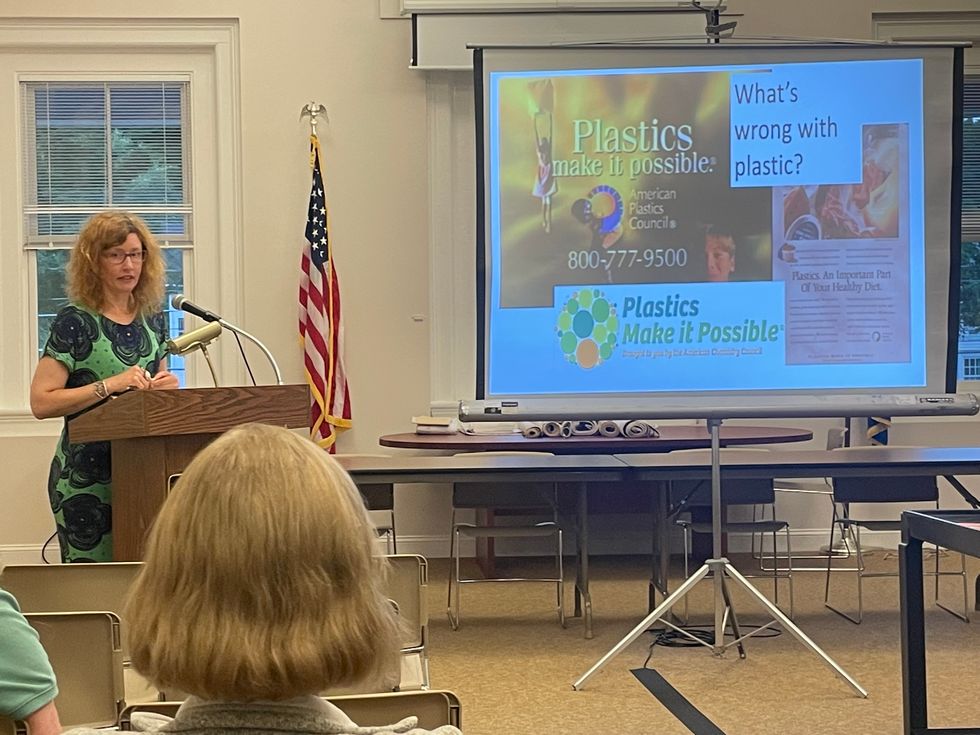
SHARON — “I thought we were different” was one audience member’s wistful comment at Sharon Town Hall on Thursday evening, Aug. 3, where approximately 18 attendees of varying ages, all but three female, heard author Eve Schaub present some updates and a personable angle to her recent book, “Year of No Garbage.” Schaub had assured the questioner that single-stream recycling everywhere is a success nowhere.
The event, a precursor to Friday’s book-signing event at the Hotchkiss Library by dozens of authors, began with an introduction by library director Gretchen Hachmeister. Hachmeister is a cousin to Schaub, but the two didn’t know each other until some online genealogical research was done recently.
The self-labeled “stunt memoirist” embarked on the first of a trio of books using her family as experimental subjects. “Year of No Sugar” was followed by “Year of No Clutter” and this latest and, she vowed, last such project.
For each one, she researched deeply and became an expert. In this case, teasing out the complexities of the 60% of garbage that is actually plastic, mostly of the single-use kind, “The learning curve was so steep I was getting nosebleed.”
Research led her to the sobering conclusion, among many others, that producers of packaging “don’t know what it is made of, and don’t care.”
The increasingly popular “use your own container” concept, for example, is generally successful only with small, local stores. This discussion involved the paradox of having to spend more money, time and carbon footprint to shop at small stores. For items too small or otherwise not allowed in municipal recycling, freecycle.org and the Front Porch Forum are good possibilities for giving away clean and dry craftable plastic caps, corks and so on.
‘If you don’t know what it is, it’s plastic’
In the realm of extreme recycling, or going beyond the limits of what one’s municipality accepts in its recycling stream, one problem is the large number of different types of plastics that make up various kinds of packaging, like chips bags that are sandwiches of three different kinds. Programs like plastic film recycling boxes in supermarkets, mail-in and pay-to-play programs like those of the Carton Council and Terracycle are not effective once examined critically.
Eighty-five percent of people say they are recycling plastic, Schaub pointed out, while the actual rate of plastics recycling is now down to a dismal 5%, and that is almost exclusively for items numbered 1 and 2 inside the “chasing arrows” symbol.
Environmental
racism and injustice
To another audience member’s question of where it all goes, Schaub listed Vietnam as a current recipient of our main export. Most people are aware that it was formerly China, until that nation enacted the National Sword ban on foreign shipments that were often too contaminated to be recycled. The worst aspect of this, she noted, is that countries where our waste ends up do not have the infrastructure to deal with it, and it becomes part of their landscape on which children work, play or tread to school, the burning fumes of which everyone must breathe.
“Watch ‘The Story of Plastic,’” Schaub urged, if you want to know the extent of environmental racism around the world and in the U.S., where St. James Parish in Louisiana, already known as Cancer Alley, is slated to see a huge new buildout by Formosa Plastics. And as to what we are all exposed to, she described a photo on which a pile of microplastics, placed on a Lincoln penny for scale, looks like a Marie Antoinette hairdo.
Also cited were the Danish water bottle study, in which a regular plastic bottle filled with tap water was found to contain 400 different plastics compounds after 24 hours, and that Western men’s sperm counts have dropped 50% in the last 50 years.
What can be done?
First, go tell someone, Schaub urged: “Awareness is the starting point for all meaningful change.” Importantly, realize that the glut of plastics is driven by supply, not by demand, as industry figures would have it. Forty percent of yearly production goes to single-use plastics. Also, you can demand that EPR, or Extended Producer Responsibility laws, (sometimes known as Polluter Pays laws) are enacted in your state.

 Models walk the organic runway at HVSFW. Ilan Harel
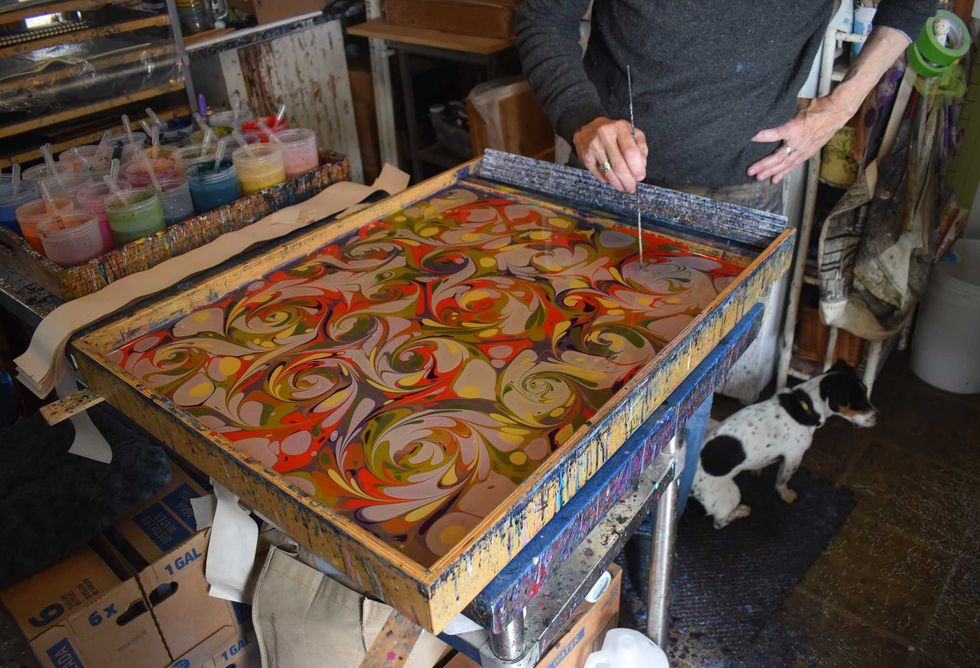 Susan Schneider, owner of Shandell’s, creates a variety of products with marbleized surfaces in her Ashley Falls studio.L. Tomaino



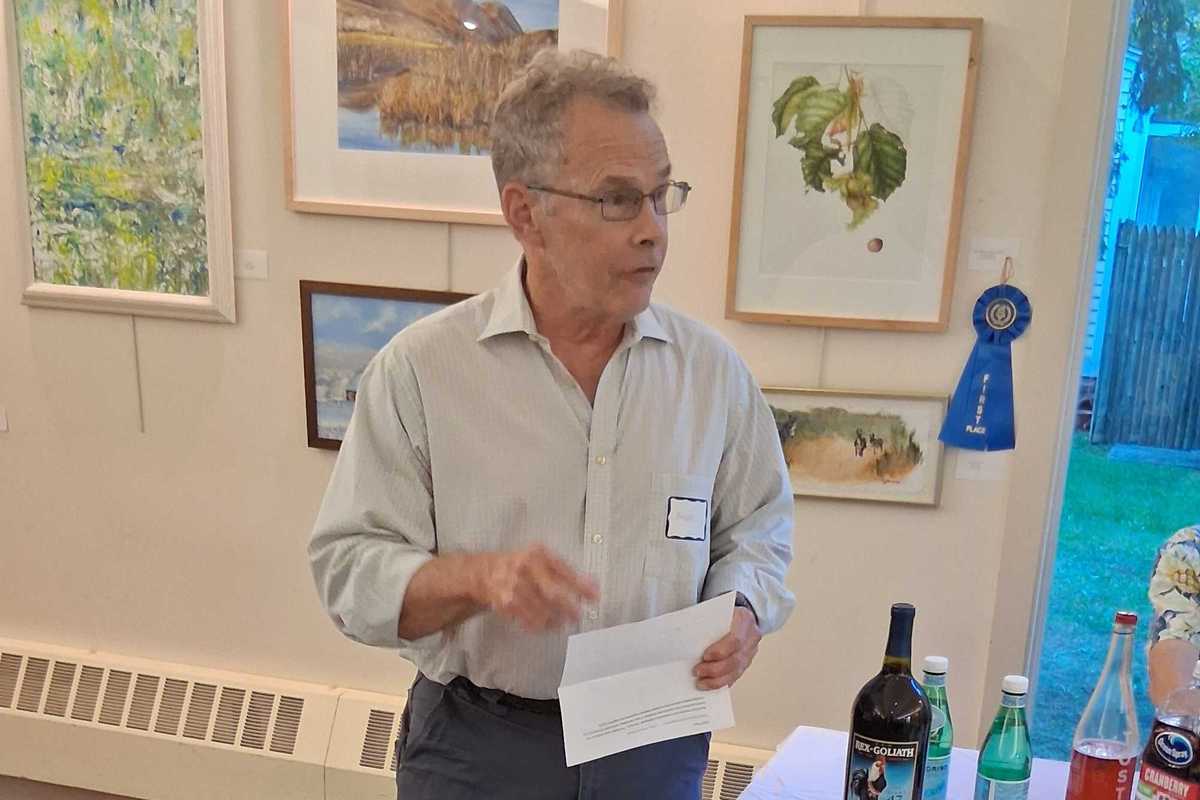 Roger McKee naming the winners with the first place entry over his left shoulder. Patrick L. Sullivan
 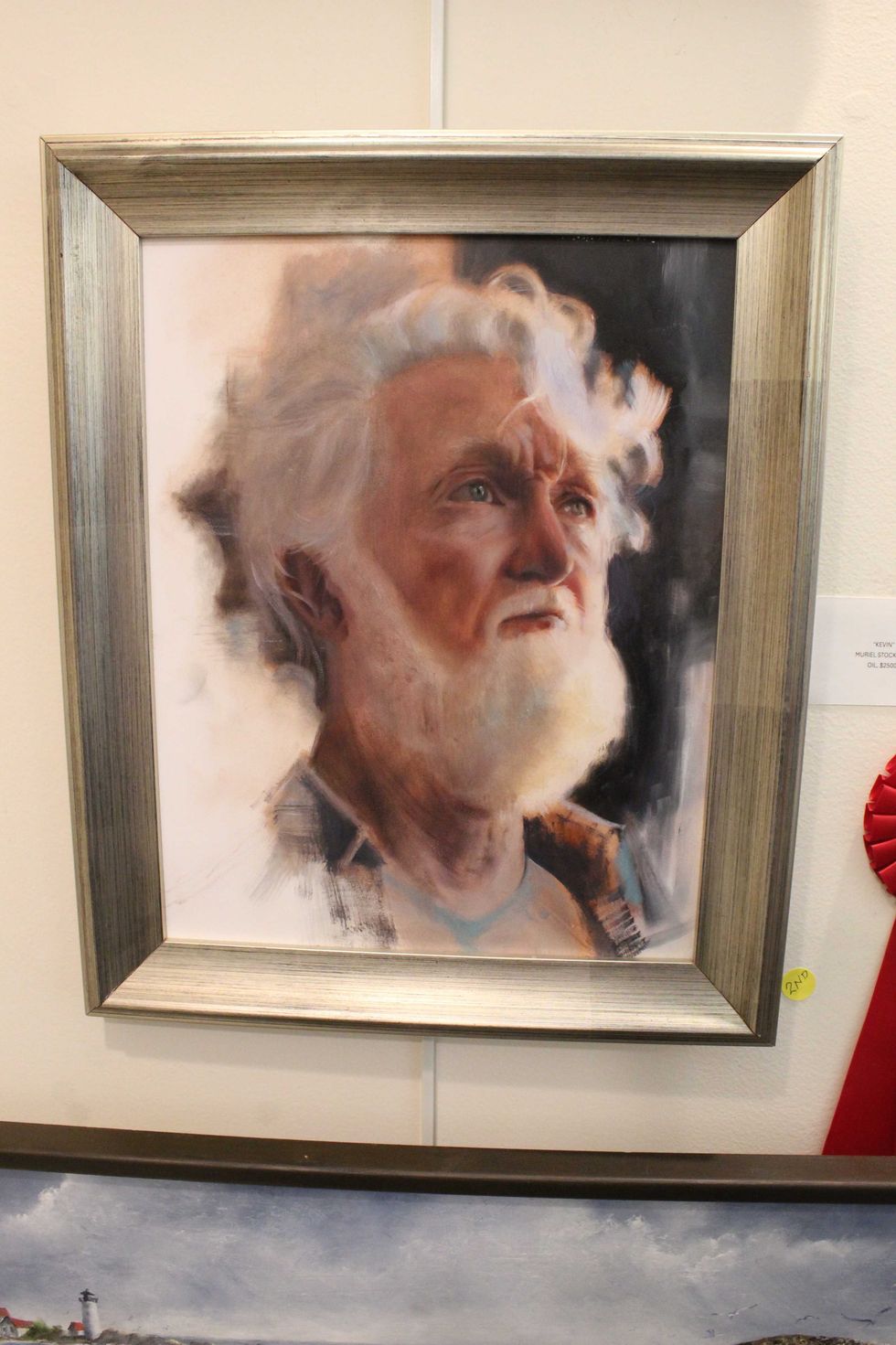 Muriel Stockdale’s “Kevin” took second place in the juried art show at Trinity Episcopal Church.Patrick L. Sullivan