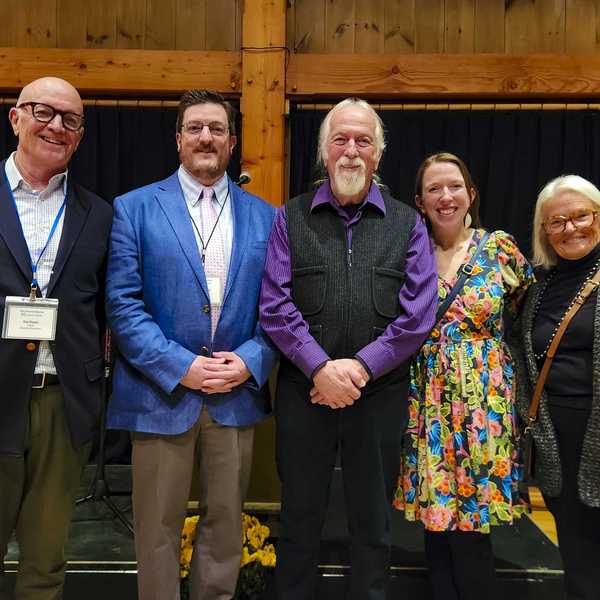
SHARON — Within a week of his appointment as president of Sharon Hospital last December, Dr. Mark Hirko found himself facing what would become one of the most catastrophic health crises to hit not just the town’s 78-bed hospital, but nearly every country in the world.
“We first heard the news coming out of China and saw how hard it was hitting there,” Hirko said. “That was our first inkling this wasn’t a normal virus.”
And that was early on — China hadn’t reported any deaths yet. Barely anyone had heard the phrase “social distancing.” Pretty much everyone was happy with one six-roll package of toilet paper.
Nevertheless, Hirko and his colleagues at the hospital and at parent company Nuvance began thinking of the what-ifs. Hundreds of the Tri-state region’s private school students would soon be heading home for Christmas vacation — many of them to foreign nations, and many of those to Asia — and they would be returning in January.
At that point, however, the U.S. still seemed largely unaffected. Students came back to campus and no one reported much beyond the usual winter colds and flu.
First two cases reported
It wasn’t until the first week of March that Hirko (on day one of a vacation in Florida with his wife) learned via conference call that the virus was spreading across the region. The next day, tests came back showing that two people in the state were infected with COVID-19.
Hirko started packing. “I just turned to my wife and said, ‘We’ve gotta go home.’”
Back at their home in Poughkeepsie, Hirko dropped his bags and headed straight to the hospital. There he and the staff worked throughout the weekend to prepare — although at that point they and the rest of the nation were still unsure what was coming.
One thing was clear: The hospital’s earlier concern about private school students returning to campus after Christmas turned out to be prescient. Most schools began canceling spring terms, telling boarders to stay home, and started setting up online classes.
By the second week of March, the hospital began seeing an influx of patients with suspicious symptoms. Was it the flu? A cold? Or COVID-19? Temperatures were taken and questions asked. Among the most crucial: “Have you traveled out of the country in the last three weeks?”
The reality was, though, that Sharon Hospital had no way of testing for COVID-19 on-site. While there is a limited number of tests available at the larger hospitals in the region, they are available only to those who have unmistakable obvious symptoms.
Even now, all the staff at Sharon can do is test for flu and take a respiratory viral panel.
If a COVID-19 infection is suspected, a swab is sent out for lab-testing, or the patients themselves are directed to a testing center.
Still limited testing
Hirko makes no bones about how he felt then and still does. “We’ve been fighting blindly because we have no tests. That is by far the most frustrating part of this whole thing.”
So the headlines with “official case numbers” aren’t showing how prevalent the disease really is in the region.
“Without widespread testing it’s impossible to tell how many people have been, or might now be, infected,” Hirko said. “We don’t know where we stand. The numbers are based only on those who’ve been tested. If we had tests, we’d have a better feel of when we might see a flattening of the curve.”
Hirko emphasized that access to tests and faster results will also help avoid the re-infections that other countries have experienced. For example, he said, Hong Kong’s immediate lockdown and stringent protective measures were a success — for a while.
“It was working, but when the social distancing rules were relaxed and foreign travelers arrived, a large increase in cases occurred.”
Everyone needs to help
That’s why Hirko said he can’t stress strongly enough the need for everyone — even those in essential service jobs — to practice social distancing as much as possible; to follow Centers for Disease Control and Prevention guidelines; and to use good old-fashioned common sense.
Pausing for a moment, he then said, forcefully: “And hoarding doesn’t help. People should not hoard — be it food or supplies like toilet paper. That does not help anyone. It minimizes the region’s ability to keep essential food and supplies steady and available to everyone.”
The only way to come through this is if everyone works together.
As an example, Hirko said while the hospital has enough masks and personal protective equipment (PPE) now, it welcomes extra supplies.
Already helping in that arena is The Hotchkiss School in Lakeville, which recently received multiple donations of masks, PPEs and goggles from a combination of international parents and faculty departments.
In turn, it has donated them to the hospital, Salisbury Visiting Nurse Association and its own Wieler Health Center; in line for the next shipment is the Salisbury Volunteer Ambulance Service.
“We all need to make an effort — as a community — to protect one another,” Hirko said. “By continuing to live with these restraints for what, in the grand scheme of things, is a relatively short time, we have a better chance of getting back to where we were.”
Editor’s note: The Lakeville Journal is providing content related to the coronavirus outbreak for free as a public service to our readers. Please support local journalism by subscribing to The Lakeville Journal, The Millerton News, or TriCornerNews.com or by becoming a contributor to our membership model. Click here for more information.

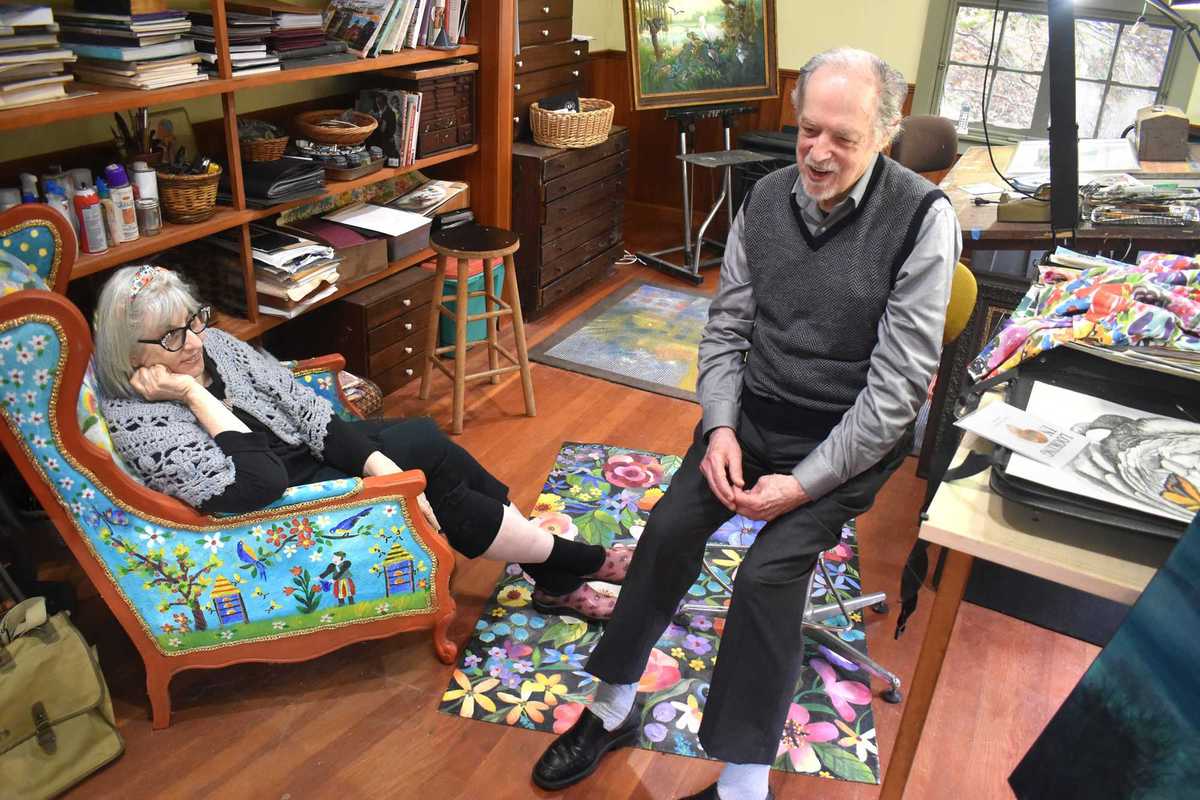
 Justine and Victor Valla in their studio with a painting of Victor’s,”Jonah and the Whale.” Robin Roraback

 A ceramic vase by Kathleen Heidemann.Provided
  Joy Brown’s delightful ceramic sculptures.Provided