Thank you!
Your support is sustaining the future of local news in our communities.

White Hart book talk proclaims ‘Democracy is not dead’

White Hart book talk proclaims ‘Democracy is not dead’

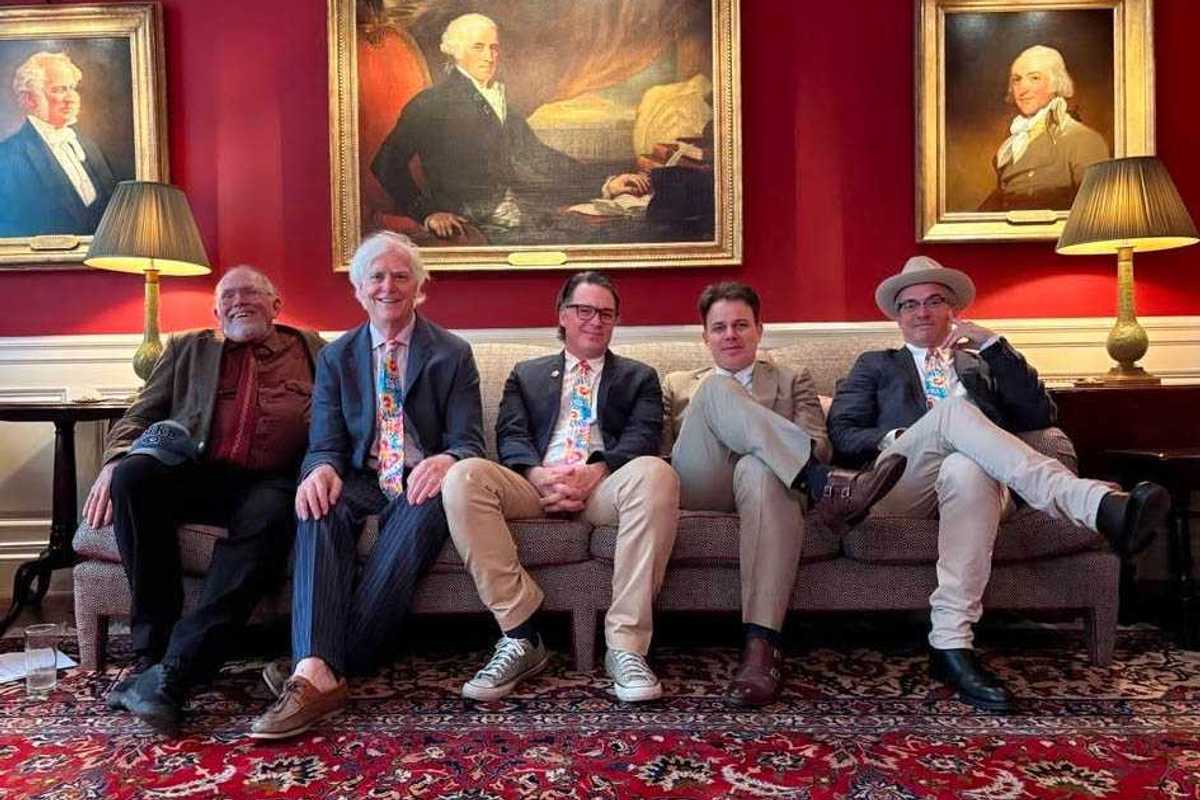
Jonathan Alter, left, discussed his latest book with John Hendrickson of The Atlantic on Nov. 15.

Patrick L. Sullivan

Journalist Jonathan Alter combined the personal and the political in a discussion of his latest book, “American Reckoning: Inside Trump’s Trial — and My Own” at the White Hart Thursday, Nov. 15.

Alter was interviewed by John Hendrickson, a senior editor at The Atlantic magazine.

The book, published in October, is an account of the “hush money” trial of Donald Trump, which ended in May 2024 with a Manhattan jury finding Trump guilty of 34 counts of falsifying business records.

He said he was one of a handful of reporters who attended all 23 days of the trial. The trial was not televised, and cameras were not allowed except briefly at the start of proceedings.

Alter said binoculars were allowed, and he spent time looking at one juror, who looked back at him as if to ask “What are you looking at?”

He said he was mindful of the importance of the trial to the recent election, and what it would mean for the book.

If Democratic candidate and Vice-President Kamala Harris won the election, the book would be similar to Jimmy Breslin’s “How the Good Guys Finally Won,” about Richard Nixon and Watergate.

If Trump won, the book would be more akin to William L. Shirer’s “Berlin Diary,” about the rise of Adolph Hitler and the Nazis in Germany, Alter said.

He said he felt compelled to cover the trial, saying it was unlikely curious citizens would “go to the transcripts.”

Alter said his previous book, about former president Jimmy Carter, took five years to write. “American Reckoning” had to be done in five weeks.

He described writing the book as “the process of nine years of dealing with this odious man.”

Alter said he interviewed Trump in the late 1990s for the “Today Show.”

“He had forgotten he’d sued me,” he said with a grin.

Alter wasn’t impressed.

“He was a New York celebrity, kind of a clown. Not a lot of presence.”

But by the time Trump announced he was running for president in 2015, he had acquired a certain quality of being a leader.

Hendrickson recalled talking with a community college student in Bucks County, Pennsylvania, before the 2016 election and being surprised when the young man said half his classmates were Trump supporters.

Alter said ”People think he’s entertaining,” adding “I find his louche lounge act unbearable.”

Asked what he thinks will happen regarding sentencing, given that Trump is now president-elect, Alter said one scenario is a suspended sentence that doesn’t go into effect until 2029, when Trump is no longer president.

Asked how Trump survived the multiple legal problems of the last four years, Alter said “There’s something feral about Trump. He survived in a tough world in New York.”

He said Trump is very experienced when it comes to media.

“He took those skills national,” Alter said. “There’s a lot he understands intuitively about America.”

Alter was cautiously optimistic about the next four years.

“Democracy is not dead,” he said. “We will survive this.”
Latest News

Doug Tallamy’s work in progress: saving the planet one backyard at a time

Windacre, a 25-acre property in Millerton will be the site of “Work in Progress,” an afternoon with acclaimed entomologist, New York Times bestselling author and Homegrown National Park co-founder Doug Tallamy.

Provided

For nearly three decades, Doug Tallamy, a professor at the University of Delaware and co-founder of Homegrown National Park, has studied the intricate relationships between native plants, insects, birds and the ecosystems that sustain them. His books, including “Bringing Nature Home” and “Nature’s Best Hope,” have helped shift the conversation about conservation from something that happens primarily in parks and preserves to something ordinary people can practice on the land around them.

On Sunday, Oct. 4, Tallamy will bring that conversation to Windacre in Millerton for “Work in Progress: Toward Native Fields,” an outdoor gathering exploring both the possibilities and the complications of restoring private land for biodiversity.

Keep ReadingShow less
Celebrating Dick Hermans’ life built around community

Dick Hermans in the Oblong Bookstore on Millerton\u2019s Main Street in 1985.

Provided
No matter what I’ve done, I’m trying to be useful to the communities I’m associated with.
— Dick Hermans

When Dick Hermans receives the Estabrook Community Leadership Award on Oct. 11, he will accept it for a lifetime of work that has taken many forms: bookseller, radio host, school board member, advocate for the Harlem Valley Rail Trail, business owner, volunteer and, perhaps most importantly, a person who has consistently looked for ways to be useful to the communities around him.

The Lakeville Journal and The Millerton News will present Hermans with the 2026 award at the annual Jubilee celebration at the Sharon Playhouse. The award honors outstanding leadership in community service and was inspired by Mary Lou and Robert Estabrook, former owners of the newspapers who believed that strengthening a community extended well beyond the work of publishing a newspaper.

Keep ReadingShow less
Tending the Fire: Homelands PowWow brings Mohican culture home to the Berkshires

Members of the Stockbridge-Munsee tribe at Homelands PowWow in 2025.

Joeseph Plante New Media Storytellers
Our goal is to continue building an annual gathering that honors the history, culture and traditions of the Stockbridge-Munsee Band of Mohicans in their original Homelands.


For the Stockbridge-Munsee Mohican people, the Berkshires are not simply a place to visit. They are ancestral homelands.

Keep ReadingShow less
google preferred source

Want more of our stories on Google? Click here to make us a Preferred Source.

Ancram Center’s “A Number” doubles questions of identity
Ledbetter (left) and Wojda (right) on the set of “A Number” at Ancram Center for the Arts.
Jeff Mousseau

How would you feel if you found out you weren’t the only you — if there was an exact replica of you? What if you found out that you’d been cloned? Would you believe that you’re the real you? Would you suspect you might be a copy of the original? How could you be sure anything about your life was real? These are some of the questions posed in Caryl Churchill’s play “A Number,” opening at the Ancram Center for the Artson Oct. 1.

Churchill was born in London in 1938 and has been hailed by the theaterl world as one of the strongest voices of her time to take on sexual politics and feminist themes. Her works garner pointedly considered analysis from the highest levels of theatrical intellectualism. Basically, it’s about as far from “The Lion King” as you can get. While she’s experimented with dance theater in the past, “A Number” is much more stripped down, highlighting Churchill’s chosen themes and the skills of both actors on stage.

Keep ReadingShow less

Dispatches from the Farm

Dispatches from the Farm

Adamah Farm crew members planning out the day’s tasks on a late September day.

Janna Siller

“Dispatches from the farm” is a new, periodic column offering a firsthand look at the rhythms, challenges and rewards of farming through the eyes of a local farmer.

The thing about plants is that they can’t get up and move. When a storm like last weekend’s nor’easter threatens to roll through, you can’t just round everybody up and settle them safely on the sofa for movie night.

Keep ReadingShow less
Pinchas Zukerman brings an all-Beethoven program to Hotchkiss

Pinchas Zukerman to perform at Hotchkiss Oct. 4

Cheryl Mazak

The passion, drama and energy of Beethoven will fill Katherine M. Elfers Hall at The Hotchkiss School on Oct. 4, when world-renowned violinist Pinchas Zukerman is joined by pianist Shai Wosner for a special recital.

The 4:30 p.m. program at the Esther Eastman Music Center will feature three of Beethoven’s celebrated violin sonatas: Violin Sonata No. 4 in A minor, Op. 23; Violin Sonata No. 5 in F major, Op. 24, “Spring”; and Violin Sonata No. 7 in C minor, Op. 30.

Keep ReadingShow less
google preferred source

Want more of our stories on Google? Click here to make us a Preferred Source.

google preferred source

Want more of our stories on Google? Click here to make us a Preferred Source.