


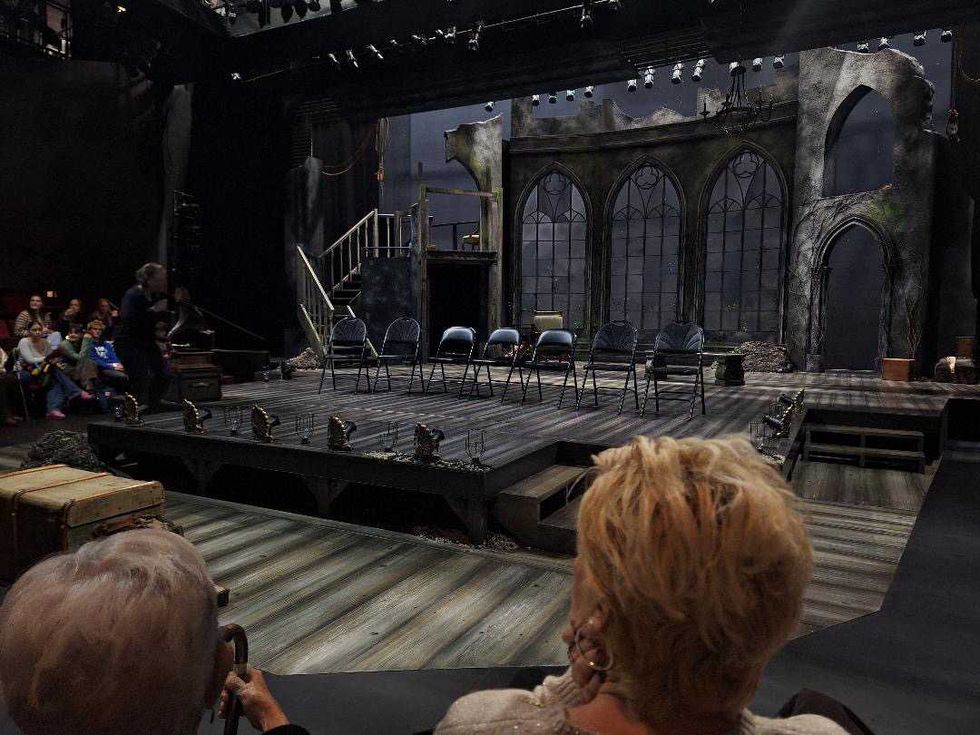
David Ricci will bring his exploration of American materialism to the Five Points Arts Center in Torrington on Saturday, April 18, at 2 p.m., where he will discuss his new book, Hunter Gatherer.
Ricci is fascinated by America’s obsession with objects. In Hunter Gatherer, he examines a distinct strain of materialism—one rooted not in the new, but in the items that endure.
When people talk about materialism, the focus often falls on the latest smartphones, gaming systems, designer bags or plush furniture. Ricci, however, turns his attention to objects that cycle in and out of people’s homes through flea markets, antique stores and curio shops.
The book features a selection of photographs from the thousands Ricci has taken while visiting more than 200 such venues across the United States. His work adopts an anthropological lens, exploring the meanings culture and society assign to these objects as they are bought, sold and recirculated over time.
Why are these items considered worthy of another life? What do they reveal about Americans’ relationships with racism, misogyny and social norms? Ricci argues that the chaotic marketplace of secondhand consumerism reflects a distinctly American mindset: “I own, therefore I am.”





 Provided


This Veterans Day, say more than “thank you”
Tim Morris
I grew up next door to a great American, the late Captain Thomas E. Zibrofski of Melrose, Massachusetts. Although Tom was a proud U.S. Marine who piloted a UH-34D helicopter in over 200 Vietnam War combat missions, I knew him primarily for his other roles: generous backyard pool owner, family friend, car-lover.
It was because of this relationship that when I reached adolescence and became curious about Tom’s military service, I did not hesitate to ask him. My thirteen-year-old self spent one memorable afternoon with Tom looking at old slide-projector photographs and listening to his stories. As the projector fan whirred in the background, I remember laughing as Tom shared stories that I could picture. He explained how one of his peers brought a bowling ball to basic training (assuming incorrectly they would have time to go bowling) and was made to carry it around everywhere by the drill instructors. He told me about the competitiveness between Marine Corps and Air Force pilots at Da Nang Air Base, and about the South Vietnamese soldiers who would ride in his helicopter carrying “three-times” their body weight in equipment.
To be sure, Tom spared me from the worst of what he experienced. He did not tell me about the day he was wounded extracting a reconnaissance patrol from a hot landing zone (the same wound that left his voice in a hoarse whisper for the rest of his life).Still, I will never forget the generosity Tom showed me that day. By answering my questions Tom made me feel valued –– like he truly wanted me to understand his military service.
Each Veterans Day, you can find articles published about the growing distance in American society between those who served in the Armed Forces and those who did not. It is commonly referred to as the “civil-military divide.” The oft-quoted statistic is that today less than 1% of the U.S. population serves in the Armed Forces, and less than 7% of the adult population are veterans. Whether or not the numbers are the cause of this so-called divide, one symptom is clear: many adults are hesitant to ask the veterans in their lives about their military service.
The reasons for this hesitation are many. We tell ourselves that we “could never understand what they went through,” so we don’t bother asking. We worry that there may be trauma that we could “trigger” by asking a question, so we decide that we better not. We think that we don’t “have the right” to ask any questions because we didn’t serve ourselves. Better just to say “Thank you for your service” and call it a Veterans Day.
While these thoughts are understandable, they are fictional reasons for a curious person to remain silent. Instead of self-censoring, consider instead striking up a conversation with a veteran in your life. Trust that your genuine curiosity about their service will shine through in your questions. Trust that a veteran is completely capable of choosing what they will and will not share with you. You should not ask to hear about a veteran’s worst day in the military, and certainly avoid “did you kill anyone,” but you may be surprised at how well you can relate to many of their experiences.
Questions like, Who was your best friend when you served? What was the hardest part of boot camp? Do you have any funny stories from training? (Prediction: they do.) Who was your most memorable instructor? What are you most proud of from your military service? What was the weather or food like at your duty station or when you deployed? Why did you join the military? can all help you better understand someone’s service.
Contrary to what you see in movies, there are many long, often boring hours associated with military service; there are countless jokes told, deep relationships formed, and positive experiences to go along with the difficult ones. Growing up, I was fortunate to have a friend and a role model who helped me understand that military service is rarely one-dimensional, even for a Purple Heart recipient. In the years since I joined the Marine Corps, I have tried to help others understand the same.
Here in the northwest corner and Dutchess County, we are fortunate to have great Americans like Tom living all around us. And as Veterans Day approaches, it is worth remembering that expressions of gratitude need not be limited to a single-sentence exchange. On November 11th, try honoring a veteran in your life by saying more than “Thank you.” Ask them about their service. You both may be thankful that you did.
Tim Morris resides in Lakeville.