Future affordable homes arrive at Perry Street via semi-truck

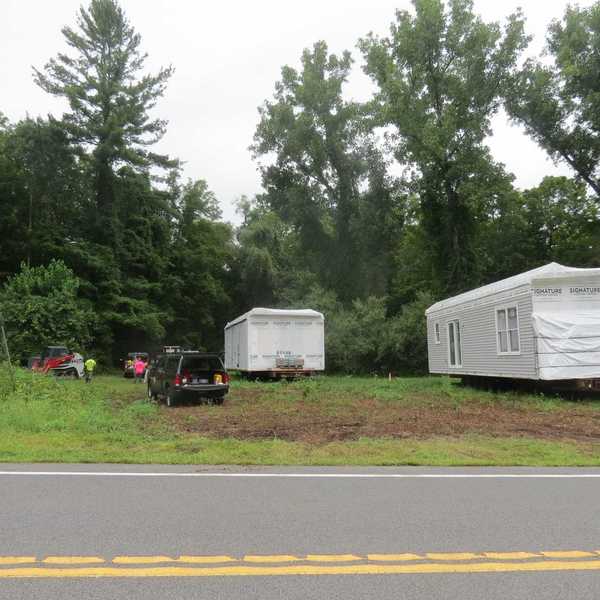
A section of modular housing bound for Perry Street arrives in Lakeville on an oversize load tractor trailer Wednesday, April 2.
Patrick L. Sullivan

A section of modular housing bound for Perry Street arrives in Lakeville on an oversize load tractor trailer Wednesday, April 2.
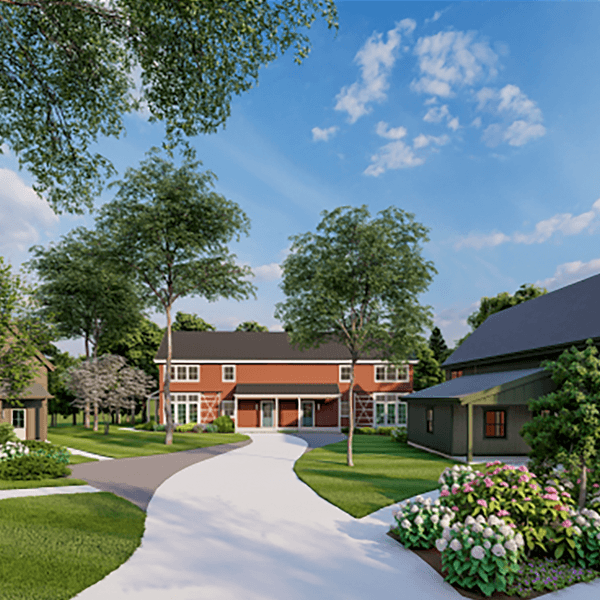
LAKEVILLE — After years of deliberation, grant applications and remediation, the affordable housing site at the top of Perry Street in Lakeville took tangible form Wednesday, April 2, when modular housing units were trucked in for placement by crane.
The units were stored temporarily at the Town Grove. Bright and early Wednesday morning the semi-trucks rumbled down Ethan Allen Street to the Grove, loaded up the first components and headed over to Perry Street, accompanied by a couple of escort cars with flashing lights.
The Perry Street site once had a dry-cleaning business. The town eventually took possession of the property for back taxes in May 2014. The Salisbury Housing Trust then took over ownership of the property after approval from town meeting in 2022.
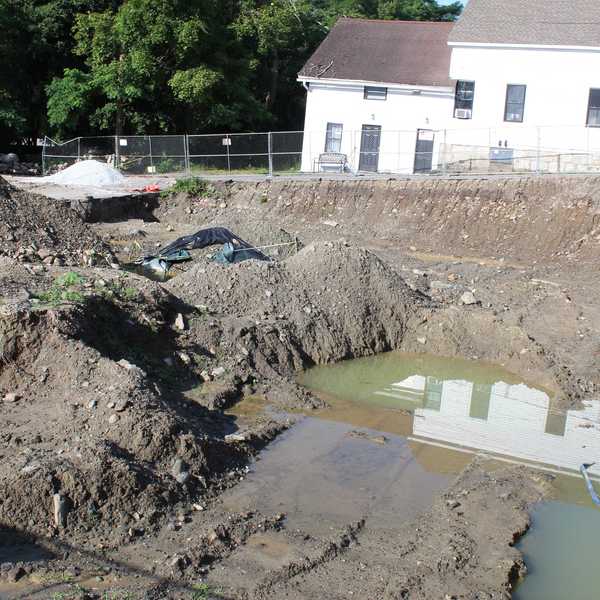
By summer of 2014, the site had been subjected to asbestos abatement and testing for any remaining hazardous materials, and the main demolition began.
The building and garage were visibly deteriorating, with one wall of the laundry partially collapsed, which made the demolition tricky.
It’s been a long haul. In 2008, First Selectman Curtis Rand asked the state Department of Economic and Community Development for technical assistance to investigate the property. The department received a $200,000 grant from the federal Environmental Protection Agency for testing and remediation, and the town received a $500,000 state Small Town Economic Assistance Program grant in August 2013. To get the grant, Rand put “workforce housing” in the application as the probable future use.
Two foundations were poured on the 0.65-acre site in March.
The 1,500 square foot, three-bedroom, two-bathroom homes will be available for purchase at a price range between $250,000 and $280,000 which includes a $25,000 forgivable down payment assistance loan. Eligible buyers must be first-time homeowners with a gross household income below the area median income.
There will be an information session for prospective buyers Thursday, April 10, 7:30 p.m. on Zoom.
For more information and the Zoom link, go to www.salisburycthousing.org/current-homes-for-sale

A judge recently dismissed one lawsuit tied to the proposed redevelopment, but a separate court appeal of the project’s approval is still pending.
LAKEVILLE — A Connecticut Superior Court judge has dismissed a lawsuit filed against Salisbury’s Planning and Zoning Commission challenging a zoning amendment tied to the controversial expansion of the Wake Robin Inn.
The case focused on a 2024 zoning regulation adopted by the P&Z that allows hotel development in the Rural Residential 1 zone, where the historic Wake Robin Inn is located. That amendment provided the legal basis for the commission’s approval of the project in October 2025; had the lawsuit succeeded, the redevelopment would have been halted.
The decision, issued Jan. 29 by the Superior Court in Torrington, rejected a claim brought by Wells Hill Road residents Angela and William Cruger seeking to nullify the amendment. The Crugers filed the lawsuit in March 2025, arguing the regulation was improperly adopted and amounted to illegal spot zoning intended to benefit the project’s developer, Aradev LLC.
The zoning amendment drew scrutiny when it was adopted, with opponents asserting it was crafted specifically to enable the Wake Robin Inn project. Town officials and land use staff, however, repeatedly said the change was years in the making and intended to address zoning nonconformities affecting historic inns throughout Salisbury.
In a memorandum of decision, the court found the plaintiffs failed to meet their burden of proof that proper notification was lacking. The judge wrote that “a close examination of the record” showed the Crugers did not demonstrate that public notice of the zoning change was procedurally deficient, unduly vague or untimely filed.
The dismissed case is the first of two legal challenges filed by the Crugers related to the Wake Robin Inn redevelopment. A second lawsuit — an appeal of the P&Z’s approval of Aradev’s application to redevelop and expand the inn — remains pending before the court.
Former Planning and Zoning Commission Chair Michael Klemens said that Thursday's ruling brought vindication. In a Jan. 30 email to the P&Z and commission attorney Charles Andres, Klemens said the lawsuit was largely based on claims that he and Land Use Director Conroy had misled the public and the commission during the regulatory process.
“So not only are the regulations recognized by the Superior Court as legally adopted,” Klemens wrote, “but the aspersions cast upon the integrity of staff and your immediate past chair are hopefully finally put to rest.”
Andres informed the Land Use Office and current P&Z Chair Cathy Shyer that the Crugers have 20 days to challenge the court’s ruling.
Olana State Historic Site, the hilltop home created by 19th-century Hudson River School painter Frederic Edwin Church, rises above the Hudson River on a clear winter afternoon.
On a recent mid-January afternoon, with the clouds parted and the snow momentarily cleared, I pointed my car northwest toward Hudson with a simple goal: to get out of the house and see something beautiful.
My destination was the Olana State Historic Site, the hilltop home of 19th-century landscape painter Frederic Edwin Church. What I found there was not just a welcome winter outing, but a reminder that beauty — expansive, restorative beauty — does not hibernate.
2026 marks the 200th anniversary of Church’s birth, making this a particularly timely moment to take in what he created during his lifetime. Church — one of the most notable artists of the Hudson River School movement — was an accomplished landscape painter who gained a reputation as an artist-traveler.
From South America and Western Europe to the Middle East and the Caribbean, Church sought out dramatic, epic scenes that he could capture on canvas and bring back to the U.S. to sell. The profits from those works, in turn, allowed him to create a breathtaking masterwork of his own: Olana.
Olana rises above the Hudson River like a mirage, its Persian-inspired facade an unexpected sight amid the barren winter landscape. With miles of trails, visitors can take in the natural splendor of rolling hills and the river from every angle. From the house itself, the view stretches across the Catskills, a layered panorama of soft blues and silvers that appears all the more dazzling in winter.

Inside the home, the sense of awe deepens. Olana’s interior is rich with color, pattern and texture — warm reds, stenciled walls, intricate woodwork — a striking counterpoint to the monochrome world outside. Light pours through tall windows, framing the Hudson Valley like living paintings.
Every corner of the house pays tribute to the far-flung places Church visited throughout his career. From architectural details to the objects he collected and displayed, visitors are transported to another world. Walking from room to room feels less like touring a house museum and more like stepping into the mind of an artist transfixed by the staggering beauty of the world around him.
As I made my way back down the hill, the winter light fading fast, I felt refreshed in a way that only comes from seeing something anew. Olana is not just a monument to one artist, but a testament to a way of viewing the world — one that values observation, patience and reverence for the natural environment. For those looking to venture out during the colder months and to be reminded why this region has inspired generations of artists and dreamers, there may be no better place to start than Olana.
Olana State Historic Site is located at 5720 State Route 9G, Hudson, New York. For more information and to purchase tours, visit: olana.org

Berkshire Hills Ski League includes Washington Montessori School, Indian Mountain School, Rumsey Hall and Marvelwood School.
CORNWALL — Mohawk Mountain hosted a meet of the Berkshire Hills Ski League Wednesday, Jan. 28.
Housatonic Valley Regional High School earned its first team victory of the season. Individually for the Mountaineers, Meadow Moerschell placed 2nd, Winter Cheney placed 3rd, Elden Grace placed 6th and Ian Thomen placed 12th.
The league includes a mix of private and public schools. HVRHS competed against Washington Montessori School, Indian Mountain School, Rumsey Hall and Marvelwood School.

Conditions were ideal for slalom skiing at Mohawk, albeit cold for spectators with the temperature in the teens. Approximately 20-inches of snow fell earlier in the week.
Mohawk will continue to host weekly meets of the BHSL each Wednesday through the end of the season. The league championship will take place Feb. 25.

State Sen. Stephen Harding
NEW MILFORD — State Sen. and Minority Leader Stephen Harding announced Jan. 20 the launch of his re-election campaign for the state’s 30th Senate District.
Harding was first elected to the State Senate in November 2022. He previously served in the House beginning in 2015. He is an attorney from New Milford.
In his campaign announcement, he said, “There is still important work to do to make Connecticut more affordable, government more accountable, and create economic opportunity. I’m running for reelection to continue standing up for our communities, listening to residents, and delivering real results.”
As of late January, no publicly listed challenger has filed to run against him.
The 30th District includes Bethlehem, Brookfield, Cornwall, Falls Village, Goshen, Kent, Litchfield, Morris, New Fairfield, New Milford, North Canaan, Salisbury, Sharon, Sherman, Warren, Washington, Winchester and part of Torrington.