HVRHS tops Thomaston in girls soccer rematch

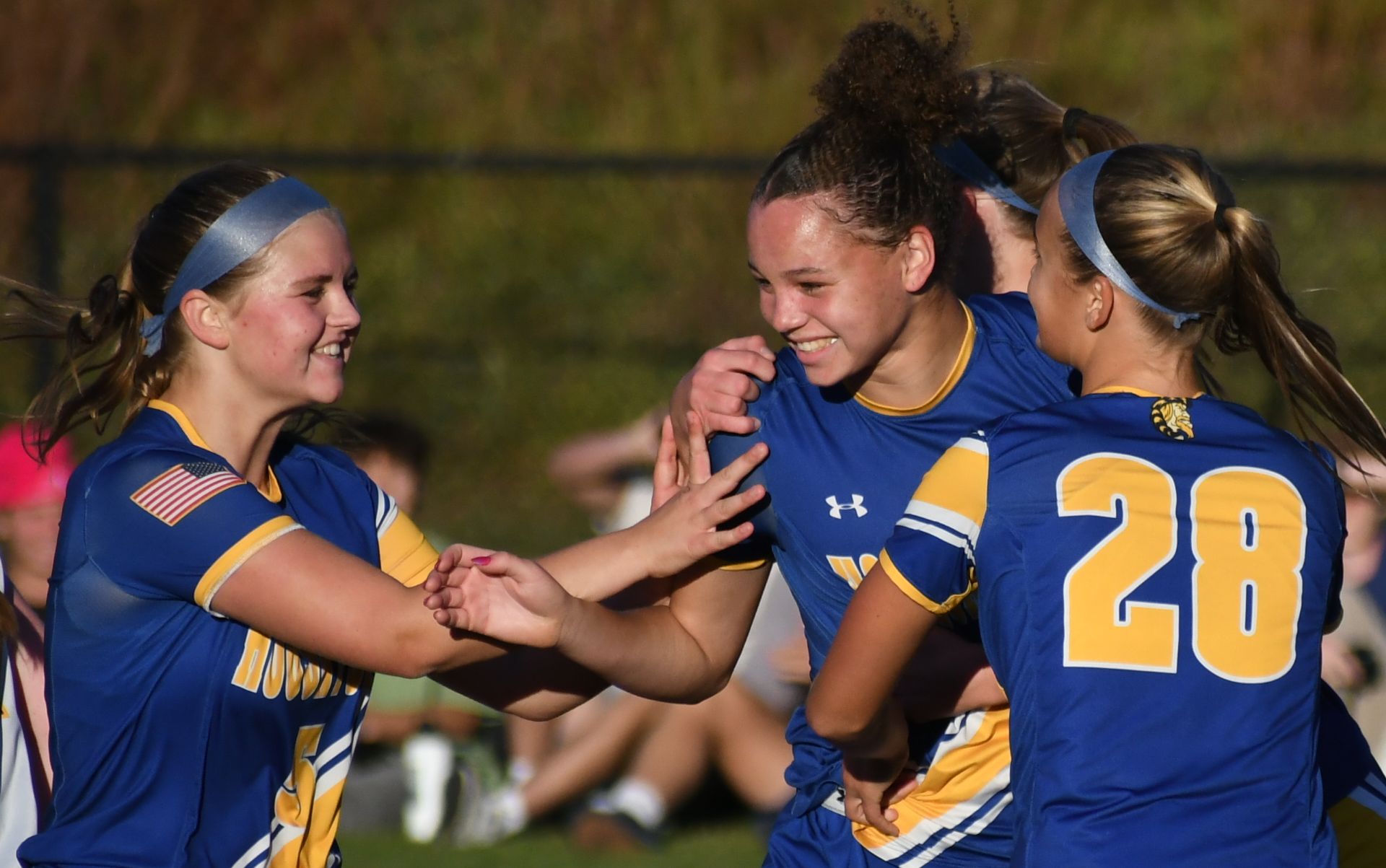
HVRHS girls soccer is back on top of the Berkshire League.
Photo by Riley Klein

HVRHS girls soccer is back on top of the Berkshire League.
THOMASTON — Housatonic Valley Regional High School girls soccer defeated Thomaston High School 2-1 to reclaim the top spot in Berkshire League standings Oct. 19.
The Mountaineers (13-2) won the battle for the BL one seed after losing 3-2 to Thomaston (12-2-1) on Oct. 17.
The rematch game reshuffled the Class S state rankings as well, moving HVRHS to second place and bumping Thomaston to third place. Windham Technical High School currently sits atop Class S with a record of 14-2 and no games remaining.
Thomaston and HVRHS each have one regular season game to play before the postseason begins. HVRHS will host Lakeview High School (4-8-2) on Tuesday, Oct. 22. Thomaston will host Terryville (10-5) the same day.
Berkshire League semifinals begin Thursday, Oct. 24. The championship is scheduled for Oct. 29 at Nonnewaug High School's athletic complex.
The Class S state tournament starts Nov. 1 and the championship will be played Nov. 16 or 17 at Trinity Health Stadium in Hartford.
NORTH CANAAN — Jesse Bunce’s victory for first selectman was as narrow as elections get in town politics: a two-vote margin that required a recount and ushered in a transition period that, by Bunce’s own description, “has not been perfect.”
Bunce, 38, assumed the town’s top job after only a few years in local government and following a period of friction on the Board of Selectmen, where he served alongside former First Selectman Brian Ohler, whom he narrowly defeated and who remains on the board.
Asked whether he was surprised he beat Ohler, Bunce said he expected a close finish. “I put in a lot of work in the campaign, so I did think the numbers were going to be close,” he said. “I didn’t know where it was gonna go, though, honestly.” He added that the result wasn’t really an upset because “it was just so close.”
Now, Bunce is framing his first term as a reset — a push to reduce divisions, rebuild trust and keep the town focused on practical needs.
“That’s my hope,” he said when asked about North Canaan’s next chapter, adding that working together is essential in a town with limited resources.
“We don’t have the tax base like some of our surrounding towns, but we do have a lot of people willing to volunteer, come together and get things done,” he said. “And I feel that’s our key to success.”
Bunce grew up in North Canaan and went through local schools before attending Oliver Wolcott Technical High School in Torrington. He lives in town with his wife, Kim, and two young boys. A third child is due in late January.
He began working for an electrical company while still in high school and stayed in the trade after graduating, shifting careers after the 2008 economic downturn.
“I had an excavation landscape business that I would do on the weekends and at night. So I just went on to that,” he said.
The excavation business dates back to his grandfather, who moved to North Canaan from Massachusetts. “My grandfather actually started it in 1964,” Bunce said, noting that he later bought out his father.
Bunce said that experience will help him fulfill his priorities at Town Hall, particularly improving infrastructure, maintaining and pricing equipment, and estimating costs for grant applications.
“That’s definitely one of my strong suits coming in [as first selectman] — with road work, infrastructure and equipment,” he said.
His path into politics began with town boards, starting as a zoning alternate after navigating the process himself. “I came and had to go through a few meetings, so I saw the process of it and wanted to get involved,” he said.
Bunce was elected to the Board of Selectmen for the first time a little over two years ago with the endorsement of the Democratic Town Committee, despite being a Republican. He said he had established a strong working relationship with the committee prior to its backing and emphasized that party labels matter little in the day-to-day work of local government.
The DTC also supported him in the first selectman race.
“We need to think what’s best for the town [not party affiliation] and try and move forward with that.”
That message of what’s best for the town was tested early, with a bumpy transition that included technology problems and operational delays, including disruptions tied to the town’s online tools and a delayed payroll at the elementary school.
At his first Board of Selectmen meeting as first selectman in December, Bunce acknowledged “early bumps,” telling residents, “This process has not been perfect. We are working through it all.”
Ohler, who sat along side him at the meeting, pledged cooperation. “You have my assurance. I will give you my full support when it is of benefit to the town,” he said, adding that discussions “will be professional” and “based on substance, not rhetoric.”
Bunce said steady communication with staff, department heads and residents will be key. He plans to be in Town Hall frequently, aiming for Mondays in the office “all day” and shorter visits throughout the week.
Asked how he would measure success when his term ends in two years, Bunce said, “If the town is flowing well, if we can achieve some of these grants… if our board is working well together.”
His policy priorities focus on improving town assets and maintaining existing infrastructure.
He said the town pool is “in really bad shape” and described plans to seek a state STEAP (Small Town Economic Assistance Program)grant to refurbish the pool house, improve accessibility and refresh athletic facilities, with construction possible in “summer of 2026.”
He also cited road and bridge repairs, saying “a lot of our roads have been neglected over the years,” and pointed to needed work on West Main Street.
Beyond infrastructure, Bunce said he wants to explore more programs for children and working families, including expanded after-school athletics.
He said property taxes are high and affordability is a concern, reinforcing his goal of keeping costs down and reducing long-term expenses.
Bunce said progress will depend on collective effort.
“I think everybody wants to be a part of making the town better,” he said.
KENT — Eric Epstein, a lifelong Kent resident and veteran volunteer firefighter, was elected unopposed this fall as the town’s first selectman, stepping into the role for the first time with deep local roots.
Epstein, a 51-year-old Democrat, took over from Marty Lindenmayer in November, after Lindenmayer chose not to seek re-election after being in office for just one term.
Born and raised in Kent, Epstein attended Kent Center School and Housatonic Valley Regional High School before earning an associate degree in business administration from SUNY Cobleskill.
After college, he returned to Kent to begin a career in sales — first at the local Chevrolet dealership, then briefly in New Milford — before joining Gowans-Knight Company, a Watertown-based fire apparatus manufacturer. Epstein continues to work part-time in sales for the company.
Public service, Epstein said, “is in my blood.” He joined the Kent Volunteer Fire Department at age 18 and has served for more than 30 years, including two stints as chief totaling 13 years. He remains an active volunteer firefighter. He has also served the town in emergency management, a volunteer position responsible for coordinating municipal responses to large-scale emergencies.
Epstein’s family history in town government and local affairs runs deep. His mother, Ruth Epstein, served two terms as Kent’s first selectman, and his father was principal of Kent Center School for three decades. Today, Epstein and his wife, MaryEllen, are raising their children, Ella, 11, and Evan, 9, in Kent; both attend Kent Center School.
Although new to elected office, Epstein is not new to municipal operations. His years working with town officials through the fire department and emergency management has provided him with regular exposure to budgeting, coordination and intergovernmental planning.
When the Democratic Town Committee approached him this summer about running for first selectman, he said the timing finally felt right.
“I care deeply about this community and believe in its potential,” Epstein said. “We face real challenges, and I want to bring thoughtful, transparent leadership that puts people first.”
Among those challenges, Epstein points first to affordability. With housing costs rising, he said, young families and workers are increasingly priced out, contributing to declining school enrollment. He supports the Kent Affordable Housing initiative’s newly approved 13-unit rental project and said expanding housing options will be critical to the town’s long-term vitality.
Epstein takes office ahead of budget season, which involves capital planning and a fiscal year budget to be finalized ahead of a May town vote. He said the learning curve is steep, but emphasized that close collaboration with the Board of Finance and department heads will be essential.
Other priorities include addressing the future of the town-owned Swift House—an unused, non-ADA-compliant historic property; rehabilitating the town’s spring-fed swimming pond; advancing road and sidewalk projects; and expanding waste-reduction efforts at the transfer station. Kent recently received a state grant to install an on-site composter, allowing food scraps to be processed locally and the finished compost returned to residents for gardens.
Epstein is also working with state officials on river access and safety issues that surfaced last summer, and with neighboring towns on regional concerns ranging from emergency medical services to waste management. He said early meetings with other Northwest Corner first selectmen have been helpful in sharing strategies on common problems.
Although he ran unopposed, Epstein said he views the office as a significant responsibility and does not take the mandate lightly.
“I’ll listen closely to residents’ concerns, learn from their experiences, and engage in open, respectful dialogue,” he said, prior to taking office.
North Canaan needs to turn the page. The town entered a new chapter in November, not only with the election of a new first selectman, but with significant changes across Town Hall. Several key positions are now held by new faces, and the Town Clerk’s office is showing stability after a lengthy period of disruption.
For a small town, such turnover matters — and it helps explain why the handoff into the new year hasn’t been seamless.
Jesse Bunce took office after a razor-thin election and a challenging transition, marked by technology issues, operational delays, and a disrupted payroll. These issues were real, but they’ve been addressed. With those behind them, the town is now looking ahead to the work that remains.
Bunce brings a background in infrastructure, equipment and cost estimation, honed through years running a local excavation business. His practical experience aligns with many of North Canaan’s most pressing needs. In a town with a limited tax base, deferred maintenance and aging public assets are not abstract policy concerns — they are real issues that require careful planning and disciplined spending.
He emphasizes a straightforward governing approach: prioritizing what’s best for the town and encouraging collaboration over division. If he can successfully implement this approach, it could provide a solid foundation for the work ahead.
Former First Selectman Brian Ohler, who remains on the Board of Selectmen after his narrow defeat, has shown grace and a clear willingness to contribute to the town’s future. His commitment to collaboration and professionalism sets an important example as the town transitions. Ohler’s work over the years has laid a foundation of service, and his willingness to work alongside Bunce offers a model for positive, unified governance.
Turning the page doesn’t mean ignoring problems or lowering expectations. Residents deserve reliable operations, functional systems, and accountability from Town Hall.
But it does mean recognizing that progress will depend on cooperation and goodwill — not just from elected officials, but from staff, volunteers and residents alike.
The challenges ahead are ones the community faces together: improving roads and bridges, addressing deteriorating town assets, supporting children and working families and managing costs to keep North Canaan affordable.
The town has experienced a period of change. The next two years should be defined not by transition issues, but by measurable progress.