Connecticut towns have been required for decades to publish legal notices in newspapers, but a bill before the General Assembly — along with a recent Appellate Court decision — could clear the way for legal publication on town websites instead.
State law requires that government agencies publish notifications of certain policy changes and meetings in a local newspaper with “substantial” circulation in the town. Fenwick, a small borough of Old Saybrook with about 50 residents, has historically sent these notices to the Middletown Press.
But when the borough’s zoning board passed a policy banning certain short-term rentals, residents sued, saying the town hadn’t provided sufficient notification.
Last week, the Connecticut appeals court upheld the lower court’s decision and ruled that publishing in the Middletown Press wasn’t enough, because the Press has no subscribers in Fenwick. The Hartford Courant has fewer than five subscribers who get the printed paper, officials said.
“We recognize that the newspaper industry has undergone significant changes since the legislature first imposed the obligation on municipalities to publish notice in a newspaper with ‘substantial circulation,’ in that municipality,” the court’s opinion says. “We also are mindful, of course, that the widespread availability of access to the Internet may justify, from a public policy perspective, permitting a municipality to publish legal notices on its website.”
But, the decision says, it’s the job of the legislature to make that call.
“We’re in a spot where we don’t quite know what to do,” said Chuck Chadwick, Fenwick’s Planning and Zoning Commission chair. “We’re on tiptoes.”
Newspaper industry
opposes bill
Last week, the Planning and Development Committee heard public comment on House Bill 6556, which would allow towns to publish legal notices on town websites.
The bill drew opposition from several in the newspaper industry who raised concerns about transparency and public access to information.
“Requiring public notices to be posted in newspapers helps ensure that the public has access to important information about government activities and decisions, and that government agencies are transparent and accountable,” wrote Mike DeLuca, publisher of Hearst Connecticut Media Group and president of the Connecticut Daily Newspapers Association, in public comment. “It is imperative these notices are published by a credible and independent body.”
The issue has come up in past legislative sessions and garnered support from town leaders across the state who argue that more people get the information from town websites and that allowing notices to be published online will bring public policy in line with new technology.
Nationwide, many small towns have faced a decline in local news coverage as the industry has faced layoffs, buyouts and cuts to resources for newsrooms. The U.S. Census Bureau reported last year that revenue for newspaper publishers had dropped by about 52% from 2002 to 2020.
Since 2005, the country has lost about a fourth of its newspapers, according to research from Northwestern.
And it has complicated the process for small towns and boroughs trying to provide legal notice, officials said.
Fenwick
Fenwick is a borough of Old Saybrook; it has its own municipal government but gets school, police and fire services from Old Saybrook.
Many town residents were renting out their homes or cottages for short periods of time, and town officials moved to ban rentals of less than two weeks. Short-term rentals have been a growing issues for municipalities across the country as residents complain that they take up housing stock and cause quality of life issues.
Months after the policy passed, residents sued, claiming that proper notice hadn’t been provided. The town had published notice in the Middletown Press, on its website and put a physical notice on a bulletin board in town.
But since the ruling, the borough has veered away from publishing in the Press. Instead, it has opted to print notices in a free weekly publication.
Newt Brainard, warden of the borough, says that while he believes this fits the court’s definition, he’s not convinced many people actually read it.
“It’s weekly, so that creates problems in terms of timing for individual notices,” Brainard said. “We are using that in the relative short term … It’s the only publication that fits the definition as far as we can tell, so that’s what we’re doing.”
The lawsuit overturned the ordinance, Chadwick said. But now, the town is concerned about the best way to move forward.
Towns officials don’t typically know how many of their constituents subscribe to certain newspapers, Brainard said. And most of his residents either visit the town website or see the physical notice, he added.
“It’s really an antiquated law, per se, and our position would be that it needs to be updated to allow for a modern day notice, whether that’s on the municipal websites or allowing notice in newspapers that traditionally circulate among your region, so it’s a little more widely interpreted,” he said.
The Journal occasionally will offer articles from CTMirror.org, a source of nonprofit journalism and a partner with The Lakeville Journal.

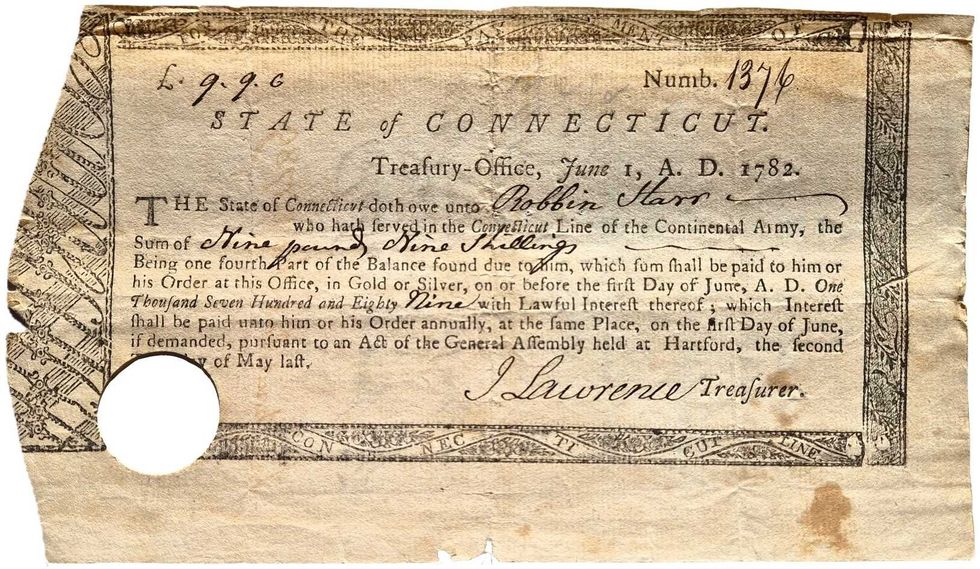 Pay Bill for Robin Starr’s service in the Continental Army.Courtesy the Alex Breanne Corporation
 John Mills speaking at Quinnipiac University.Courtesy the Alex Breanne Corporation
 Stephanie Saetta,with her rescue dog George and Blue (left), a shepherd mix awaiting his forever home.Madi Long
 Blue, a 7 year-old Shepard mix, is waiting for his forever home. Madi Long