Magician pulls back curtain on history of his craft

Magician pulls back curtain on history of his craft

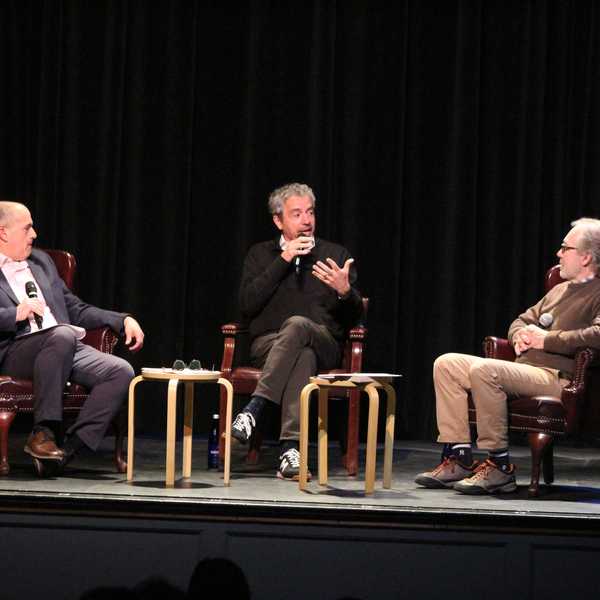
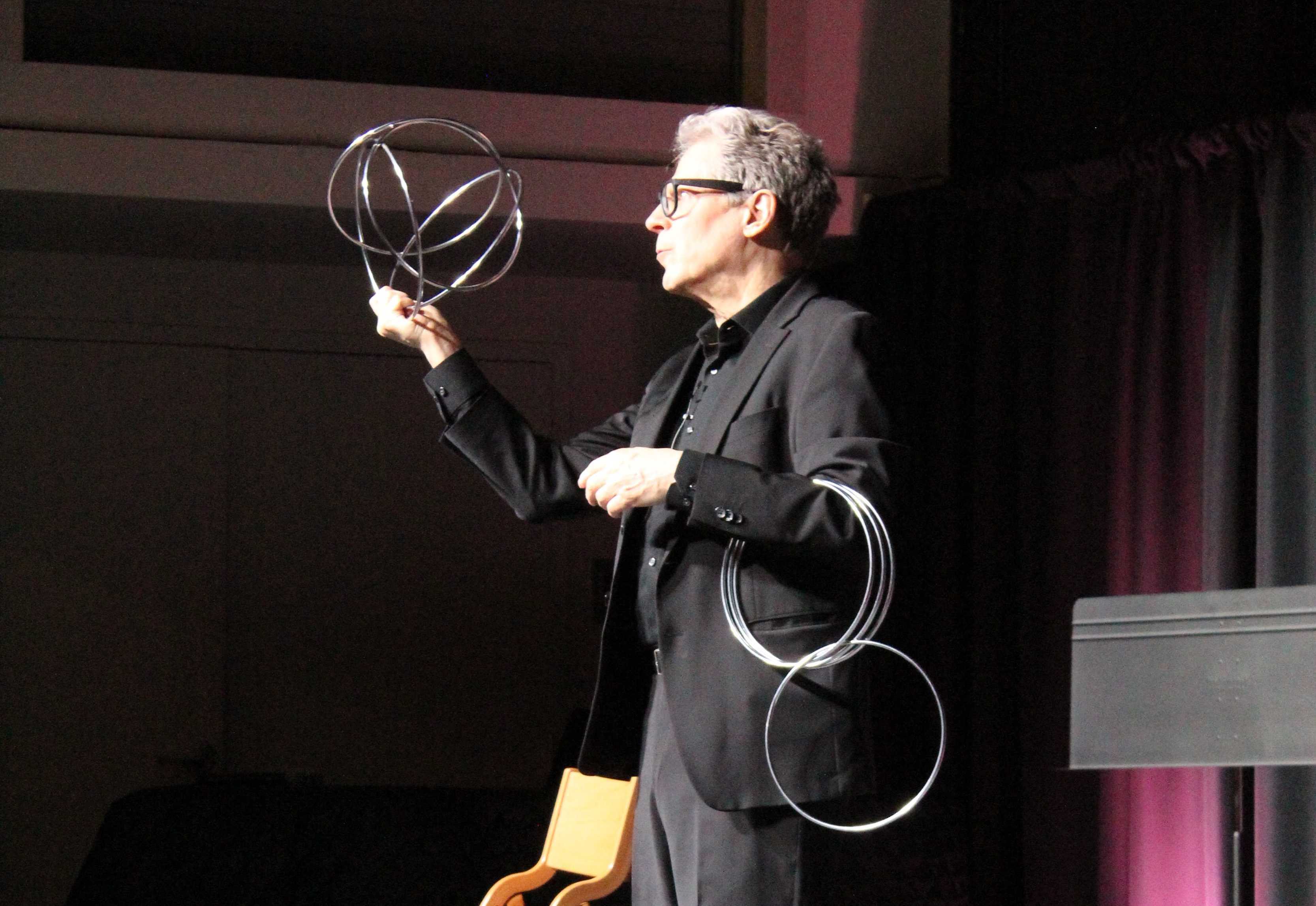
Jon Brunelle, magician, performs at Salisbury School Friday, Feb. 6, at the Salisbury Forum.

Patrick L. Sullivan

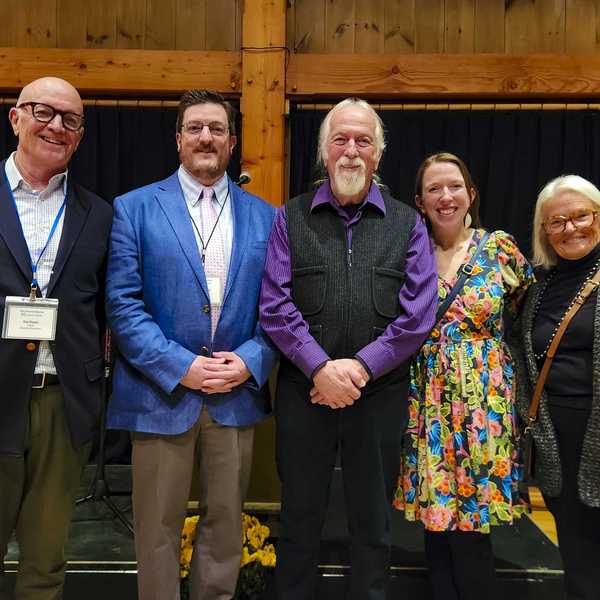
SALISBURY — Magician Jon Brunelle made a pencil levitate and hypnotized the president of the Salisbury Forum during “Illusory Magic: A Personal History of the Craft in Pictures, Words and Trickery,” a Salisbury Forum event at Salisbury School Friday, Feb. 6.

Between tricks and illusions, Brunelle provided a brief history of magic, and of his own career.

He said he was primarily active in the 1970s and 1980s, and showed a clip from Japanese television of him causing hard round coins to pass through a pack of playing cards and into a coffee mug.

“Notice my ’80s hair,” he said.

Brunelle said that in medieval Europe magicians had to be alert to charges of witchcraft.

They incorporated religious references into their acts to stave off such accusations, to the extent of a beheading illusion featuring John the Baptist.

The familiar “cups and balls” sleight of hand routine is old enough to have been satirized by painter Hieronymus Bosch in the 16th century.

His own introduction to the craft came at age 9, via a book advertised on a bubble gum wrapper: “Practical Magic,” by David Robbins.

Eventually he was able to make a living at it. One source of revenue was performing at industrial trade shows.

He developed a performance art act in the 1980s that combined surrealism and absurdism with elements of magic.

As to how the tricks work, Brunelle said successful magicians are students of psychology. They understand human perception, and how to “control the delivery of information.”

“Eye contact, hypnosis, clothing — it’s all misdirection.”

This was how he was able to “hypnotize” Salisbury Forum president Sarah Tennyson, while the audience laughed.

He also touched on how artificial intelligence is changing how people perceive reality.

He cited the time the early-20th century magician and escape artist Harry Houdini was bound and jumped off a bridge through a hole in the ice of the frozen Detroit River.

Houdini was down below the surface for quite a while, and the spectators feared the worst.

He reappeared, and subsequently claimed he freed himself quickly but was swept away by the current. Houdini said he made his way back to the hole, sucking in air from pockets in the ice.

The miraculous escape was passed along from newspaper to newspaper, and gained national attention.

“Even though the river wasn’t frozen that day,” Brunelle said.

If something similar happened today, it would be all over social media and be chalked up to “AI, the deep state, the Second Coming.”

Asked specifically about the effect of AI on magic, he said “it’s going to ruin everything.”

“I don’t think that anyone will believe photographic evidence.”

On the other hand, “if everybody distrusts what they see online, we’ll see more live performances.”


Latest News

In remembrance:
Tim Prentice and the art of making the wind visible
In remembrance: Tim Prentice and the art of making the wind visible

There are artists who make objects, and then there are artists who alter the way we move through the world. Tim Prentice belonged to the latter. The kinetic sculptor, architect and longtime Cornwall resident died in November 2025 at age 95, leaving a legacy of what he called “toys for the wind,” work that did not simply occupy space but activated it, inviting viewers to slow down, look longer and feel more deeply the invisible forces that shape daily life.

Prentice received a master’s degree from the Yale School of Art and Architecture in 1960, where he studied with German-born American artist and educator Josef Albers, taking his course once as an undergraduate and again in graduate school.In “The Air Made Visible,” a 2024 short film by the Vision & Art Project produced by the American Macular Degeneration Fund, a nonprofit organization that documents artists working with vision loss, Prentice spoke of his admiration for Albers’ discipline and his ability to strip away everything but color. He recalled thinking, “If I could do that same thing with motion, I’d have a chance of finding a new form.”

Keep ReadingShow less
Laurie Fendrich and Peter Plagens:
A shared 
life in art 
and love

Laurie Fendrich and Peter Plagens at home in front of one of Plagens’s paintings.

Natalia Zukerman
He taught me jazz, I taught him Mozart.
Laurie Fendrich

For more than four decades, artists Laurie Fendrich and Peter Plagens have built a life together sustained by a shared devotion to painting, writing, teaching, looking, and endless talking about art, about culture, about the world. Their story began in a critique room.

“I came to the Art Institute of Chicago as a visiting instructor doing critiques when Laurie was an MFA candidate,” Plagens recalled.

Keep ReadingShow less
Strategic partnership unites design, architecture and construction

Hyalite Builders is leading the structural rehabilitation of The Stissing Center in Pine Plains.

Provided

For homeowners overwhelmed by juggling designers, architects and contractors, a new Salisbury-based collaboration is offering a one-team approach from concept to construction. Casa Marcelo Interior Design Studio, based in Salisbury, has joined forces with Charles Matz Architect, led by Charles Matz, AIA RIBA, and Hyalite Builders, led by Matt Soleau. The alliance introduces an integrated design-build model that aims to streamline the sometimes-fragmented process of home renovation and new construction.

“The whole thing is based on integrated services,” said Marcelo, founder of Casa Marcelo. “Normally when clients come to us, they are coming to us for design. But there’s also some architecture and construction that needs to happen eventually. So, I thought, why don’t we just partner with people that we know we can work well with together?”

Keep ReadingShow less