Aren’t we making undue heavy weather over the alleged solvency or insolvency of Social Security, Medicare and the nation? Are we not overlooking the obvious? Let’s have a closer look at the facts, and apply a few principles of democratic equity and fairness.Social Security, introduced under FDR in 1935, fiercely defended by Eisenhower in 1956 and declared a sacred trust by Obama in 2011, is fully solvent, “in the black,” now and for two decades to come, even if we don’t tweak it. Yes, we could raise the retirement age above 65; that’s a discussion worth having on its own merits. But the more obvious and effective solution is to simply raise the “cap” on income subject to payroll tax. Today, a person earning more than $106,800, possibly millions of dollars a year, pays no payroll tax whatsoever on income over that amount. Why not? To be truly fair, let’s just raise the cap as a sort of “flat tax,” the same tax rate for all Americans irrespective of wealth. Social Security will remain solvent forever. The super wealthy won’t notice the difference. Ordinary Americans will. Problem solved. As to Medicare, introduced under Johnson in 1965, the current political debates shaking Congress and the nation are passionate, but wildly off the mark. To start, the Obama administration is not proposing to reduce benefits, but only cut waste and fraud. The two unperceived elephants in the room, however, are that 1.) the current health insurance reforms, though a step in the right direction, are nowhere near what a civilized people and nation deserve, and 2.) the reforms, for all their good intentions, still fail to regulate the excessive costs of health insurance, medical care and pharmaceuticals. Have you ever had to clean up after an elephant? It’s heavy lifting. But it can be done, so let’s do it.What are we after? Health insurance in this country ought to be affordable and effective. This means we have to give careful attention to sensible limitations on costs of premiums, deductibles, co-pays and exclusions. Americans should have insurance that effectively covers most serious health needs, including such basics as mental health, eye and ear impairments, dental work, preventive care and, of course, full coverage for catastrophic events. Furthermore, such insurance should cover all Americans, even when traveling, in any county, state or foreign country, without supplemental cost. Naysayers will say such coverage benefits are not economically sustainable. If they opened their eyes to the actual world, they would see otherwise.The previous three paragraphs are actually a summary of the coverage of the existing staff health insurance plan of the World Health Organization (WHO) operating “in the black” in some 200 countries in the world, including the United States. The WHO plan assets, of course, are fully funded and protected in a “lock box,” not susceptible to use for foreign wars. WHO routinely screens medical claims and pharmaceutical prices and for some purposes negotiates lower prices on bulk or group purchases. There’s no fundamental reason why these kinds of international practices could not be adopted or adapted in a U.S. national health care plan. When we see a better mouse trap, we should go for it. Problem solved.The usual objection to better mouse traps like this is that they smell of “socialism.” The objection tends to come from those who haven’t the faintest idea what “socialism” actually is, or whether the argument is relevant. Thus, for example, in the relatively “fact-free” debate in this country, it is not generally realized that in “socialist” Germany the national health insurance system is in fact mediated by more than 200 private companies, which proves there’s more than one way to skin a cat. Yet, in Germany prices are indeed regulated downward, with affordability in mind, and in terms of objective health outcomes Germany now far outranks the United States. To assume in this country that we can do the same old things in the same old way and expect a different result is, by some standards, a form of insanity.It was disappointing enough that in 2009 the U.S. Congress never even debated the obvious advantages of a “single payer” health insurance system, but it was truly tragic that in 2010 Congress could not even rally around a voluntary “public option,” which alone would be the surest way to bring down costs, not through legislation, but through natural competition in the “free” marketplace. Faced with an alternative mousetrap, the private insurance and pharmaceutical industries would have had to freely and voluntarily bring their prices in line, in order to remain in the market. Problem solved twice over.The second part of this column will run next week. Sharon resident Anthony Piel is a former director and general legal counsel of the World Health Organization.
Latest News
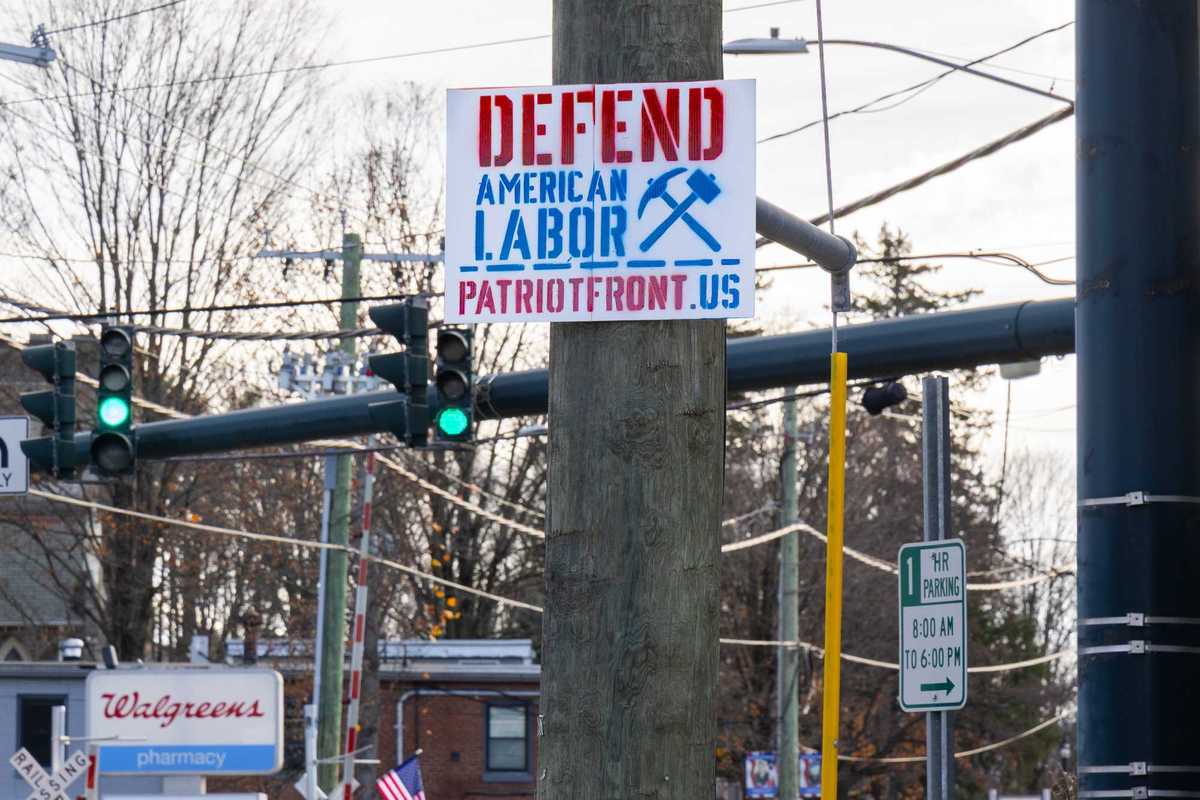
A Patriot Front sign hangs in front of the Canfield Building on Main Street in North Canaan on Wednesday, Nov. 11. The sign was removed later that day.
State police said they alerted the resident troopers in North Canaan and Salisbury, along with other troopers assigned to Troop B.
On Nov. 3, North Canaan residents Mary Riccardelli and Dean Saccardi spotted a sign near Canaan United Methodist Church and took it down. It read, “Strong families, strong nations” and displayed a white father, mother and child.
The two brought the sign home and repainted it with a message about community unity. “We’re gonna make it into a positive message about the community and unity as a nation,” Riccardelli said.
“This is messed up and not something that we should respect or keep on a pole in our town. We don’t have any room for that,” she said.
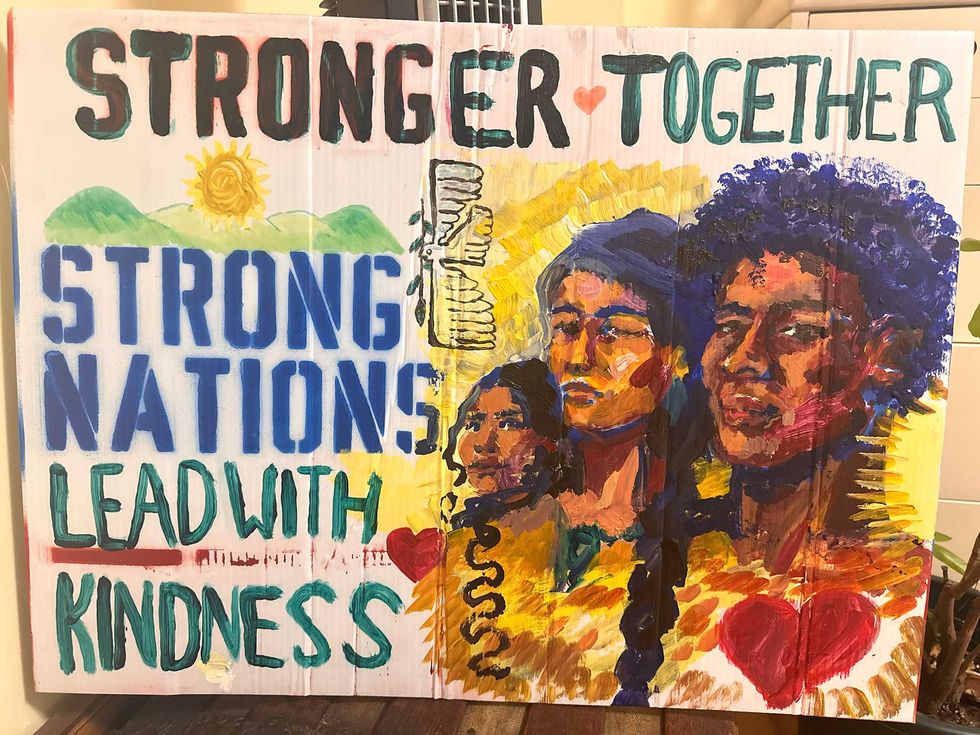 Some residents painted over a Patriot Front sign that had been removed and plan tohang it back up to spread a message of positivity and community.Provided
In its manifesto, Patriot Front says American identity is inherited through ancestry. It advocates for the preservation of white European culture.
On Saturday, Nov. 7, Ted Perotti, a North Canaan resident, noticed a sign by Bunny Maguire Park. It read, “Defend American Labor Patriot Front US.”
Perotti returned with Max Vadakin, his co-director at CanaanTV, and filmed as they removed, tore up and discarded the sign.
“When you see something like a hate group starting to put their messaging up, it’s really worrisome for us when we care so much about this town and what people think about this town too,” Perotti said.
“It haunts me to think of somebody from out of town driving through and seeing these signs and not feeling welcomed in Canaan,” he added.
State police said two more signs referring to Patriot Front were discovered on Nov. 12 near Route 126 and Main Street in Falls Village. They have been taken down.
Police said they referred that incident to hate crimes investigators.
Dave Barger, the Falls Village first selectman and a retired state police master sergeant, said about half a dozen signs had been taken down around the town.
Barger said he stood by the statement on the town’s website that reads, “Falls Village is committed to nurturing a welcoming community that respects the dignity and humanity of all of its neighbors and residents –regardless of race, ethnicity, nationality, age, economic status, religious beliefs, sexual orientation, gender identity, or differing abilities.”
State police said Troop B received no reports of similar signs in other towns in the Northwest Corner.
Other news outlets reported Patriot Front signs in Tolland earlier this year and have previously reported signs in Winsted, Naugatuck, Westport and Greenwich.
In North Canaan, Democratic Town Committee Chair Chris Jacques alerted First Selectman Jesse Bunce to the signs.
The following day, Bunce asked town crews to check all local roads and remove any similar signs they found. Crews found another sign in front of the Canfield Building on Main Street.
“We don’t support anything like this,” Bunce said. “Equal rights to everybody is how I feel.”



Want more of our stories on Google? Click here to make us a Preferred Source.