What is a strong leader? What current nation leaders are models of leader greatness — for what qualities? What is/would be a strong leader for the U.S. — what qualities, what behaviors, what actions?
Big questions, quandaries in the 2024 Presidential election year as political debates formal and informal have transitioned from policy choices of years past: abortion, guns, taxes, voting rights to choices about the country’s fundamentals, its foundation: democracy, freedom to worship/a secular state, no one above the law. Leadership is more than one man’s belief narrative, it is a man and a raft of supporters, advocates, exponents of power and influence. Leadership, presidential leadership, U.S. presidential leadership is daily being defined and wielded for voter persuasion in 2024.
Frequently over the past eight plus years, Strong Man leadership has been enviously trumpeted by a set of politicians, pundits, think tanks, at rallies, in speeches, in select media, in Project 2025, as best fitting the United States President. Strong Men are the shot callers, they solo make decisions, execute major actions, they delineate who has access, they distribute wealth. If possible, they build, direct and regally display their military. Any nation without them at the helm is stupid.
Trump spices his rally rhetoric with his interpretation of leadership being best exemplified by Strong Men leaders particularly Putin of Russia and Orban of Hungary.
Of Putin, the Republican Presidential nominee said at the time of the invasion of Ukraine: “I’d say that’s pretty smart. He’s taking over a country — really a vast, vast location, a great piece of land with a lot of people, and just walking right in.”
With a nod to Orban’s autocratic regime, this same Republican Presidential nominee praised “There’s nobody that’s better, smarter or a better leader than Viktor Orban.” He continued that Orban is controversial because Orban says : ‘This is the way it’s going to be,’ and that’s the end of it. Right? He’s the boss. No, he’s a great leader.” Since 2010, Orban has dismantled democracy in Hungary establishing a one-party illiberal state. Media, banking, and energy sectors are now owned and run by the state and select businessmen.
Neither Russia nor Hungary demonstrates high global ratings for their economy, life expectancy, standard of living.
— Russia is #1 in land and water mass in the world – twice that of Canada #2, U.S. #3 and China #4. Russia is reliant on massive natural resources: oil, gas, coal, metals. wheat.
— Russia, worldwide, is 9th in population at 144M vs U.S. # 3 with 340M after India and China each with over a billion. Both Hungary and Russia are experiencing unwanted population decline. Russian life expectancy is 7 years lower than that of other developed countries.
— Russia, worldwide, is ranked 11th for GDP, the measure of market value for all final goods and services. The U.S. is ranked #1. Hungary is ranked 53rd.
— Russia for GDP per capita (GDP divided by population) a measure of standard of living, places 65th in global ratings. The U.S. is ranked 6th. Hungary is 48th. Luxembourg is #1.
Trump and others admire leadership of Strong Men for their personal, unrestricted power, command, self-determined authority. Rarely if ever in lauding a Strong Man do admirers, including Trump, mention exemplary contributions of the Strong Man’s leadership to his people — their well-being, standard of living. When have we heard Putin himself extoll the betterment, the excellence of Russia as demonstrated by wide spread populous prosperity, employment of its well-educated work force, Russians living a longer life. Where are examples of Putin praising Russia’s innovative leadership in industries, new industries beyond the natural resources gifted in the land.
Strong refers to the power of the authoritarian to proclaim, control not references to the strength of his country’s standard of living. No Strong Man countries of the past including Mussolini’s Italy, Franco’s Spain or of the present Hungary, Russia, Philippines, North Korea sit at the apex of performance — economic, educational, health. Top positions in these arenas are taken by the world’s democracies. Strong Man nations do hold 4 out of the top 10 rated slots for military strength: Russia is ranked #2 to the U.S. at #1, China is #3. As a Strong Man, speak loud, wield a large stick.
In contrast to Strong Man leaders, democratic leaders recognize leadership as demonstrated by getting things done for the country and its citizens, for global security and health, for humanitarian values.
“For we are given power not to advance our own purposes, nor to make a great show in the world, nor a name. There is but one just use of power, and it is to serve people.”
— George W. Bush
“We cannot build our own future without helping others to build theirs.”
— Bill Clinton
“You must obey the law, always, not only when they grab you by your special place.”
— Vladimir Putin
Kathy Herald-Marlowe lives in Sharon.

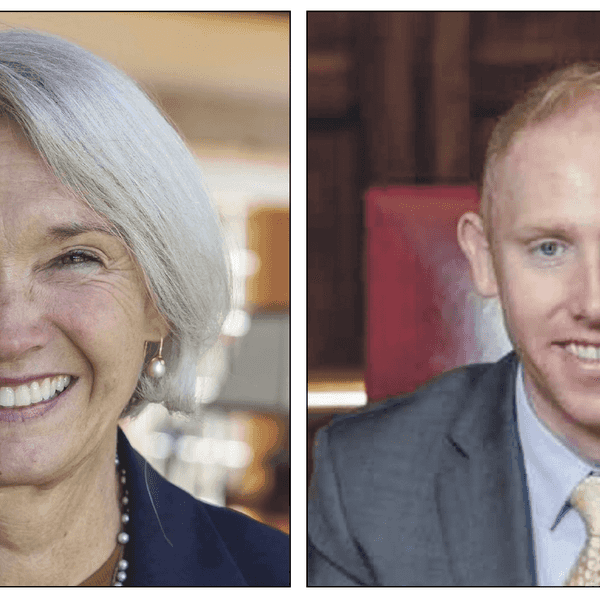
 Meg Sher, executive director of the David M. Hunt Library in Falls Village.L. Tomaino

 Samir LanGusProvided