Students SOAR in Salisbury

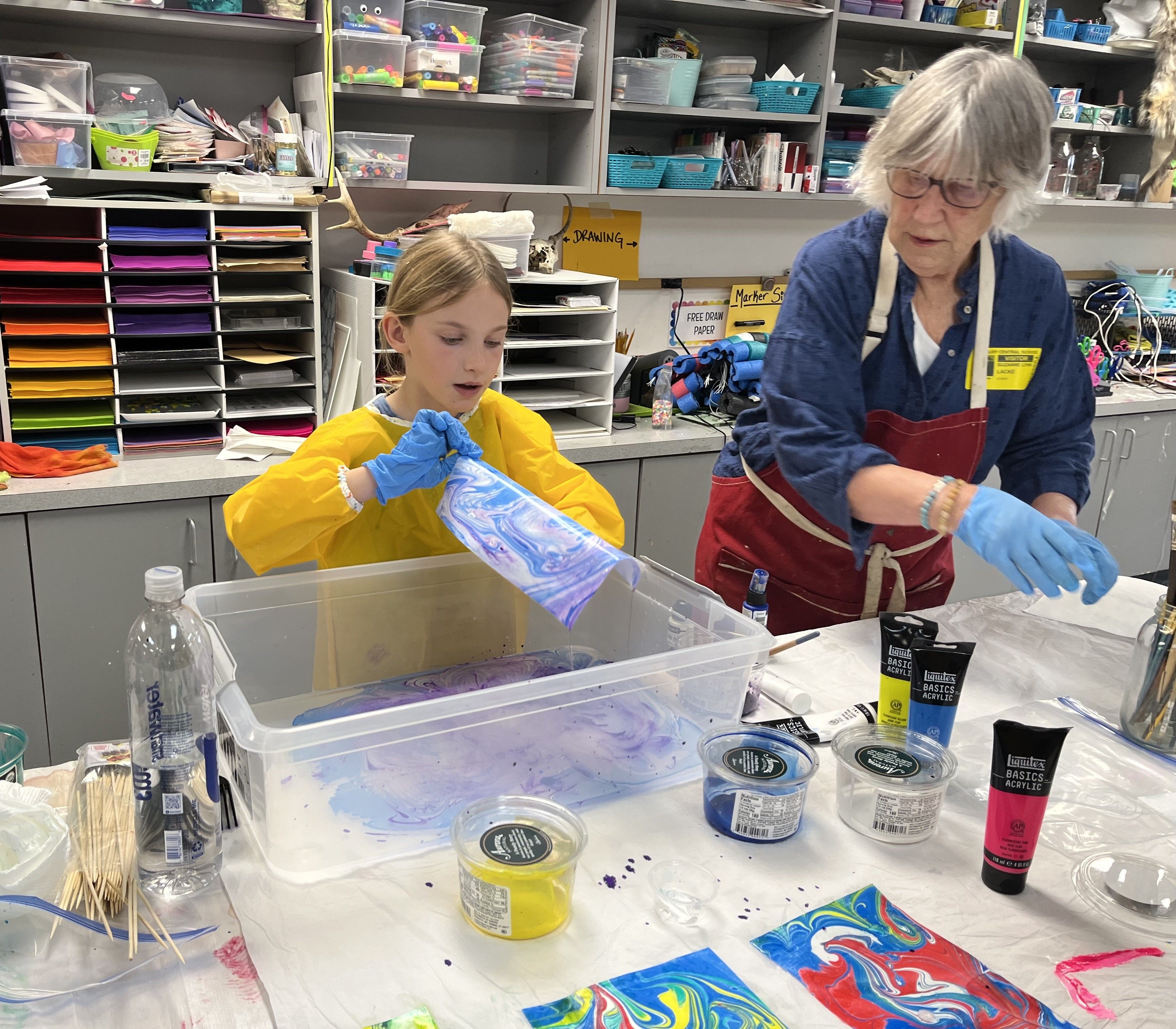
Papermaking with guest artist and teacher Suzanne Lynn Lacke.
Natalia Zukerman

Papermaking with guest artist and teacher Suzanne Lynn Lacke.
SALISBURY — For more than two decades SOAR (Seek Originate Aim Reach) has been helping Salisbury Central School students reach new heights.
A nonprofit founded in 2000 by Zenas Block, SOAR’s enrichment program provides supplemental education to fill the gaps left in traditional classroom curriculums.
In the 2023-24 school year, more than 100 students took SOAR classes each trimester.
The program’s offerings range from jewelry and bookmaking to abstract painting and gardening. More than a dozen classes are available each trimester to cater to a diverse selection of talents and interests.
“We want to provide options that resonate with every child,” said Executive Director Lauren Brown.
Brown’s vision for the program reflects her professional expertise and her deep understanding of the needs of students and their families.
“SOAR was always doing great things,” Brown shared, “but when COVID hit, it became a lifeline for families desperate for ways to keep their children engaged and connected.”
From remote dance classes to innovative online workshops, SOAR adapted to meet the evolving needs of its community.
Central to SOAR’s success is its partnership with Salisbury Central School, where “the support is amazing,” Brown shared. The school allows the program to utilize classrooms and collaborates on curriculum enhancement.
SOAR maintains a commitment to inclusivity and accessibility, making sure that no child is turned away due to financial constraints. With support from grants, donations and an endowment through the Berkshire Taconic Community Foundation, Brown explained.
“We do charge a nominal fee, but we offer financial aid, and we’ve gotten grants from Salisbury Family Services to help offset some of those requests. We’ve had more people request financial aid, which is great because we want every kid to be able to have the opportunity.”

Each session runs for six to eight weeks and prices range from $9 to $12 per class, which includes all materials. SOAR also provides teacher grants that makes things like field trips, speakers, and assemblies possible.
Looking ahead, Brown is planning for further expansion of the program, with a summer camp in the works and outreach to neighboring schools like Kent and Sharon Center Schools.
The demand for SOAR’s programs is evident, with enrollment numbers steadily increasing. “We’re trying to expand in ways that are meaningful and stay within our mission,” said Brown. “You know, we’ve got a great art program (at Salisbury Central School), but classes are only 45 minutes to an hour each week. There’s just a need for more,” she continued.
Through Brown’s enthusiasm and connections in the community, she has been able to bring in an impressive lineup of guest teachers. She shared, “I’ve gotten professional artists who have come in and maybe don’t have experience with kids and then do amazing work with them.”
Brown also opened the program to kindergarten students. Classes are typically once or twice a week and are an hour to an hour and a half in length.
Brown’s own journey in education is one from classroom teacher to administrator. Previously a third-grade teacher at Indian Mountain School where her wife still teaches, her transition to leading SOAR was driven by a desire to reassess her priorities, particularly in the wake of the challenges posed by the COVID-19 pandemic.
The shift couldn’t have come at a better time and Brown excitedly shared, “It was a big decision to leave the classroom…but now I’m able to balance my life and work and make connections with the community. It is really amazing.”
To find out more about the SOAR program, go to www.soarkids.org
Students of Salisbury Central School watch ski jumpers soar during an assembly with Salisbury Winter Sports Association Wednesday, Dec. 17.
SALISBURY — Representatives of Salisbury Winter Sports Association gave a presentation at Salisbury Central School Wednesday, Dec. 17.
Former U.S. Olympic coach Larry Stone explained the fundamentals of the unique sport of ski jumping and its long history in Salisbury, where he learned to jump.
“When I was growing up here there were actually eight ski jumps just in this town in addition to the three down at Satre Hill,” he said. He noted that this winter will be the 100th year of Jumpfest at Satre Hill, named for the Satre brothers who moved from Norway in the 1920s. “They brought their sport with them and the first ski jump was actually when one of the Satres skied off of a barn roof in the center of Salisbury to show people how to do it.”
Mentioning the upcoming Winter Olympics in Cortina/Milan, Italy, Stone spoke of legendary Salisbury ski jumper Roy Sherwood who competed at Cortina in the 1956 Olympics.

Students at SCS saw videos of ski jumpers training and competing. Stone invited up students who had jumped at Satre Hill and 14 stepped forward.
One student was Aerin Sheil, who was asked what it feels like to jump: “It kind of feels like you’re flying. It’s a really good feeling.”
Gus Tripler, another student, said, “It’s like you’re suspended in the air and can see everything.”
He said his record distance of 18 meters was set in Vermont.
The student remarks gave way to closing comments that emphasized the school’s partnership with the Salisbury Winter Sports Association.
“Our partnership with SWSA is one of the most incredible things about Salisbury Central School,” Principal John Conklin said as he closed the assembly. He encouraged the students to attend Jumpfest Feb. 6 to 8.

The Community Closet at HVRHS is open for students to take clothes for any reason during the school day.
What started with one unexpected donation of clothes has grown into a quietly impactful resource for all students at HVRHS: the Community Closet. Now located in a spacious area above the cafeteria, the closet offers free clothing to any student for any reason.
The idea began a few years ago when a community member reached out to the former superintendent wondering if anyone at the school could benefit from used clothing that would otherwise go to waste. The superintendent then got in contact with Rachel Novak, the school social worker. “Once I had all those bags of clothes in my room, I was like, ‘I should put this in a space,’” Novak said. Her simple idea eventually became a full-sized closet accessible to all students.
From the beginning, Novak envisioned the closet as an inclusive space. “It’s open to anybody, it’s not just based on economic needs,” she said. Sustainability also plays a role. “Thinking about the environment, some students like to thrift and just get clothes that way,” Novak said.
After the initial donation, contributions continued to grow. “I reached out to our staff members and faculty,” Novak said. The most consistent donations come from the faculty at HVRHS and a few community members who learned about the closet. Finding teenage-appropriate clothes has been a challenge. “I get a lot of donations that are nice, but I don’t think teenagers would want to wear them,” Novak said.
Another ongoing obstacle has been awareness. Many students don’t know the closet exists at all. “That’s been the hard part,” Novak said. “Getting it out to the wider community of the school.” Novak is looking for students and staff to spread the word. “It helps because our school nurse knows and other faculty members,” she said. “When they know a student needs something, they just bring them up.”
Looking ahead, she hopes to promote the space more actively. “When we come back from this break, I do plan to … get fliers and all that up and going,” Novak said. There may even be an upcoming expansion — she has discussed the possibility of turning part of the area into a food pantry. “That would be more of a need-based system for students,” she said. “But right now, promoting it is where I’m at.”
The Community Closet is well-stocked currently. “Just because of the amount of clothes I have, I’m not accepting any more donations until I clear some stuff out,” Novak said. She is still willing to make room for more fashionable, teen-friendly items donated by students. “That way I’ll have more teenager approved clothes.”
Above all, she wants students to know that no one is limited to using the space. “Sometimes there’s a stigma around it … like, ‘I don’t need help. I don’t want to take away from anybody else that may need it,’” Novak said. Due to the amount of clothes, students should feel welcome to use the closet for any reason. Some students even grab items last minute for sports and activities. “It’s important for kids to know it’s for everyone.”
Whether a student wants to thrift clothes sustainably, forgot to pack clothes for an after-school practice, or is in need of a new outfit, the Community Closet is a resource for all.
Sophomore Eliana Lang enjoys her Housy Shack cookie.
Now in its second year, the Housy Shack is a hit among students. The special education department-run store that sells warm cookies, drinks and other snacks to students and teachers draws people to a room in the back hallway every time it’s open.
The smell of warm cookies welcomes visitors to the store with snacks, drinks and even Housy merchandise for sale. The cookies are definitely the favorite, sometimes lines go out the door to get one before they sell out.
The cookies are so popular that the store had to increase prices from 50 cents to a dollar and implement a four cookie per person maximum. The Shack sells about 40-100 cookies per day and has about 20-60 HVRHS customers visiting per day.
Julie Browning and Heather Strid, two of the HVRHS faculty members that help run the Shack, said their goal was to create real-world job experiences as well as real-world shopping experiences for students at HVRHS. “Learning the skills to work in the world can be taught in a classroom, but the lessons are more meaningful and valuable when they are applied in real work situations, which is what we create through the school store,” Browning said.
The original purpose for the store seems to be working, as several students are learning important skills. Students said the store taught them skills like counting money, checking inventory and cleanliness along with social skills and customer service that could help in the professional world after high school.

As the store quickly became a hit, organizers were faced with the challenge of finding funding. “When we started planning to start the school store two years ago we needed money to buy equipment, supplies and food to start it up but were not sure how to get it,” Browning said. “Mrs. Strid came up with the idea of applying for a grant from the 21st Century Fund to help us get started and they were so generous.” That grant has been crucial to the success and growth of the school store.
Not only does the Housy Shack benefit the special education department, students said it fosters a sense of community throughout the school. “School store cookies are my favorite thing ever. They brighten up my day,” said Eliana Lang, a sophomore at HVRHS. Dayana, one of the student staffers at the Housy Shack, said her favorite part of working in the school store is when students come in to make purchases. She enjoys talking to them and ringing up their orders on the cash register. The Housy Shack brings people together and offers the opportunity for students to connect with each other.
As the school year continues, the members of the school store look forward to expanding their inventory by creating and selling a variety of Housy merchandise — t-shirts, sweatshirts, water bottles, and more. “I have had several students put in requests for certain hats, key chains, etc. … so there will be more of that to come,” Browning said. Last school year, profits were all invested back into the school store. “This year we are hoping to make more of a profit and will look to use the money that we make for field trips, outings as well as opportunities to donate and give back to the community,” Browning said. They also would like to use the school store to fundraise for other causes. “Right now we are collecting donations for The Little Guild Animal Shelter, so if anyone has pet supplies they would like to donate please drop them off in exchange for a cookie,” Browning said.