At Mad Rose Gallery, two exhibits invite a new way of seeing

Gallery director and artist Natalie Tyler
Natalia Zukerman

Gallery director and artist Natalie Tyler
Mad Rose Gallery in Millerton recently invited visitors to experience both of its current exhibits, “Ebb & Flow” and “The Female Gaze” with many of the artists in attendance.
The tour began with “Ebb & Flow,” an installation of glass works by Steven Weinberg, Lisa Sacco, Eric Hilton and Natalie Tyler. In the late-afternoon sun, the room became a kaleidoscope of bending, fracturing, flickering light. Color slid across the walls; reflections dissolved into shadow. It was a subtly instructive prelude to “The Female Gaze” next door as the glass didn’t just glow — it shifted the angle of attention, teaching the eye to notice differently.
The term “the female gaze” is attributed to feminist film theorist Laura Mulvey, who, in her 1975 essay “Visual Pleasure and Narrative Cinema,” named what Hollywood had long taken for granted: the camera — and by extension, the viewer — was aligned with a masculine subjectivity. Women existed on-screen largely as objects, not agents.
In the decades since, the “female gaze” has evolved into something more expansive. It signals authorship, yes, but also empathy, subjectivity, and the refusal to flatten lived experience into familiar tropes. It is not simply the opposite of the male gaze; it is another way of seeing altogether.
Mad Rose’s eight featured photographers explore this premise across mediums, histories and sensibilities using diverse approaches to challenge conventional narratives. The response has been so positive that the exhibit has been extended through Dec. 28.
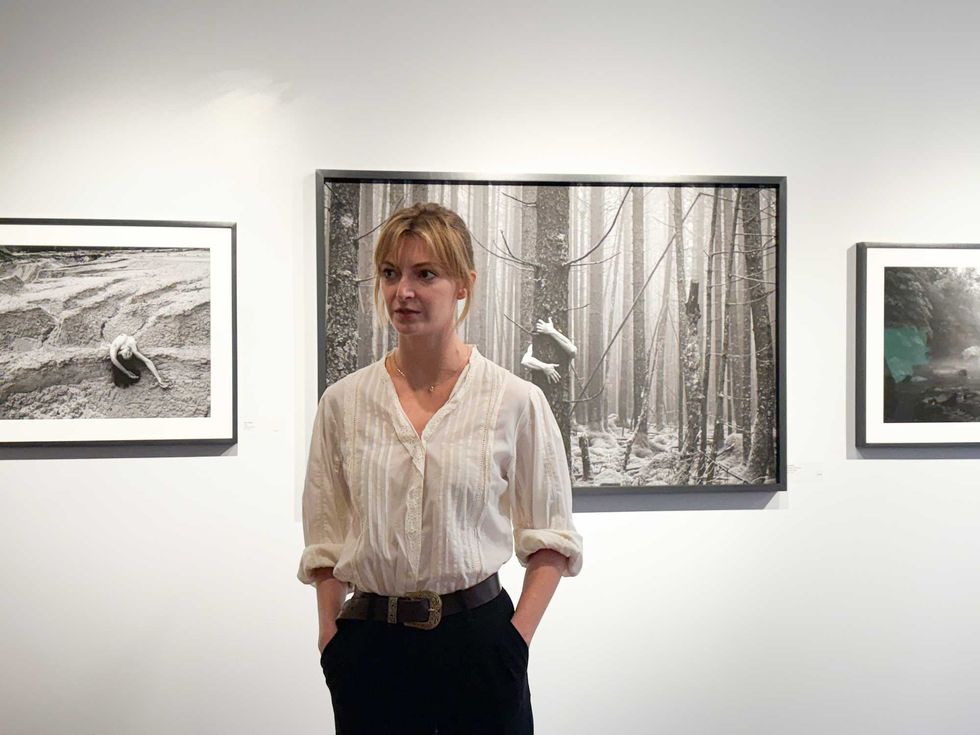
The tour began with Ava Pellor, whose large black-and-white portraits of bodies in nature rely on trust. She explained that she photographs with a tripod or a Rolleiflex so she “never breaks the connection with the subject.” The goal isn’t voyeurism, she said, but agency.
“What really shocks me is when people say, ‘I’ve never been photographed by a woman before,’ and then they thank me for letting them be who they are,” she explained. “That’s why I photograph the nude, to almost desexualize the female body, or the human body in general.”
The work explores the symbiotic, inseparable relationship between bodies and the natural world. “To live symbolically is to remember we are not apart from nature, but a continuation of it,” said Pellor.
Across from Pellor hang glossy and colorful images by internationally renowned fashion and costume designer, Han Feng. Co-founder of Mad Rose Neal Rosenthal spoke of her work saying, “I find her work exceptionally expressive and beautiful.”
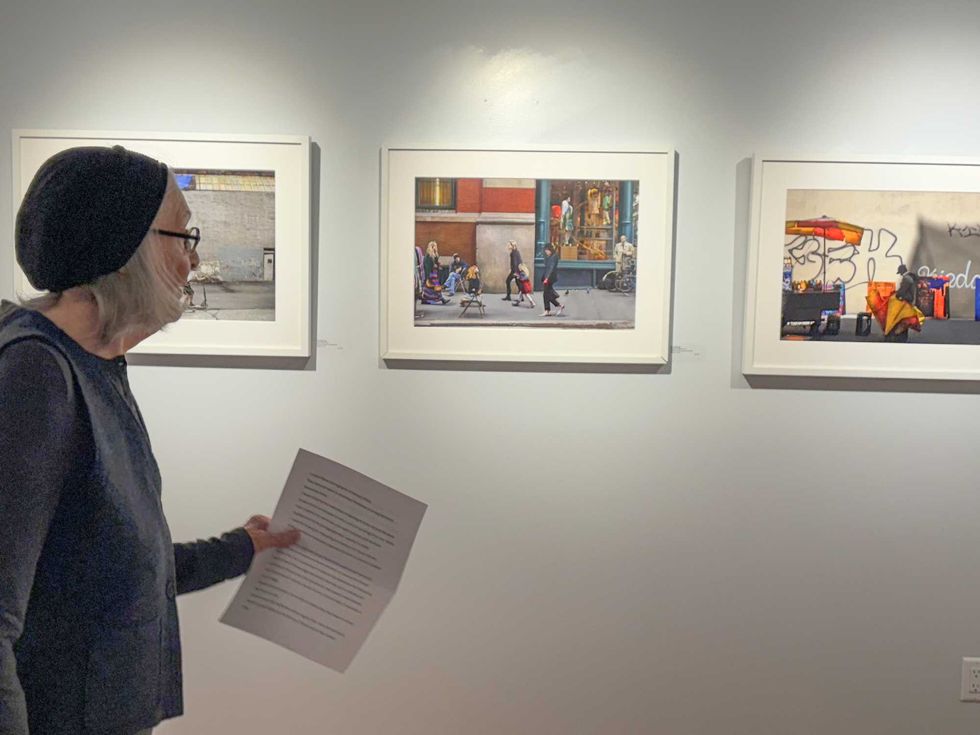
Next was Jan Meissner, a writer who discovered the camera could tell stories she couldn’t write. Her early-2000s street photographs were taken in Soho. “I’ve never staged a photograph in my life,” she said. Revisiting the images now was strange, she admitted, depictions of a city that no longer exists.“I don’t think I could make these photographs anymore. The terrain has changed and I have changed. It was a moment in time, and I thank Mad Rose for sending me back there.”
An abstract photographer and longtime human rights lawyer, Pamela Takiff brings a different kind of witnessing. Her work begins with overlooked textures — broken glass, peeling paint —then pares away context so the viewer’s imagination takes over.
A Guggenheim Fellow and recent Cleveland Arts Prize Lifetime Achievement Award recipient, Barbara Bosworth’s black-and-white images were made with her 8x10 camera. “I began looking for light in the darkness,” she wrote of the work, which circles family, land, and the thin veil between presence and memory.
Artist Beatrice PediconiNatalia Zukerman
Beatrice Pediconi’s work spans drawing, photography, painting and video, all organized around her investigations of water as medium. She describes the pieces on view, created between 2009 and 2016, as explorations of “the fragility of all life, highlighting its ephemeral condition.”
Barbara Woike, who spent 33 years as a news photo editor with the Associated Press, offered both history and perspective as she guided visitors through her nearly 50-year-old portraits. “All of these photographs were shot almost 50 years ago,” she said. All pre-digital, all grounded in the subject itself. “Back in the day, photography was more about realism. Even if an abstract picture was shot, it was still shot from something very real — a leaf, a pepper, a naked body twisted so that you’d pause and ask, ‘What is this?’ before realizing it was a body.”
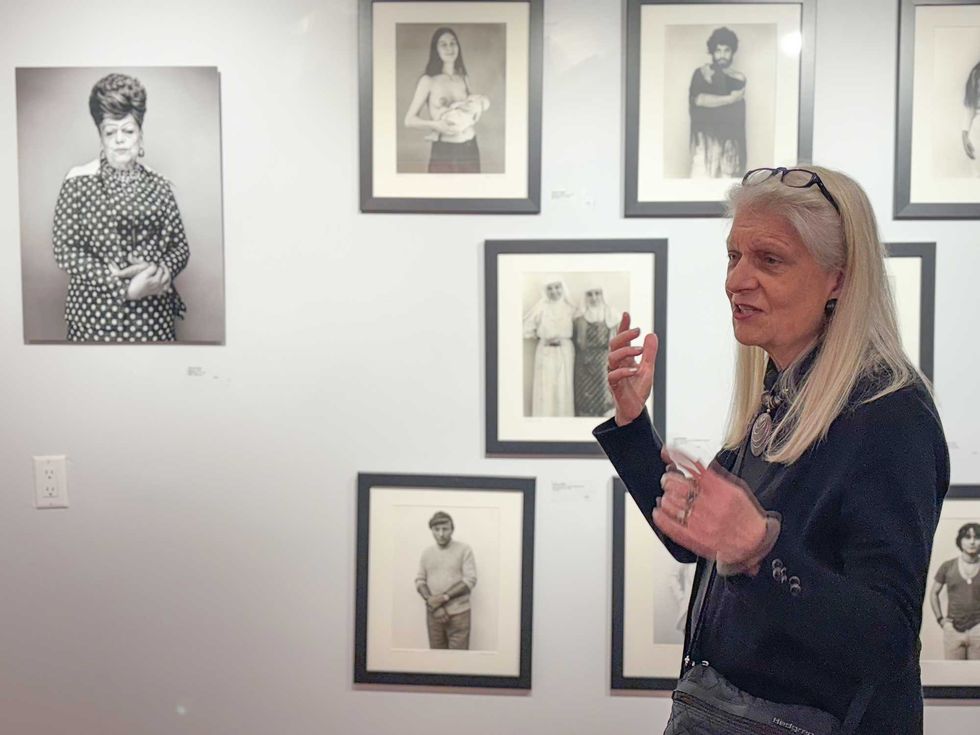
Woike’s career, she explained, grew from that foundation. When digital photography arrived, she witnessed its shift firsthand but stayed true to the ethos of capturing the moment. “Even though photography went digital, there was no alteration of images. I could have been fired for moving a Coca-Cola can out of a picture.”
Her work, she emphasized, has always been about the subject, not the photographer. “The work was about subject matter, not about me. Back then, people still argued whether photography was art at all. Someone might look at these pictures,” she said, gesturing to Beatrice Pediconi’s abstractions across the gallery, “and ask, ‘Is it photography?’ It’s about light, and what light can put into an image.”
Many of Woike’s subjects are no longer alive. “Some I never followed, others I knew until the day they died. That’s the power of portraiture — it lets people stay alive.”
One image holds particular weight: a portrait of Katherine “Sissy” Wells, the first trans person Woike met. When Woike posted the photograph on Facebook to mark what would have been Wells’ 108th birthday, hundreds of people responded with memories. In capturing Wells, Woike did more than preserve a face — she reframed perception, reminding viewers that the story beneath the image, like light through glass, is what makes it real.
The tour ended with Rosenthal speaking about his partner and gallery co-founder, Kerry Madigan’s work. Madigan, who has been making photographs since the 1970s, is experiencing aphasia due to cognitive impairment. Her images, preserved memories, form what Rosenthal described as “a bit of a travelogue of our experiences together traveling all over the world.”
Guests were then invited upstairs for the Mad Rose Winter Salon, featuring the work of local artists at various stages of their careers. Once again, viewers were reminded that perspective is never fixed. It shifts depending on where you stand, what you know, and who is doing the seeing.

An overflow crowd packed Kent Town Hall on June 27 for a scheduled vote on a proposed wakesurfing ban on Lake Waramaug, prompting then–First Selectman Marty Lindenmayer to adjourn the meeting without a vote.
KENT —In 2025, Kent officials and residents spent much of the year navigating zoning disputes, regional policy issues and leadership changes that kept Town Hall at the center of community life.
The year opened with heightened tensions when a local dispute on Stone Fences Lane brought a long-running, home-based pottery studio before the Planning and Zoning Commission.
While some residents raised concerns about increased vehicle traffic associated with the studio, the commission ultimately reaffirmed the town’s support for cottage industries and the local arts community, bringing Alison Palmer Studios into zoning compliance in April through the approval of a conditioned special permit.
During deliberations, then–Vice Chair Karen Casey said she would be “terribly upset if we all of a sudden prohibit artists from living in their homes and doing their artwork,” calling such work “part of our culture here.”
In the spring, the town released the results of a community survey on recreational cannabis that had been circulated since December 2024. Sarah Chase, chair of the Cannabis Regulation Subcommittee, said the responses reflected a community that was “cautious but open-minded,” supportive of medical access, respectful of farming traditions, and focused on preserving Kent’s character.
The survey guided both the development of zoning regulations governing medical cannabis facilities and agricultural uses, and a ballot measure prohibiting the retail sale of recreational cannabis within town limits. Voters approved the ordinance banning retail on the Nov. 4 general election ballot.
The warmer months brought Kent into a high-profile regional dispute over wakesurfing on Lake Waramaug. After unprecedented turnout forced the postponement of a June vote, a proposed tri-town ban involving Kent, Washington, and Warren was approved decisively on July 31.
In Kent, 83% of voters supported the ban, which is scheduled to take effect in February. An opposition group subsequently filed an appeal, which remains under legal review.
Regional cooperation continued over the summer as Kent and New Milford joined forces to address resident concerns about large tour buses traveling along the narrow, winding South Kent Road en route to Club Getaway. Collaboration among the two towns, local residents, Club Getaway, and the state Department of Transportation ultimately resulted in a ban on large commercial buses along the road and nearby access routes.
During the summer, overcrowding at a popular swimming hole on North Kent Road prompted then–First Selectman Marty Lindenmayer to close the road until cooler autumn temperatures reduced the volume of visitors. Town officials and other stakeholders overseeing the site said they plan to work together over the winter to develop a long-term solution.
The fall brought discoveries that shed light on Kent’s past. At Good Hill Cemetery, a weathered headstone bearing a partially faded inscription memorializing two Revolutionary War–era sisters drew historians and puzzle-solvers eager to decipher its message.
Meanwhile, in Emery Park, Parks and Recreation Director Matt Busse partnered with the state archaeologist to survey the area for evidence of historic coal-worker settlements, uncovering a largely undocumented chapter of the park’s rugged history.
Also in Emery Park, town officials reviewed and accepted a bid to redevelop the long-defunct swimming pond, which has been closed for six years.
October brought lighter moments, as the Connecticut Antique Machinery Association hosted its popular Fall Fest and SPARK events, drawing residents of all ages. The month concluded with Halloween festivities on Main Street, where costumed revelers turned out in force for a contest judged by horror-rock icon Rob Zombie.
November marked a transition in town leadership. Eric Epstein was elected as the first selectman following Lindenmayer’s decision not to seek reelection. The month also saw the resignation of longtime Planning and Zoning Commission Chair Wes Wyrick, who stepped down after two decades of service. Karen Casey was elected to succeed him as chair in December.
The new officers have a full agenda in 2026. A longstanding zoning dispute with antique auto dealership Motoriot, centered on employee and inventory vehicle parking, continues following the issuance of a cease-and-desist order in November. A revised site plan is scheduled to go before P&Z on Jan. 8. Also slated for discussion is an application from substance-use disorder rehabilitation facility High Watch, which has stirred strong community response, and a zoning challenge tied to a proposed warehouse-to-residential conversion on Lane Street near downtown.
NORTH CANAAN — The past year was marked by several significant news events.
In January, the town honored Bunny McGuire for her decades of service to the community with the renaming of a park in her honor. The field, pavilion, playground and dog park on Main Street later received new signage to designate the area Bunny McGuire Park.
In February, Town Clerk Jean Jacquier stopped reporting to work amid a legal dispute, triggering months of uncertainty at Town Hall. Her prolonged absence became the focus of multiple court cases, heightened political tensions in town, and fueled debate in the lead-up to the municipal election. Following the election, Jacquier returned to her position and served through the remainder of her duly elected term.
In April, North Canaan Elementary School marked the 35th anniversary of its Arbor Day celebration, alongside the 55th anniversary of Earth Day, with the planting of a chinkapin oak as the newest addition to the school’s arboretum.
In May, the Becton, Dickinson and Company facility in North Canaan was evacuated after a hazmat scare. An employee identified a suspicious package, which resulted in a lock down and about 300 employees entered decontamination protocol, requiring them to leave clothing behind and shower before going home. The FBI transported the package from the facility to the state laboratory in Rocky Hill and all testing for active agents came back negative.

Memorial Day brought the community into town for a day of remembrance. The parade marched from Town Hall to the Doughboy statue, where residents gathered to pay respects to fallen members of the armed services.
Town commissions approved the construction of a new Dunkin’ location across from the Stop & Shop plaza on Main Street. The proposal calls for a roughly 2,000-square-foot rectangular building with 16 parking spaces and a drive-thru. Once the new site opens, the existing Dunkin’ inside the nearby gas station will close.
In July, Bunny McGuire Park was transformed into a carnival as community events unfolded across town, culminating in a parade and a grand fireworks display.

In August, Old Railroad Days made its debut, bringing the town’s rail heritage to life through four days of tours, exhibits and demonstrations. Throughout the celebration, Canaan Union Station pulsed with activity as residents and visitors gathered to take part.
At Geer Village, chef Gina Trivelli-Young opened Manna Catering in the café space formerly occupied by Railway Café. “A lot of my food is geared toward health, the nourishment of mind, body and soul,” said Trivelli-Young.
Geer also announced a “strategic partnership” with Integritus Healthcare, a 501 (c) 3 charitable organization and post-acute healthcare industry leader based out of Pittsfield. Integritus will become the management company for the Geer Village campus of services and Geer will remain the owner/operator of the programs and services, with Integritus Healthcare providing oversight.
New playground equipment was installed at NCES, which has been put to good use since school came back into session.
Douglas Library Director Norma DeMay announced her retirement from the role this year. “I’ve loved my job,” she said, full of praise for her staff and board members. “I love chatting with the people who come in. And you can’t beat a 9-minute commute.” DeMay was succeeded by Laura Moran.
Residents gathered at Colonial Theatre in October for the Canaan Foundation’s 25th anniversary, as well as a celebration of the town. The foundation was formed by a group of local citizens with a mission to enhance the quality of life for townspeople. This year a total of 24 grants were issued for a total of $28,500.
The Community Thanksgiving Dinner at the Pilgrim House provided nourishment and camaraderie for both guests and volunteers alike. Jeanine Coleman is a loyal server each year. “It’s my favorite time of year,” she said. “I love doing this.”
The Parade of Lights followed the weekend after Thanksgiving, which ushered in the holiday season. Cub Scouts donned their Santa Claus hats on Sunday, Dec. 7, at NCES to host a pancake breakfast with Santa.
The year was also marked by the election of a new first selectman, as challenger Jesse Bunce edged out incumbent Brian Ohler by two votes in a closely watched race.
In May, Cornwall residents gathered at the cemetery on Route 4 for a ceremony honoring local Revolutionary War veterans.
CORNWALL — The year 2025 was one of high spirits and strong connections in Cornwall.
January started on a sweet note with the annual New Year’s Day breakfast at the United Church of Christ’s Parish House. Volunteers served up fresh pancakes, sausage, juice, coffee and real maple syrup.
February brought a focus on housing, as legislators, local officials and affordable housing advocates gathered on a cold morning Feb. 7 on Town Street to celebrate the launch of a regional affordable housing program.
State Rep. Maria Horn, D-64, said, “What better than a cold, windy day to remind you of the importance of having a warm home,” she said.
Two new homes were completed later in the year on Town Street, and the Cornwall Housing Corporation invited the community to an open house celebration.
On the housing front, the Planning and Zoning Commission also worked throughout 2025 to address regulations that may have been restricting new home construction in town.
In March, a heroic effort by bystanders likely saved the life of a driver in a one-car accident on Route 7. The car had struck a utility pole and was surrounded by live wires when nearby residents rushed to help.
“The woman was pulled from the car with, by my estimate, 90 seconds to spare before the flames would have reached her,” said Kent Volunteer Fire Department Chief Alan Gawel.
Two of the responders, Niya Borst and Emil Urbanowicz, both students at Housatonic Valley Regional High School, were recognized in front of the student body. Borst said she and her aunt used a sledgehammer to break the rear window in an attempt to free the driver.
In April, Cornwall Consolidated School’s 7th graders completed a research project honoring Naomi Freeman, Cornwall’s first Black female landowner. As part of the project, a portion of Great Hollow Road was renamed for Freeman on an honorary basis.

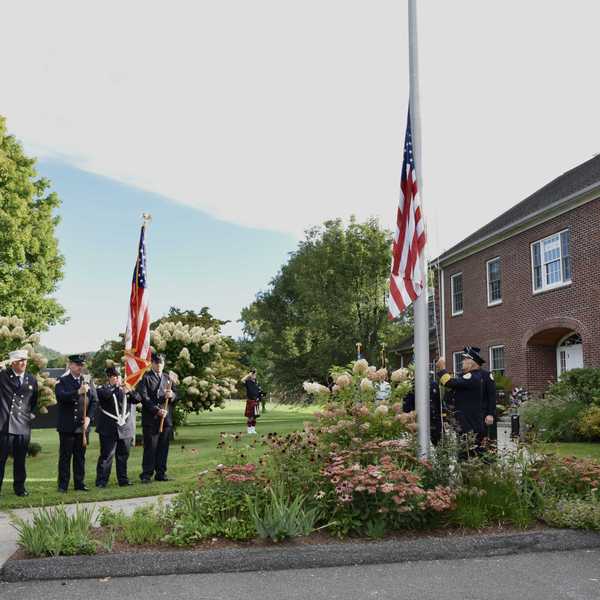
In May, Cornwall held a powerful ceremony to honor local veterans of the Revolutionary War and replaced 10 refurbished grave markers in the cemetery on Route 4.
Cornwall’s Manny Matsudaira earned valedictorian honors at HVRHS.
The Village Green was the destination for summer fun with July Fest, Taste of Cornwall in August and the Agricultural Fair in September.
In the fall, Cornwall Volunteer Fire Department launched a major fundraising campaign to replace two outdated firetrucks. The effort was a huge success and CVFD successfully met its goal of $600,000.
At the fire department’s open house in October, Resident Richard Schlesinger spoke of his experience being rescued by the volunteer ambulance corps after experiencing cardiac arrest about four years ago. “They saved my life because they had the right equipment and the dedication and the skill.”
December saw the addition of a new event in Cornwall: The Parade of Lights. The illuminated procession brought cheer and joy as Cornwall concluded another trip around the sun.
Matthew Yanarella shows children and adults how to make cannoli at the Hunt Library on Sept. 12.
FALLS VILLAGE — The year 2025 saw some new faces in town, starting with Liz and Howie Ives of the Off the Trail Cafe, which took over the town-owned space at 107 Main St., formerly occupied by the Falls Village Cafe.
As the name suggests, the café’s owners have made a point of welcoming Appalachian Trail hikers, including be collaborating with the Center on Main next door on an informal, trail-themed art project.
The Center on Main also welcomed a new face in 2025, with Britta Sallik joining the organization as its community connections manager.
Farther up Main Street, the David M. Hunt Library brought on Anna Pattison as its new assistant director and youth programming coordinator.
At the Congregational Church, parishioners marked the end of an era as the Rev. Rich Reifsnyder presided over his final service on Sunday, Oct. 12. Reifsnyder, who began his tenure in February 2018, said the position was initially intended to be short-term.
“A couple of Sundays here and there,” he said. “Then it sort of developed.”
In 2025, Hunt Library kept its calendar full with a wide range of well-attended programs, many of which spilled outdoors during the warmer months.
Highlights included a cannoli-making workshop with Matthew Yanarella, who wisely took the somewhat messy demonstration outside.
The library also hosted a series of outdoor summer concerts, culminating in an entertaining and unexpected open mic night on Aug. 8.
Programming extended beyond the arts and culinary pursuits as well. On April 16, Pat Campbell of Educated Canines Assisting with Disabilities (ECAD) visited the library with Titan, a golden retriever–Labrador mix, offering a demonstration of how service dogs are trained.
On March 22, Zarifa Adiba, a musician from Kabul, Afghanistan, and the author of Playing for Freedom: The Journey of a Young Afghan Girl, spoke at the library about her journey from the dangerous streets of Kabul to a new life in Flushing, New York.

Vehicles of all sorts filled the downtown streets twice over the summer. The Falls Village Car and Motorcycle Show on July 13 attracted more than 600 entries and more spectators than ever, according to organizer Judy Jacobs.
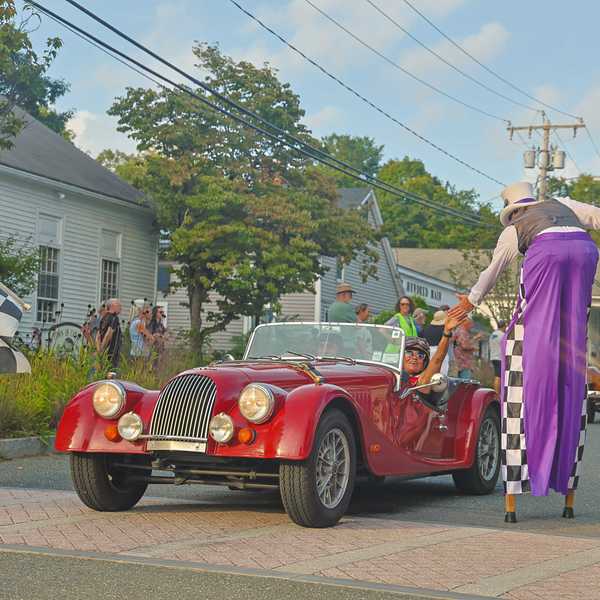
And the vintage race car parade on Aug. 28 wound through Salisbury and Lakeville before finishing up in downtown Falls Village. Featured this year were vintage vehicles from the early 20th century, courtesy of the Rag Time Racers, a California-based group of race car enthusiasts specializing in very early vehicles.

Over at Housatonic Valley Regional High School, work began on a “land lab” for the Agricultural Science and Technology Education Department when students cleared brush at the newly acquired, two-acre plot of open field and woodland a half mile up Warren Turnpike on Sept. 22. The area is planned to be a native forest management area meant to teach students about the health and maintenance of an ecosystem.
The Emergency Services Center hosted a special Planning and Zoning Commission meeting with the Falls Village Housing Trust and Habitat for Humanity on Nov. 5. The two housing groups provided an update on the status of affordable housing developments on River Road, with the Trust’s Jandi Hanna saying she expects to break ground in 2026. Bob Whalen of Habitat said his organization will be filing an application for either houses or duplexes some time in 2026.
Meanwhile, First Selectman Dave Barger responded to resident complaints about the town’s electric vehicle charging rates by pushing the device’s supplier for a reduction.
By the end of July, the price per kilowatt-hour had fallen from $1.45 to between 45 and 49 cents.