Audubon talk promotes upside of dark skies

Audubon talk promotes upside of dark skies

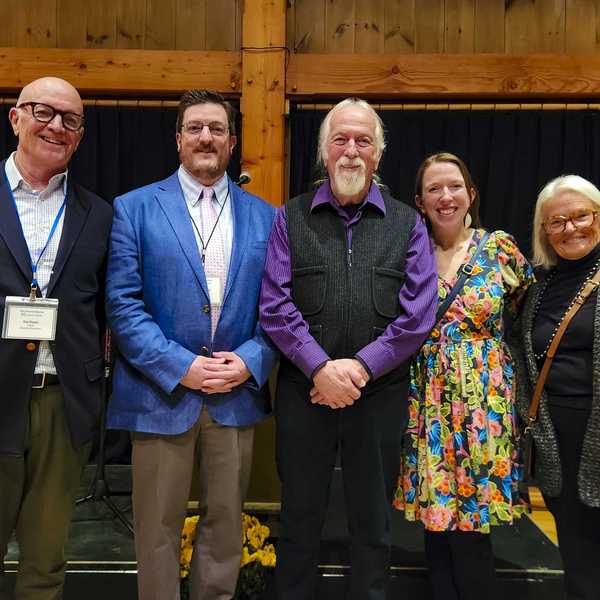
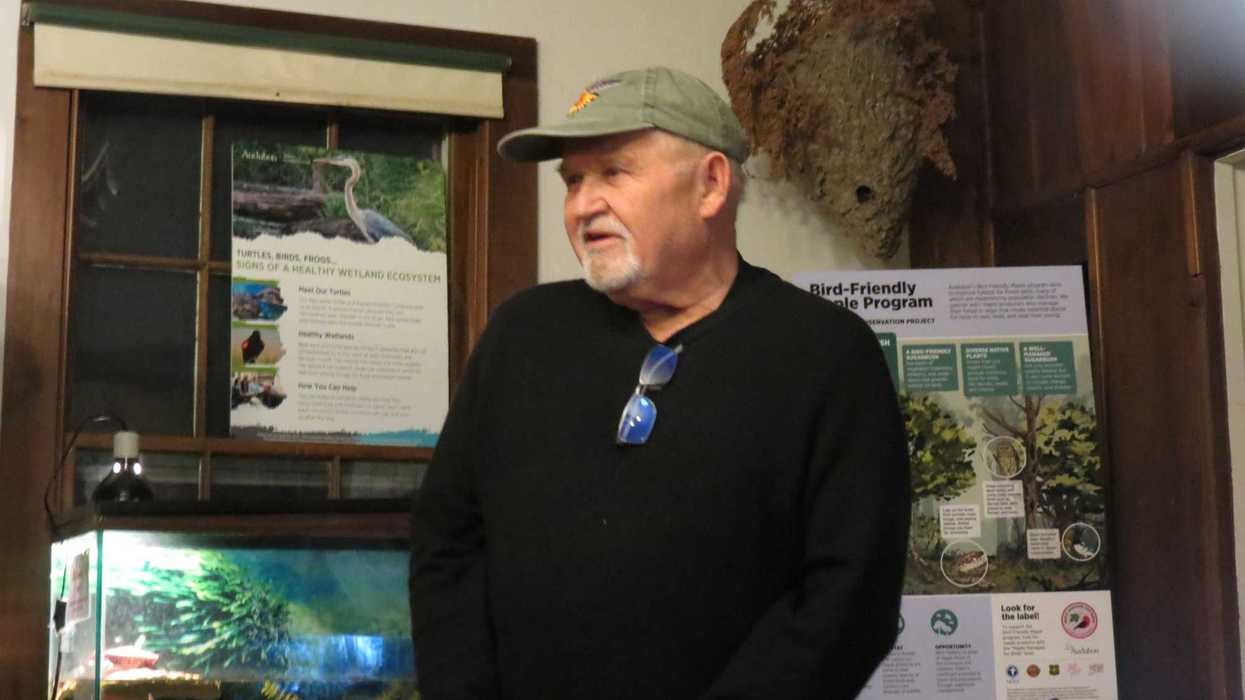
Leo Smith of Dark Sky Connecticut speaks at the Sharon Audubon Center on light pollution.

Ruth Epstein

SHARON — Leo Smith believes everyone has the right to look up and see a sky full of stars. But that is not always the case, and he spends his time working toward that goal for future generations.

Smith gave a talk on Thursday, Feb. 26, titled “Light Pollution: Its Adverse Impact on the Ecology and Ways to Minimize It,” as part of Sharon Audubon’s Policy Potluck Education series, the first of this season.

He began by noting that he had once lived in an 1859 farmhouse in Suffield and had great concerns about the glare that might be emitted when the turf farm behind his property was sold for development.

It was then that he got involved in the nonprofit Dark Sky Connecticut, which advocates for reducing light pollution through policy, education and lighting regulations. Members promote sustainable, shielded outdoor lighting to protect wildlife, improve human health and restore the night sky, often collaborating with local Audubon societies.

“Everything needs light, and darkness is as critical as light,” he said. “We’re working to get the state legislature to understand that natural darkness is a natural resource.”

Misdirected light results in glare, he said, diminishing visibility. Overlighting is also a problem, often driven by regulations that require more illumination than necessary. In most cases, he said, it is not intentional but stems from a lack of awareness.

“Light pollution has consequences for all wildlife,” said Smith. “Artificial light causes them disorientation.”

Birds migrate at night and use the moon and stars to help avoid predators. Many are nocturnal and need darkness to thrive.

Trees, as well as human health, can be affected by light pollution, with studies showing that lower light levels can reduce melatonin levels. There are also connections to light and Alzheimer’s and heart disease, said Smith. He encourages the use of timers and sensors to extinguish lights with regularity.

Streetlight plans for municipalities should be encouraged, but most standards are put in “willy-nilly,” Smith said. He explained that Connecticut was the first state to enact light pollution laws along state roads in 1999, but there is a need for stricter enforcement.

The state’s Building Code has a light pollution control amendment for all buildings other than one- or two-family homes.

One hundred and four of the state’s 169 towns have planning and zoning regulations that deal with outdoor lighting.

“Once again, it’s about enforcement,” he said, “but most developers will comply since they want approval of their applications.”

Smith works with other similar organizations, including Lights Out Connecticut and the Alliance to Reduce Light Pollution in Connecticut.

The next in the Audubon series will be on March 19, when tick-borne diseases will be the topic.
Latest News

Living art takes center stage in the Berkshires

Contemporary chamber musicians, HUB, performing at The Clark.

D.H. Callahan

Northwestern Massachusetts may sometimes feel remote, but last weekend it felt like the center of the contemporary art world.

Within 15 miles of each other, MASS MoCA in North Adams and the Clark Art Institute in Williamstown showcased not only their renowned historic collections, but an impressive range of living artists pushing boundaries in technology, identity and sound.

Keep ReadingShow less
Persistently amplifying women’s voices

Francesca Donner, founder and editor of The Persistent. Subscribe at thepersistent.com.

Aly Morrissey

Francesca Donner pours a cup of tea in the cozy library of Troutbeck’s Manor House in Amenia, likely a habit she picked up during her formative years in the United Kingdom. Flanked by old books and a roaring fire, Donner feels at home in the quiet room, where she spends much of her time working as founder, editor and CEO of The Persistent, a journalism platform created to amplify women’s voices.

Although her parents are American and she spent her earliest years in New York City and Litchfield County — even attending Washington Montessori School as a preschooler — Donner moved to England at around five years old and completed most of her education there. Her accent still bears the imprint of what she describes as a traditional English schooling.

Keep ReadingShow less
Jarrett Porter on the enduring power of Schubert’s ‘Winterreise’
Baritone Jarrett Porter to perform Schubert’s “Winterreise”
Tim Gersten

On March 7, Berkshire Opera Festival will bring “Winterreise” to Studio E at Tanglewood’s Linde Center for Music and Learning, with baritone Jarrett Porter and BOF Artistic Director and pianist Brian Garman performing Franz Schubert’s haunting 24-song setting of poems by Wilhelm Müller.

A rejected lover. A frozen landscape. A mind unraveling in real time. Nearly 200 years after its premiere, “Winterreise” remains unnervingly current in its psychological portrait of isolation, heartbreak and existential drift.

Keep ReadingShow less
google preferred source

Want more of our stories on Google? Click here to make us a Preferred Source.

A grand finale for Crescendo’s 22nd season

Christine Gevert, artistic director, brings together international and local musicians for a season of rare works.

Stephen Potter

Crescendo, the Lakeville-based nonprofit specializing in early and rarely performed classical music, will close its 22nd season with a slate of spring concerts featuring international performers, local musicians and works by pioneering composers from the Baroque era to the 20th century.

Christine Gevert, the organization’s artistic director, has gathered international vocal and instrumental talent, blending it with local voices to provide Berkshire audiences with rare musical treats.

Keep ReadingShow less

Leopold Week honors land and legacy

Leopold Week honors land and legacy

Aldo Leopold in 1942, seated at his desk examining a gray partridge specimen.

Robert C. Oetking

In his 1949 seminal work, “A Sand County Almanac,” Aldo Leopold, regarded by many conservationists as the father of wildlife ecology and modern conservation, wrote, “There are some who can live without wild things and some who cannot.” Leopold was a forester, philosopher, conservationist, educator, writer and outdoor enthusiast.

Originally published by Oxford University Press, “A Sand County Almanac” has sold 2 million copies and been translated into 15 languages. On Sunday, March 8, from 3 to 5 p.m. in the Great Hall of the Norfolk Library, the public is invited to a community reading of selections from the book followed by a moderated discussion with Steve Dunsky, director of “Green Fire,” an Emmy Award-winning documentary film exploring the origins of Leopold’s “land ethic.” Similar reading events take place each year across the country during “Leopold Week” in early March. Planning for this Litchfield County reading began when the Norfolk Library received a grant from the Aldo Leopold Foundation, which provided copies of “A Sand County Almanac” to distribute during the event.

Keep ReadingShow less
Millbrook dance party draws nearly 80 to Village Hall

Impressive dance moves were displayed by Village Trustee Shannon Mawson who added a visual flair of fabric in motion at Club Friendly, a community dance at Village Hall on Friday, Feb. 27.

Leila Hawken

Nearly 80 residents filled Village Hall on Friday, Feb. 27, for a two-hour community dance party organizers hope will become a recurring event.

The gathering, dubbed “Club Friendly,” transformed Village Hall into a lively dance space with colorful décor, upbeat lighting and a steady mix of tracks spun by local DJ Christopher James. Serving as emcee, James kept the energy high and encouraged dancers of all ages to take to the floor.

Keep ReadingShow less
google preferred source

Want more of our stories on Google? Click here to make us a Preferred Source.

google preferred source

Want more of our stories on Google? Click here to make us a Preferred Source.