Community groups showcase enduring commitment to Kent’s future

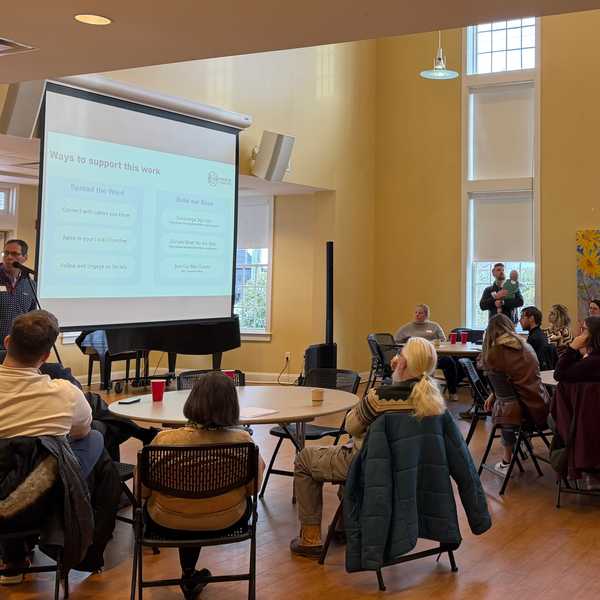
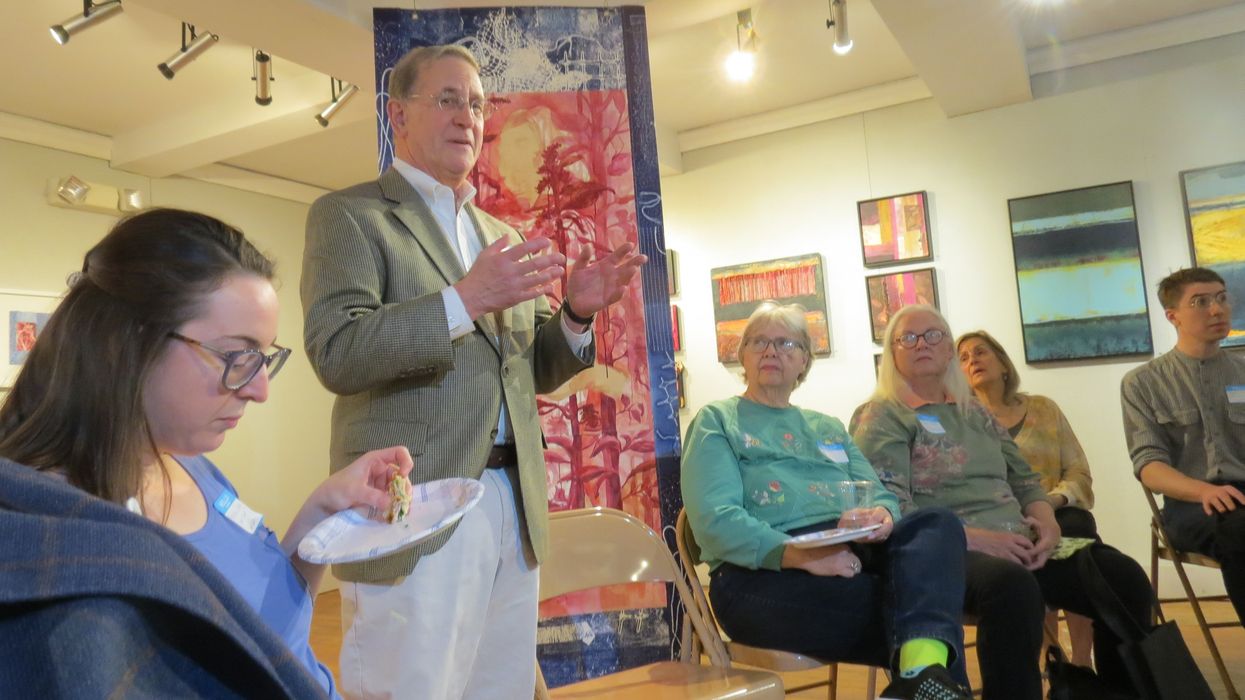
Chuck Goldberg of Kent Affordable Housing leads a gathering at which Kent’s nonprofits spoke about the missions of their groups.
Ruth Epstein

Chuck Goldberg of Kent Affordable Housing leads a gathering at which Kent’s nonprofits spoke about the missions of their groups.
KENT — Volunteerism is the engine that makes towns run.
Without the civic organizations whose missions cover a wide swath of objectives, communities would not be as rich and welcoming as they are.
This was apparent Thursday, May 1, as the Kent Chamber of Commerce gathered representatives from the town’s nonprofits to talk about the services and activities they offer. The discussion was led by Charles Goldberg, who said the purpose of the meeting was to let everyone know what each group was doing and encourage cooperation.
“There are wonderful outcomes when people get together to make things happen,” he said.
Goldberg was there as part of Kent Affordable Housing, which is now focused on a project to erect 13 rental units on a 1.59-acre parcel that was ceded to the group by the town. The land sits adjacent to Kent Commons and the design will consist of one building with an elevator.
Members of the Kent Garden Club described how they work to beautify the town by putting plantings around the Civil War monument and the welcoming signs at the four entrances to the village, among other initiatives. When president Nancy Schaefer said the club was established in 1933, that led to a friendly competition as to which organization was the longest standing.
Sarah Marshall, executive director of the Kent Memorial Library, spoke about the renovation and expansion project for which the groundbreaking is expected this fall. The plan is to annex the old firehouse next door, where an 80-person community room will be placed upstairs, as well as two small meeting rooms. The aim of the Kent Community Nursery School, located in the parish house of St. Andrew’s Episcopal Church, is to bring play and nature back to early childhood, said Anna deRham, co-director.
The Kent Art Association, which hosted the event, has monthly shows featuring a host of mediums. It was established in 1923 by nine well-known artists. The gallery on South Main Street was once part of the old Kent Inn and was moved to its current site in 1976. High Watch Recovery Center was founded in 1935, serving those with alcohol and drug addiction.
“We got this,” exclaimed K.C. Compton, who serves as parish secretary at St. Andrew’s, referring to being the oldest organization in the room. It is celebrating its 200th anniversary this year. “We really want to become a community hub, where everyone is welcome,” she said.
The Kent Lions Club is 48 years old, said President Karren Garrity. She said it basically helps fund such causes as the environment, cancer and eyesight. “We hold events to raise money so we can give it away,” she said. Connie Manes, executive director of the Kent Land Trust said that group doesn’t just protect nature, but seeks to engage people. It owns or has conserved 12,000 acres.
The Kent Chamber of Commerce runs a community calendar to let residents know where and when events are happening, which helps to prevent conflicts. Its not just about promoting businesses, but bringing people and nonprofits together to make Kent a destination point, said its members.
While the Kent Historical Society is not 200 years old, said curator Marge Smith, it is the repository of 250 years of documents and information. The Kent Quilters use their talent to create quilts that help raise funds for nonprofits.
Others who were in attendance were representatives of the Eric Sloane Museum, Trades Up, whose goal is to get youngsters to use hand tools, Kent Curiosity Lab, an enrichment program for Kent Center School students, and Kent Dispatch, an online community newspaper.

TACONIC — Richard Charles Paddock, 78, passed away Friday, Jan. 2, 2026, at Charlotte Hungerford Hospital.
He was born in Hartford on April 12, 1947 to the late Elizabeth M. Paddock (Trust) and the late Charles D. Paddock. He grew up in East Hartford but maintained a strong connection to the Taconic part of Salisbury where his paternal grandfather, Charlie Paddock, worked for Herbert and Orleana Scoville. The whole family enjoyed summers and weekends on a plot of land in Taconic gifted to Charlie by the Scovilles for his many years of service as a chauffeur.
Dick graduated from East Hartford High School in June of 1965 and went on to join the Class of 1969 at the Massachusetts Institute of Technology. He graduated from MIT with a degree in Electrical Engineering and followed in his father’s footsteps by accepting a job with IBM in 1969. His career at IBM spanned 31 years and involved everything from supercomputers to single chip microcomputers.
He formally retired from IBM in 2000 but stayed on at IBM as a contract employee for the IBM Executive Briefing Center in Poughkeepsie, New York. His work at the briefing center ended in July 2002 and he finally had time to pursue other interests. Those interests included the iron industry of the Northwest Corner and the Central New England Railroad which passed through Taconic from 1871 until 1965.
Dick joined the Friends of Beckley Furnace in 2003 where he helped develop educational programs with the late Ed Kirby and designed and produced interpretive signs to explain the site to visitors, spending most summer Saturdays as a docent at the site. He also joined the Historical Society branch of the Salisbury Association where he assisted in the preparation of numerous books, the oral history and interpretive signs for the Salisbury area. He also served several terms as a Trustee for the Association. Other activities included teaching courses for the Taconic Learning Center and The Bard Lifetime Learning Center and being a frequent speaker in the area on various topics such as the railroads, the iron industry and the industrial heritage of the area.
He leaves behind his wife and best friend, Frances Paddock of Taconic, two stepchildren; David Rosell of Greenville, New York, his son, Sterling of Tivoli, New York; Alicia Rosell of Dalton, Georgia, her daughters, Mary Rosell and Paula Gordon, also of Dalton, and his very large family of in-laws and many friends.
There will be no funeral services at this time. Ryan Funeral Home, 255 Main St., Lakeville, is in care of arrangements.
If you would like to remember Dick, please contribute to Friends of Beckley Furnace, P.O. Box 383, East Canaan, CT 06024, or the Salisbury Association (https://salisburyassociation.org/ways-to-support/donate/)
To offer an online condolence, please visit ryanfhct.com
SALISBURY — Richard Paddock, a longtime Salisbury resident whose deep curiosity and generosity of spirit helped preserve and share the town’s history, died last week. He was 78.
Paddock was widely known as a gifted storyteller and local historian, equally comfortable leading bus tours, researching railroads or patiently helping others navigate new technology. His passion for learning — and for passing that knowledge along — made him a central figure in the Salisbury Association’s Historical Society and other preservation efforts throughout the Northwest Corner.
“He was an incredible storyteller,” said Salisbury Association Executive Assistant and Historian Lou Bucceri, who co-chaired the association’s historical society with Paddock. He remembered the bus tour of Twin Lakes that Paddock led that was so popular a second one had to be scheduled. He also was instrumental, along with Bill Morrill, in obtaining a Revolutionary War cannon for the association.
The Twin Lakes neighborhood was central to Paddock’s life, where he spent summers as a young boy. His family’s ties to the area stretched back generations. His grandfather, Charles Paddock, lost his wife and three of his four children during the influenza epidemic of 1917, leaving him to raise an 8-year-old son — Paddock’s father.
Charles Paddock later found work as a chauffeur for the family of Herbert Scoville Jr., who maintained a mansion in Taconic. Scoville, a trained scientist, spent years working for the CIA before serving with the Arms Control and Disarmament Agency, and became a tireless advocate for nuclear disarmament in the latter part of his life.
In a 2016 interview with Jean McMillen, who recorded more than 400 oral histories of Salisbury residents, Paddock reflected on the Scoville family’s generosity, noting that several longtime employees — including his grandfather — were granted an acre of land after 25 years of service.
“You hear a lot of stories about brutality between the householder and the employees. That is just not the way it was here with the Scoville family. I have done some research. I know several of the current generation of the Scoville family. I got interested in the family and they played a big role in my grandfather’s life and my father’s life and certainly I live now on that piece of land that they gave my grandfather, so they steered my life as well,” Paddock said.
Peter Wick, a longtime friend of Paddock, said their relationship began when they were both young boys — Paddock visiting his grandfather in Twin Lakes and Wick visiting his own family in the area. Both of their grandfathers worked for wealthy residents in Taconic.
Wick, now of Granby, called his friend “an inspiration. He was definitely one of my best friends. I think I need to ask Dick something and then realize he’s not there. He was so smart, especially when it came to technology.”
Paddock’s family lived winters in East Hartford and he graduated from the Massachusetts Institute of Technology with a degree in electrical engineering. He spent his career at IBM, where he developed a deep interest in computers and became highly proficient in the field.
McMillen, who became close with Paddock and his wife, Fran, said he was so very helpful in teaching her how to use computers for her oral histories.
“He was so knowledgeable and gifted; he never made me feel dumb. He always showed kindness and generosity.” McMillen said.
She added that Paddock had wide-ranging interests, including history and railroads.
Paddock’s passion for history led him to become active in the Salisbury Association’s Historical Society, and, later, the Friends of Beckley Furnace. The East Canaan furnace produced iron ore back in the 1800s, bringing a flourishing industry to the Northwest Corner. In his oral history, Paddock explained the members decided to help the state make some use of the furnace, which it had purchased in 1945. Spearheaded by the late Ed Kirby and Fred Hall, the committee was able to get some money to stabilize the structure.
“They wanted to turn it into a real asset in the park system,” he told McMillan. “Times have not changed much; the state of Connecticut had the inclination but not the resources to really operate that. We formed a non-profit and a bunch of us old gray-haired guys take care of that site.”
For many years, Paddock and several others spent Saturday mornings at the site, interpreting its history for visitors and often surprising them by explaining that railroad car wheels were made from iron produced at the furnace.
“Think about the time frame between 1830 and 1900,” he said in the oral history. “Westward expansion is being carried out on top of wheels made in Connecticut. Certainly not exclusively, but the best wheels that went the farthest were made here in northwest Connecticut. This silly little town had a lot of impact on the development of the country.”
Christian Allyn joined the group as a young docent, working alongside the older volunteers on those Saturday mornings. He recalls many fond memories from that time, including a surprise visit from former First Lady Laura Bush in 2014 and selling iron ingot paperweights to visitors.
Allyn said he learned a great deal from the men “who would dive deep into both the business and personality sides of the iron industry. Those lessons were foundational in establishing my life in the Northwest hills.”
Railroads were another of Paddock’s passions. He was particularly interested in the long-gone Central New England line since, as a child, he discovered tracks that crossed a causeway at Twin Lakes. As he did with every subject of interest, he did extensive research on local trains and would present programs on the topic.
Bucceri echoed the sentiments of many: “If you didn’t know Dick, I’m sorry. I miss him so much.”
— Ruth Epstein
LAKEVILLE — Edward Ashton “Nick” Nickerson died on Jan. 1, 2026, in Sharon, Connecticut. The cause of death was congestive heart failure following a heart attack. He was 100.
Nick was born July 1, 1925, in Wilmington, Delaware, the son of a DuPont Company executive, Elgin Nickerson, and his wife, Margaret Pattison Nickerson. He spent most of his boyhood in Fairfield, Connecticut, and Newburgh, New York.
He grew up with his older sister, Roma, and attended the local public elementary schools. Because Nick suffered from asthma, his parents sent him to boarding schools in the mountains in his teenage years. For one year, he had the unusual experience of going to a boys’ school at Mohonk Mountain House, a grand hotel on a mountain lake in New Paltz, New York. The owners, the Smiley family, taught classes and housed the boys in the hotel rooms. In the afternoons, the boys would swim, hike, ski, skate, or work around the property. He loved the school and talked about it for the rest of his life.
Nick went on to graduate from Northwood School in Lake Placid, New York, near the site of the 1932 Winter Olympics. He was on the ski team and ski jumped (the latter of which left him with nightmares!).
In 1943, Nick joined the 10th Mountain Division—the first American ski troops—and fought in the Apennine Mountains of Italy in 1945. He was awarded the Silver Star for, in the words of the Army, “gallant conduct under fire” and “disregard for his own safety to save the lives of his comrades.”
After the war, he attended Dartmouth College, where he wrote for the student paper, helped edit the literary magazine, and graduated with an English degree in 1949. He landed a job as a reporter for the Rutland Daily Herald in Vermont, then was hired by the Associated Press wire service. While assigned to the AP’s Baltimore bureau, he met Liselotte “Bee” Davis, a college student and native of Baltimore. After her graduation, they married on Sept. 16, 1955, and moved to New York City when he was transferred to AP’s headquarters there.
After spending the 1950s in journalism, he switched to teaching. He said that the first time he set foot in a classroom, he knew he was in the right place. In the 1960s, he taught English at three boarding schools. He became chair of the English department at the Emma Willard School in Troy, New York, a girls’ school that his mother and many other family members attended.
In the mid-1960s, Nick became interested in teaching at the university level and earned a Ph.D. in English at the State University of New York in Albany. He combined his English teaching and newspaper reporting to become the first director of the University of Delaware’s journalism program, which was part of the English department. He led the journalism program for 21 years, teaching everything from basic reporting to radio writing. He also taught English and American literature classes, including a popular detective fiction class.
He retired as a university professor in 1991. He and Bee moved to Lakeville in the Northwest Corner of Connecticut. He taught extension classes on literature through the Taconic Learning Center, joined book clubs, sang with the HousaTonics men’s barbershop group, swam (including across Lake Wononscopomuc), and cross-country skied for years. He endowed a lecture fund at the University of Delaware to bring reporters to speak on campus.
He and Bee lived on Belgo Road in Lakeville. After nearly 52 years of marriage, she died of cancer in 2007. He moved to the Noble Horizons retirement community, where he was a friendly fixture for years.
He celebrated Christmas with his family in 2025 then, days later, entered Sharon Hospital with pneumonia that led to a heart attack and congestive heart failure. On New Year’s Day 2026, at age 100 years, six months, he died as his daughter read him a poem by John Keats, “On First Looking into Chapman’s Homer.”
Nick loved chatting up strangers, savoring a good meal with wine, reading, playing chess, learning new things, skiing, traveling, concertgoing, wordplay, spending time with friends and family, and almost anything Italian. Days before his death, he asked his son to take him out to his favorite restaurant—the Woodland in Lakeville—for dinner.
Survivors include his daughter, Louisa, of Bethesda, Maryland, and her partner, David Shelton; his son, Matthew, daughter-in-law, Elizabeth, and grandchildren, John and Julia, all of Chicago; a niece, Anne Hockmeyer Brown; a nephew, Brian Hockmeyer, and Brian’s wife, Ann. Nick’s sister, Roma Nickerson Hockmeyer, died in 1981.
A memorial service will be held at the Congregational Church of Salisbury, Connecticut, on Saturday, Feb. 14, at noon. A reception will follow.
SHARON — Steven Michael “Bird” Willette, 76, of Silver Lake Shores, passed away on Dec. 25, 2025, at Vassar Brother Medical Center, with his family at his side.
Steve was born in New York City to Dorman Willette and Ann (Sabol) Willette.
He grew up in the Hell’s Kitchen neighborhood of Manhattan, New York, where he fell in love with doowop, a cappella, and all things music.
As a teen he spent summers in Sharon, where he and his family built a cabin near Mudge Pond; he relocated here permanently in the early 90s to raise his children amid the strong community and natural beauty.
Steve was a vocalist, a genuine classic car lover, and a silversmith; he operated a jewelry business with his wife for a number of years, after which he worked as a bus driver, safely driving children for Connecticut Region 1 as well as the Webutuck School.
He is survived by his beloved wife of 32 years, Maureen; his son, Ryan; and his daughter, Desirée.
The family has chosen to temporarily hold off on memorial services to allow more time for loved ones to join us. Details will be made public as they are decided on.
The Kenny Funeral Home has care of arrangements.