Fundraising efforts ramp up after Kemmerer Farm fire

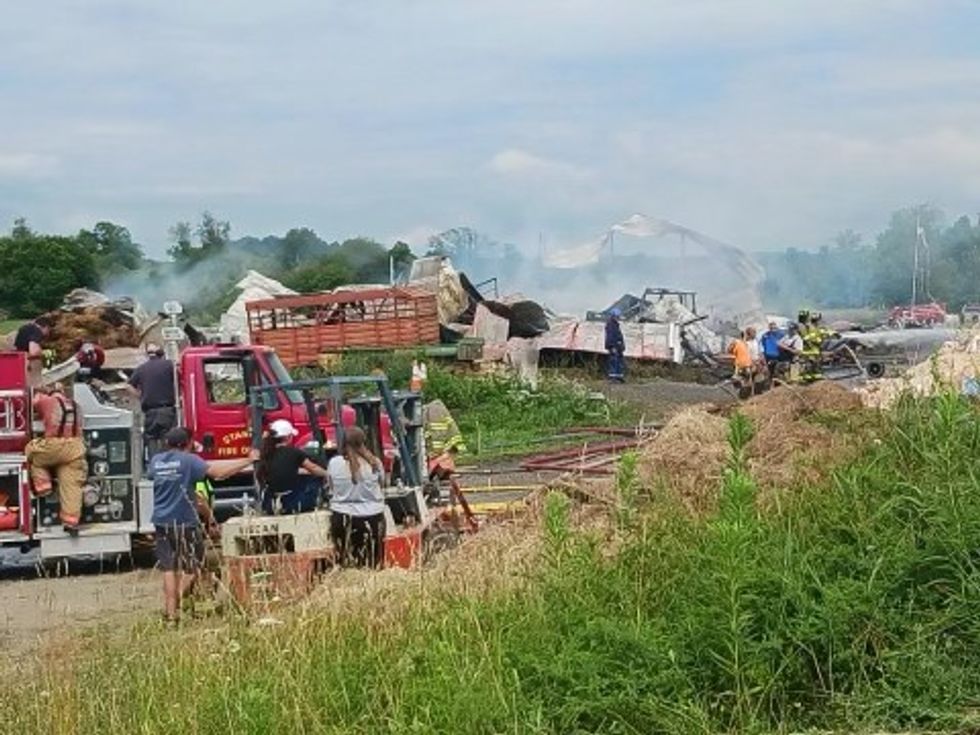
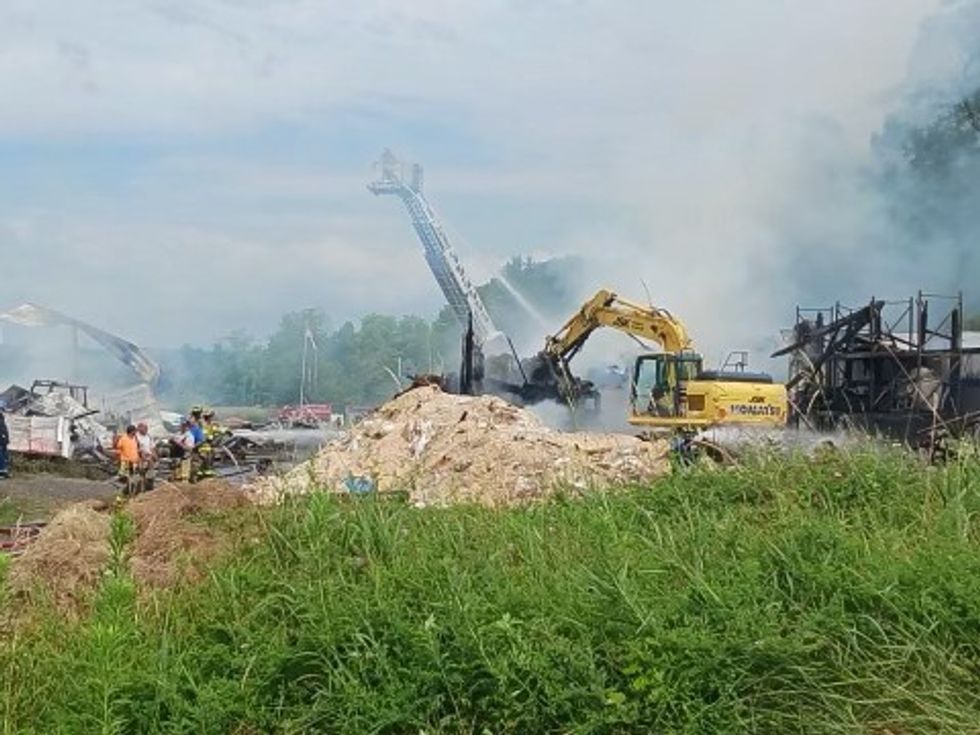
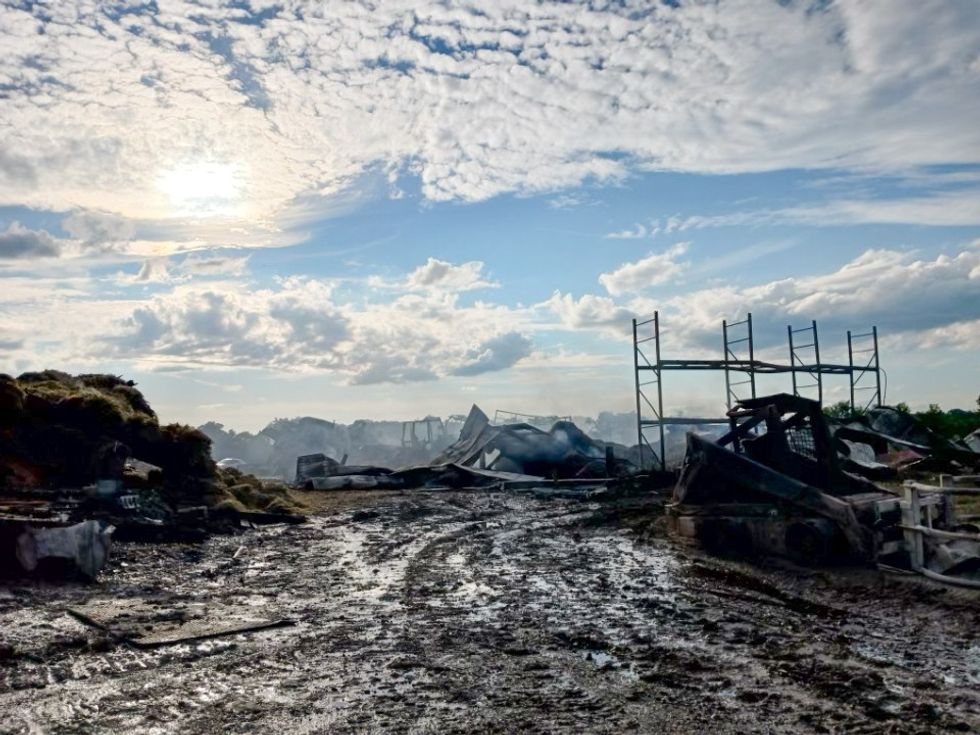
Fire on July 18 claimed crops, barns and all equipment at the Kemmerer Farm in Stanfordville.
Emily Hay Kemmerer

Fire on July 18 claimed crops, barns and all equipment at the Kemmerer Farm in Stanfordville.
STANFORD — Following the fire that devastated the Kemmerer Farm on July 18, the Kemmerers are attempting to rebuild their livelihood with support from the local community.
The family lost all of their crops and hay, three barns and their farming equipment.
As of last weekend, a GoFundMe, set up to support the Kemmerer family, had raised around $59,633. There are several different fundraising events planned for the near future to continue providing support.
Wendy Burton, Town Supervisor of Stanford, anticipates a ticketed brunch and silent auction on Sept. 28 at Bangallworks. The goal is to raise $40,000 at that event. She explained that even though the farm was covered by insurance, it would not cover all of the expenses that come with rebuilding.
Burton expressed that the community at large is on such a “beautiful roll.” More than 400 volunteers worked together this spring to build the “sparc park,” a community playground that draws families and children from Pine Plains, Millbrook, Milan and Clinton Corner/Salt Point.
Burton calls upon this same community to come together once more and help the Kemmerers clean up and rebuild.
Danielle (Dani) Nicholson, a longtime resident of Pine Plains, has been at the forefront of helping the Kemmerer family and garnering support from the local community. She is a self-proclaimed “freelance hospitality professional.” She is famed for her empanadas in the Stanford area and has begun selling them with help from generous donations by local farmers who provide ingredients. The funds she raises directly support the Kemmerer family.
Nicholson worked extensively with the Millbrook Horse Trials and organizers to raise awareness for the nearby Kemmerer Farm at the event. Her initial idea was to hang flyers around the grounds, which blossomed into something much bigger.
The Central Press donated flyers and posters, many of the vendors lent their support, and a raffle was set up with the help of the horse trials to offer free entry for one competitor to the competition in 2025. Tickets were $20, and the funds were donated to the Kemmerer GoFundMe.
She also worked in conjunction with the vendors and boutiques featured at the Millbrook Horse Trials to sell thousands of dollars worth of merchandise within several hours at the patron luncheon on Sunday, July 28th.
Vanner House, one of the boutique vendors at the horse trials that graciously allowed Nicholson to model their apparel and accessories, has offered to continue to support the cause. They will donate 10% of all online purchases that use the promo code KEMMERERGIVE10 directly to the family. Their website is, www.vannerhouse.com
Nicholson expressed that it is in her “blood and bones to want to do more.” Herself, along with Courtney Haire, and other members of the community are planning a Fall Farm Fundraiser to raise awareness and support for the Kemmerer Family. For more information or to get involved, community members can reach out to savekemmererfarm@gmail.com
Nicholson is a friend of Emily Kemmerer and the family, as well as an example of the power of community. She explained that “we may all be little fish in a big pond, but we can still make ripples.” The link to the GoFundMe is: https://gofund.me/58d84221
Kemmerer Farm was one of two Dutchess County family farms recognized as Century Farms at the New York State Agricultural Society’s 2023 annual meeting. To receive Century Farm status, a farm must be in continuous operation by the same family on the same property for at least 100 years.
State Sen. Stephen Harding
NEW MILFORD — State Sen. and Minority Leader Stephen Harding announced Jan. 20 the launch of his re-election campaign for the state’s 30th Senate District.
Harding was first elected to the State Senate in November 2022. He previously served in the House beginning in 2015. He is an attorney from New Milford.
In his campaign announcement, he said, “There is still important work to do to make Connecticut more affordable, government more accountable, and create economic opportunity. I’m running for reelection to continue standing up for our communities, listening to residents, and delivering real results.”
As of late January, no publicly listed challenger has filed to run against him.
The 30th District includes Bethlehem, Brookfield, Cornwall, Falls Village, Goshen, Kent, Litchfield, Morris, New Fairfield, New Milford, North Canaan, Salisbury, Sharon, Sherman, Warren, Washington, Winchester and part of Torrington.
MILLERTON — James (Jimmy) Cookingham, 51, a lifelong local resident, passed away on Jan. 19, 2026.
James was born on April 17, 1972 in Sharon, the son of Robert Cookingham and the late Joanne Cookingham.
He attended Webutuck Central School.
Jimmy was an avid farmer since a very young age at Daisey Hill and eventually had joint ownership of Daisey Hill Farm in Millerton with his wife Jessica.
He took great pride in growing pumpkins and sweet corn.
He was very outdoorsy and besides farming, loved to ride four wheelers, fish, and deer hunt. He also loved to make a roaring bonfire.
He was a farmer, friend, husband, father, son and brother. He will be missed by many.
He is survived by his father, Robert Cookingham, wife Jessica (Ball) Cookingham, daughters, Hailey Cookingham-Loiodice (Matt), Taylor Ellis-Tanner (Jimmy) and sister Brenda Valyou, as well as many cousins, nieces and nephews.
He is predeceased by his mother, Joanne (Palmer) Cookingham.
His daughter, Hailey, will always keep his legacy alive by their father-daughter antics, such as their handshake, nicknames and making “quacking noises” at each other.
Services/Memorials will be held at a later date.
The Kenny Funeral Home has care of arrangements.
Telecom Reg’s Best Kept On the Books
When Connecticut land-use commissions update their regulations, it seems like a no-brainer to jettison old telecommunications regulations adopted decades ago during a short-lived period when municipalities had authority to regulate second generation (2G) transmissions prior to the Connecticut Siting Council (CSC) being ordered by a state court in 2000 to regulate all cell tower infrastructure as “functionally equivalent” services.
It is far better to update those regs instead, especially for macro-towers given new technologies like small cells. Even though only ‘advisory’ to the CSC, the preferences of towns by law must be taken into consideration in CSC decision making. Detailed telecom regs – not just a general wish list -- are evidence that a town has put considerable thought into where they prefer such infrastructure be sited without prohibiting service that many – though not all – citizens want and that first responders rely on for public safety.
Such regs come in handy when egregious tower sites are proposed in sensitive areas, typically on private land. The regs are a town’s first line of defense, especially when cross referenced to plans of conservation and development, P&Z regulations, and wetlands setbacks. They identify how/where the town plans to intersect with the CSC process. They are also a roadmap for service providers regarding preferred sites and sometimes less neighborhood contention. In fact, to have no telecom regs can weaken a town’s rights to protect environmental, scenic, and historic assets, and serve up whole neighborhoods to unnecessary overlapping coverage and corporate overreach. Such regs are unique to every town and should not follow anyone else’s boiler plate, especially industry’s.
Connecticut is the only state that has a centralized siting entity for cell towers. The good news is that applicants must prove need for new tower sites in an evidentiary proceeding and any decisions have the weight of the state behind them. The bad news is that the CSC used to be far less industry-friendly and rote in their reviews, which now resemble a check list. There is an operative assumption at CSC that if an applicant wants a tower, they must need it, otherwise why spend significant money to run the approval gauntlet? This reflects a subtle shift over the years at CSC from sincere willingness to protect the environment toward minimal tweaking of bad applications with minor changes. The bottom line is that towns really cannot rely on the CSC to do all the work for them.
What CSC issues telecom providers is a “certificate of environmental compatibility” after an evidentiary proceeding (not unlike a court case) with intervenors, parties, expert witnesses, and the service provider’s technical pro’s sworn in and subject to cross examination. Service providers get to do the same with any opposition from intervenor/party participants – like towns and citizens -- and their experts. It’s an impressive process whose ultimate goal is the fine balancing between allowing adequate/reliable public services and protecting state ecology with minimal damage to scenic, historic, and recreational values. They unfortunately often fall short of their mandate – like approving cell towers with diesel generators over town aquifers -- evidenced by CSC only rejecting about five cell towers in the past 15-20 years.
The CSC was founded in 1972 and clarified its mission in the 1980’s to prevent the state from being carved up willy-nilly by gas pipelines, high tension corridors, and broadcast towers. With the sudden proliferation of cell towers beginning in late 1990’s, it became the most sued agency in Connecticut by both an arrogant upstart industry if applications were denied and by towns/citizens when bad sites were forced on them. CSC gradually formed a defensive posture that drives their decisions toward industry with deeper pockets and attorneys on retainer.
For citizens, nothing can wreck one’s day like the CSC. It behooves towns to protect what little toolkit they have, and understand the legal parameters of the CSC’s playing field. The CSC is not a “normal” government agency where municipal/citizen redress is based on logic and local support. Their process is largely immune to everything but specific kinds of evidence – like town regs with setbacks/fall zones, radio frequency transmission signal strengths, sensitive areas identified, and detailed wildlife inventory, among others.
There is a current cell tower fight involving two intervening towns -- Washington and Warren; both with good cell tower regs – over a tower site within 1200’ of a Montessori School, near Steep Rock’s nature preserves with comprehensive geology/wildlife databases that include endangered, threatened and special concern flora and fauna, on established federal/state migratory bird flyways, within throwing distance to a historic site capable of being listed on the Underground Railroad, and with an access road on a blind curve entering a state highway that will permanently damage wetlands, vernal pools, and core forests. There are well credentialed environmental experts, including Dr. Michael Klemens, former chair of Salisbury’s P&Z, as well as the former director of migratory bird management at the US Fish and Wildlife Service, and an RF engineer testifying to alternative approaches, plus three attorneys representing intervenors. It is the most professional challenge I have seen at CSC since Falls Village successfully mounted one that protected Robbins Swamps several years ago.
The hearing is ongoing, with uncertain results. To see what it takes today to stop an inappropriate tower siting, see Docket #543 under “Pending Matters” at https://portal.ct.gov/csc before removing local cell tower regs – the lowest hanging fruit that any town can possess in case it’s needed.
B, Blake Levitt is the Communications Director at The Berkshire-Litchfield Environmental Council. She writes about how technology affects biology.