Garbage woes at popular North Kent Road swimming hole
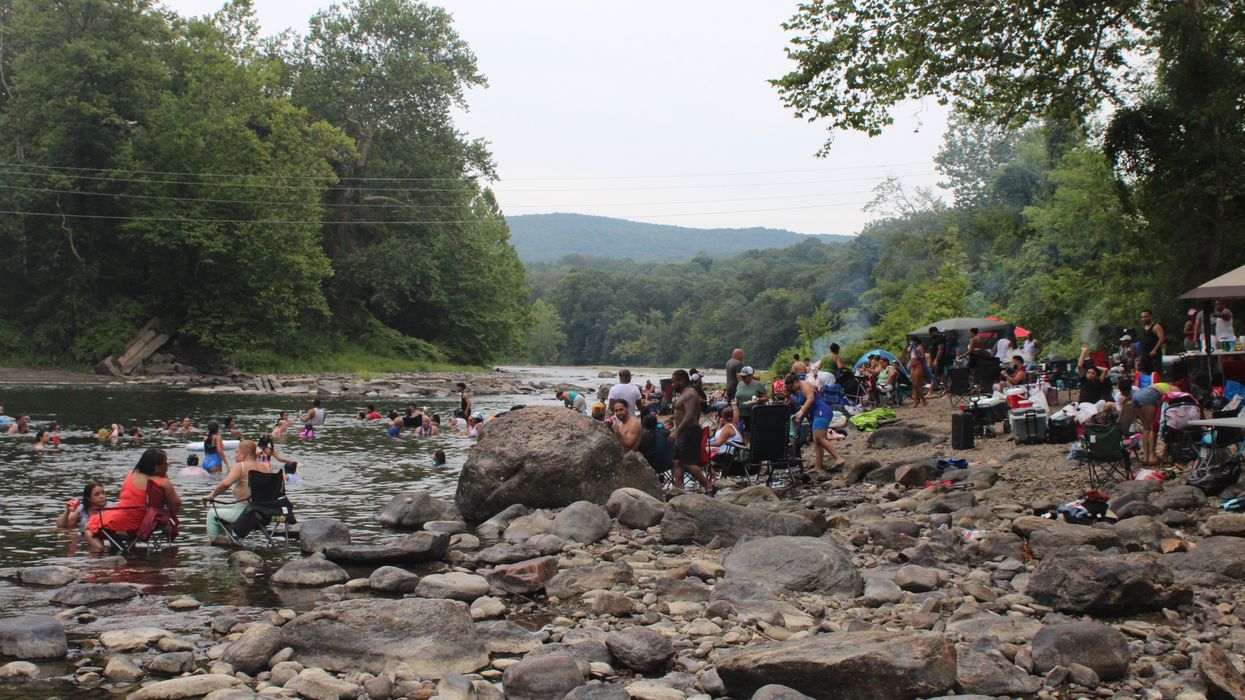
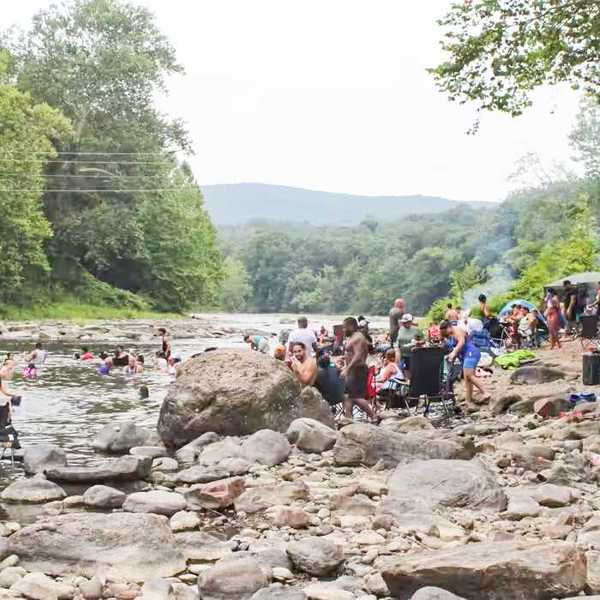
Riverside-revelers bring many diversions to the banks of the Housatonic on a recent Sunday afternoon.
Alec Linden


Riverside-revelers bring many diversions to the banks of the Housatonic on a recent Sunday afternoon.
KENT — Even as afternoon clouds gathered, Sunday was a proper scene down on a bucolic bend in the Housatonic River off North Kent Road No. 2, a longtime swimming hole that has received negative publicity in recent years for misuse, primarily in the form of litter and waste left negligently at the site. Despite the jovial mood and thumping music, some of the riverside revelers were aware that things must change to ensure the summertime oasis stays open.
“We’re in jeopardy of losing this really nice spot to hang out at, to play music and spend time with our families if we don’t clean up” said a Danbury-based taxi driver who wished to remain anonymous.
Sitting on a camping chair in ankle deep water by the riverbank surrounded by the rest of her group, she gestured at the surrounding landscape: a swimming-pool like hole where swimmers of all ages relaxed in the August-warm river, surrounded by gentle rapids.
“It’s a fun area that connects you with nature,” she said. “I can speak for my group — we pick up all our trash.”
Those who don’t respect the area ruin the spot for everybody, the taxi driver said.
Frank, another Danbury resident who said he’d been visiting the spot for 12 years, said that he comes to “enjoy a nice meal with family,” arriving early to secure a prime spot. He said he knows many of the groups that frequent the location, which remind him of scenes from his home in the Dominican Republic.
His advice to those thinking of littering? “Do the thing you think is better for the world — don’t watch what others do, just do the right thing.”
The outreach of river stewards has made noticeable impacts, the taxi driver said, pointing at half full-trash bags at each surrounding group’s setup. The stewards are interns from the Housatonic Valley Association who have been distributing garbage bags and stewardship guidance at popular locations along the Wild and Scenic stretch of the Housatonic since June. This was their last weekend on the job, and their efforts did not go unnoticed: the taxi driver from Danbury said she had visited swimming holes across Connecticut and never found such a welcoming community as that in Kent.
Kent Resident Trooper Vicki Donahoe, who had been stationed at the trailhead since 11:30 that Sunday morning, and all day Saturday before that, said that a convivial approach was the best path forward, but that the litter must stop. “I want them to be happy. I just want them to pick up their garbage.”
The only issues Trooper Donohoe had experienced thus far were illegal parking incidents, which she promptly addressed. Otherwise, river-goers had been receptive to her guidance on how to respect the river and accepted offerings of garbage bags.
Still, the litter remains. Trooper Donohoe pointed at some discolored napkins on the ground just in front of the trailhead kiosk to the preserve, which is owned by the state Department of Energy and the Environment. “Look at that nasty stuff,” she said. “No one wants to pick that up.” She reported that a group of self-volunteered residents had retrieved hundreds of bottle caps at the site the day before. “That’s not right.”
With 51 cars parked on the road and multitudes of that number on the shoreline below, the beach at 4 p.m. on Sunday was relatively clean, largely due to the efforts of those residents who have removed hundreds of pounds of trash from the beach in recent weeks.
What to do with the spot moving forward is a complicated matter, but some river advocates are determined to find solutions that keep the river open and accessible.
Mike Jastremski, Watershed Conservation Director at the Housatonic Valley Association, advocated at an Aug. 4 selectmen’s meeting, and again in a subsequent interview, for “equitable, safe and sustainable” river access: a recognition that “the river belongs to all of us,” that it is inherently dangerous but with safer zones, and that it be managed in a way that promotes recreation that is both sustainable to the community and the resource itself.
The North Kent Road spot, he argued, satisfies the first two tenets quite well, as a free, publicly accessible and relatively safe swimming hole in comparison with other riskier, but still popular, locations along the river.
A core facet of stewardship and the HVA’s mission is getting people to personally connect with the resource. “You’re not going to care about it unless you’re there,” he said.
Beyond changing the mindsets of river users, he said, is getting the various parties of interest in the area to work together to come up with solutions, which includes the town, DEEP, Eversource Energy, the Kent Land Trust, the Housatonic Valley Association, and, of course, neighbors residents and recreators.
“People want to be on the river,” Jastremski said, “and not only that, they have a right to be on the river.”
A judge recently dismissed one lawsuit tied to the proposed redevelopment, but a separate court appeal of the project’s approval is still pending.
LAKEVILLE — A Connecticut Superior Court judge has dismissed a lawsuit filed against Salisbury’s Planning and Zoning Commission challenging a zoning amendment tied to the controversial expansion of the Wake Robin Inn.
The case focused on a 2024 zoning regulation adopted by the P&Z that allows hotel development in the Rural Residential 1 zone, where the historic Wake Robin Inn is located. That amendment provided the legal basis for the commission’s approval of the project in October 2025; had the lawsuit succeeded, the redevelopment would have been halted.
The decision, issued Jan. 29 by the Superior Court in Torrington, rejected a claim brought by Wells Hill Road residents Angela and William Cruger seeking to nullify the amendment. The Crugers filed the lawsuit in March 2025, arguing the regulation was improperly adopted and amounted to illegal spot zoning intended to benefit the project’s developer, Aradev LLC.
The zoning amendment drew scrutiny when it was adopted, with opponents asserting it was crafted specifically to enable the Wake Robin Inn project. Town officials and land use staff, however, repeatedly said the change was years in the making and intended to address zoning nonconformities affecting historic inns throughout Salisbury.
In a memorandum of decision, the court found the plaintiffs failed to meet their burden of proof that proper notification was lacking. The judge wrote that “a close examination of the record” showed the Crugers did not demonstrate that public notice of the zoning change was procedurally deficient, unduly vague or untimely filed.
The dismissed case is the first of two legal challenges filed by the Crugers related to the Wake Robin Inn redevelopment. A second lawsuit — an appeal of the P&Z’s approval of Aradev’s application to redevelop and expand the inn — remains pending before the court.
Former Planning and Zoning Commission Chair Michael Klemens said that Thursday's ruling brought vindication. In a Jan. 30 email to the P&Z and commission attorney Charles Andres, Klemens said the lawsuit was largely based on claims that he and Land Use Director Conroy had misled the public and the commission during the regulatory process.
“So not only are the regulations recognized by the Superior Court as legally adopted,” Klemens wrote, “but the aspersions cast upon the integrity of staff and your immediate past chair are hopefully finally put to rest.”
Andres informed the Land Use Office and current P&Z Chair Cathy Shyer that the Crugers have 20 days to challenge the court’s ruling.
Under the approved plan, Aradev would redevelop the Wake Robin Inn to include a new detached 2,000-square-foot cabin, event space, a sit-down restaurant and fast-casual counter, as well as a spa, library, lounge, gym and seasonal pool. If built, the project would increase the number of guest rooms from 38 to 54.
Olana State Historic Site, the hilltop home created by 19th-century Hudson River School painter Frederic Edwin Church, rises above the Hudson River on a clear winter afternoon.
On a recent mid-January afternoon, with the clouds parted and the snow momentarily cleared, I pointed my car northwest toward Hudson with a simple goal: to get out of the house and see something beautiful.
My destination was the Olana State Historic Site, the hilltop home of 19th-century landscape painter Frederic Edwin Church. What I found there was not just a welcome winter outing, but a reminder that beauty — expansive, restorative beauty — does not hibernate.
2026 marks the 200th anniversary of Church’s birth, making this a particularly timely moment to take in what he created during his lifetime. Church — one of the most notable artists of the Hudson River School movement — was an accomplished landscape painter who gained a reputation as an artist-traveler.
From South America and Western Europe to the Middle East and the Caribbean, Church sought out dramatic, epic scenes that he could capture on canvas and bring back to the U.S. to sell. The profits from those works, in turn, allowed him to create a breathtaking masterwork of his own: Olana.
Olana rises above the Hudson River like a mirage, its Persian-inspired facade an unexpected sight amid the barren winter landscape. With miles of trails, visitors can take in the natural splendor of rolling hills and the river from every angle. From the house itself, the view stretches across the Catskills, a layered panorama of soft blues and silvers that appears all the more dazzling in winter.

Inside the home, the sense of awe deepens. Olana’s interior is rich with color, pattern and texture — warm reds, stenciled walls, intricate woodwork — a striking counterpoint to the monochrome world outside. Light pours through tall windows, framing the Hudson Valley like living paintings.
Every corner of the house pays tribute to the far-flung places Church visited throughout his career. From architectural details to the objects he collected and displayed, visitors are transported to another world. Walking from room to room feels less like touring a house museum and more like stepping into the mind of an artist transfixed by the staggering beauty of the world around him.
As I made my way back down the hill, the winter light fading fast, I felt refreshed in a way that only comes from seeing something anew. Olana is not just a monument to one artist, but a testament to a way of viewing the world — one that values observation, patience and reverence for the natural environment. For those looking to venture out during the colder months and to be reminded why this region has inspired generations of artists and dreamers, there may be no better place to start than Olana.
Olana State Historic Site is located at 5720 State Route 9G, Hudson, New York. For more information and to purchase tours, visit: olana.org

Berkshire Hills Ski League includes Washington Montessori School, Indian Mountain School, Rumsey Hall and Marvelwood School.
CORNWALL — Mohawk Mountain hosted a meet of the Berkshire Hills Ski League Wednesday, Jan. 28.
Housatonic Valley Regional High School earned its first team victory of the season. Individually for the Mountaineers, Meadow Moerschell placed 2nd, Winter Cheney placed 3rd, Elden Grace placed 6th and Ian Thomen placed 12th.
The league includes a mix of private and public schools. HVRHS competed against Washington Montessori School, Indian Mountain School, Rumsey Hall and Marvelwood School.

Conditions were ideal for slalom skiing at Mohawk, albeit cold for spectators with the temperature in the teens. Approximately 20-inches of snow fell earlier in the week.
Mohawk will continue to host weekly meets of the BHSL each Wednesday through the end of the season. The league championship will take place Feb. 25.

State Sen. Stephen Harding
NEW MILFORD — State Sen. and Minority Leader Stephen Harding announced Jan. 20 the launch of his re-election campaign for the state’s 30th Senate District.
Harding was first elected to the State Senate in November 2022. He previously served in the House beginning in 2015. He is an attorney from New Milford.
In his campaign announcement, he said, “There is still important work to do to make Connecticut more affordable, government more accountable, and create economic opportunity. I’m running for reelection to continue standing up for our communities, listening to residents, and delivering real results.”
As of late January, no publicly listed challenger has filed to run against him.
The 30th District includes Bethlehem, Brookfield, Cornwall, Falls Village, Goshen, Kent, Litchfield, Morris, New Fairfield, New Milford, North Canaan, Salisbury, Sharon, Sherman, Warren, Washington, Winchester and part of Torrington.