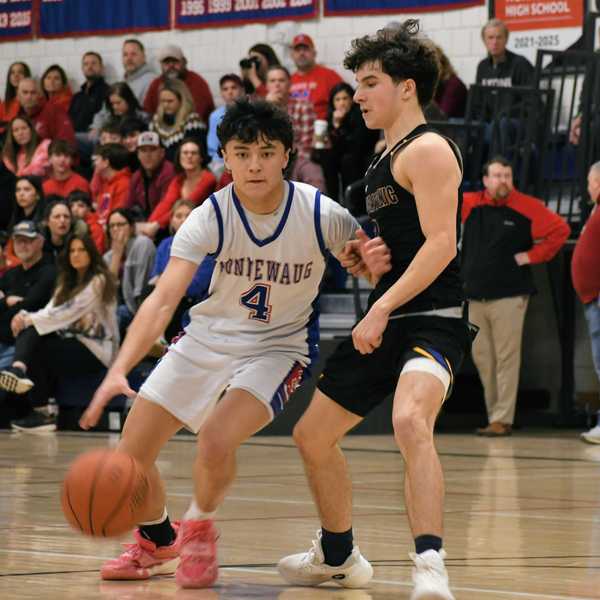
Gilbert tops HVRHS 57-45

Gilbert's star guard Emily Arel scored 29 points through double coverage when Gilbert hosted HVRHS Jan. 21.
Riley Klein

Gilbert's star guard Emily Arel scored 29 points through double coverage when Gilbert hosted HVRHS Jan. 21.
WINSTED — Led by senior Emily Arel’s game-high 29 points, Gilbert advanced to a record of 8-3 this season with a 57-45 home court victory over Housatonic Valley Regional High School (7-5) Tuesday, Jan. 21.
Despite several players out due to illness, HVRHS played Gilbert close and trailed by just three points early in the fourth quarter. Arel led Gilbert on a late scoring run and closed out the win for the Yellowjackets.
HVRHS seniors Tessa Dekker and Daniela Brennan were both sidelined by sickness. Seven players suited up for the Mountaineers, and one exited early due to a hard collision.

HVRHS’s defensive strategy was to contain Arel with double-teams and force other Gilbert players to score. The plan was relatively effective through three quarters, but Arel kicked into high gear late and scored 12 of Gilbert’s 18 fourth-quarter-points.
Arel had help from junior Addy Lillie, who scored 14 points in the game, and Neela Gilbert-Alfar, who scored eight points.
HVRHS was led offensively by Olivia Brooks with 14 points. Kylie Leonard scored nine points before exiting with an injury in the third quarter. Victoria Brooks and Khyra McClennon each scored six points, Maddie Johnson scored five points, Carmela Egan scored four points and Hayden Bachman, who was critical in defending Arel, scored one point.
With winning records going into the back nine of the regular season, both teams have their eyes set on the postseason. The Berkshire League tournament will get going in late February and Connecticut Interscholastic Athletic Conference tournaments will follow in early March.

Leila Hawken
Impressive dance moves were displayed by Village Trustee Shannon Mawson who added a visual flair of fabric in motion at Club Friendly, a community dance at Village Hall on Friday, Feb. 27.
Nearly 80 residents filled Village Hall on Friday, Feb. 27, for a two-hour community dance party organizers hope will become a recurring event.
The gathering, dubbed “Club Friendly,” transformed Village Hall into a lively dance space with colorful décor, upbeat lighting and a steady mix of tracks spun by local DJ Christopher James. Serving as emcee, James kept the energy high and encouraged dancers of all ages to take to the floor.
Young children also got into the spirit, tossing countless balloons that were scattered throughout the hall.

Pizza and light refreshments were served in the Village Hall meeting room, offering a place for attendees to recharge between songs.
The event was organized by the Millbrook Library and the Millbrook Arts Group, and was used as a pilot program to gauge interest in hosting future community dance nights.
“It could continue with different themes,” said library director Courtney Tsahalis, adding that participation by other sponsoring organizations would be welcome.
Tsahalis said the turnout shows there’s interest in holding more dances.
Lakeville Journal
Isle of Klezbos brings its high-energy, all-women klezmer to the Stissing Center in Pine Plains on Saturday, March 7. Touring internationally since 1998, the ensemble blends neo-folkloric originals and reimagined Yiddish classics in a style dubbed “cutting-edge klezmer” by New York Magazine.
Lakeville Journal
Housing, land use, community
On Thursday, Feb. 26, I attended a collegial conversation, a tour and a luncheon offered by the Salisbury Housing Trust at its Open House held at Town Hall. The Trust has been working to find possibilities for affordable homeownership options in Salisbury.
The entire event was generated by John Harney, President of the Salisbury Housing Trust. Speakers were Abby Conroy, Salisbury’s Director of Land Use, and Kayla Johnson, Salisbury’s Assessor. In addition, there were other presenters: Janna Siller, Director, Adamah Farm; Jocelyn Ayer of the Housing Collective; Mirna Martinez, Executive Director of the Southeastern Connecticut Community Land Trust; Karmine Aybar from the Naugatuck Valley Project. Miles Todaro who works with Abby in Land Use managed the Power Point slides.
The slides clarified how the different community trusts function. The Salisbury Housing Trust retains the land and leases it to the homeowners to reduce property taxes and ensure that the house deed is restricted and the property remains affordable. The Southeastern Connecticut Community Land Trust also does this but in addition, has a community farming component and a house for teens to continue their education and develop work skills. The Naugatuck Valley Project is a faith- and labor-based organization supporting fair housing in Waterbury. We heard about the challenges and opportunities of rural versus urban affordable housing initiatives.
On The Run in Lakeville graciously supplied coffee and pastries as well as a delicious lunch which we enjoyed while seeing the new 26 Grove Street home. The spirit of the meeting was positive and energizing for three hours. People wanted to keep talking at the end of the event at Town Hall. We continued to meet each other, sharing ideas and accomplishments and just having fun while have a chili/wrap lunch at 26 Grove Street. This new home is beautiful and the family who moves in will be fortunate. Kudos to John Harney who organized this event. Frosting on the cake was the gift bag from Harney Tea for each participant. Thank you, Mike Harney.
Eileen Epperson
Salisbury
Youth basketball program impressive
I’d like to compliment everyone involved in organizing and coaching the youth basketball program at the High School. My granddaughter participated at the 6 year old level, and I’ve had the chance to attend a practice a couple of months ago and again this past Saturday morning. The improvement in all of the participants in that short a time is remarkable!
It’s terrific to see both male and female coaches working with the kids. Even at this young age, when a whistle blows, every child immediately stops and looks to the coaches for instruction — a real indication of the structure, respect and positive environment they’ve created.
I couldn’t be more impressed. If this level of enthusiasm and development continues, the elementary schools, Housatonic, or whatever teams these kids eventually join — will be incredibly fortunate to have them.
Thank you so much to all of you for your dedication and hard work!
Dave Beaujon
Canaan
Rail Trail care, signage needed on bridges
July 23, 2025, was a beautiful summer morning. I loaded my bicycle and headed for Harlem Valley Rail Trail. I was on one of the narrower wooden bridges when I heard someone say “On your left.”
I had never had a cyclist pass me from behind on the bridges before. I pulled my bike closer to the side of the bridge. I was out for a leisurely ride, but the gentleman that came up behind me was all business.
There were vines growing over the side of the bridge so I rode back toward the center of the bridge after he passed. Another cyclist, who did not announce himself, came up on me quickly. I pulled back to the right, and when I did my handlebar caught the fence.
I fell down.
The cyclists came back as I lay on the bridge, with the bike wrapped around my legs. They got the bike off me. I grabbed the fence and pulled myself up. My helmet still sat on my head. In shock, I stumbled around the bridge. My right arm was bleeding and my left leg was badly bruised. My neck hurt – like a really bad stiff neck. I called my husband and told him where to meet me.
Unable to walk, I rode my bike the last mile as the two cyclists followed me. My husband took me directly to the hospital. A CT scan showed I had broken my neck at C2, called the “Hangman’s Fracture.” I was transported to Hartford Hospital. The break appeared stable so I was put in a neck brace, told I was very lucky not to be dead or paralyzed, and that I needed to follow up with an orthopedic surgeon.
That began the longest six and a half months of my life. The neck brace was a 24/7 fixture. If I didn’t heal I’d need surgery to put rods and screws in my neck. The whole experience was traumatic and grueling.
By the grace of God, my 66 year old neck decided to heal eventually. My body will never be as it was before, and I lost over six months of life. I tell this story because my life was forever altered in a second by the behavior of others.
Many people use and enjoy the Rail Trail. If you see an elderly person on a leisurely ride, or a family with children, please take a moment to respect their right to do so without being placed in life-changing danger. I know that the cyclists who passed me did not want to harm me, but a moment’s impatience and disregard for me nearly cost me my life. I hope Dutchess County Parks will at least put signs up at the bridge approaches asking cyclists NOT to pass from behind. Sometimes we just need a little reminder to be considerate of others. Is it really so much to ask?
Rachel Lamb
Lakeville
Primary care shortage needs bold leadership
Yes, we really need primary care doctors. Attracting potential candidates to the Northwest Corner has always been problematic, as more candidates are drawn to more populated areas with larger teaching facilities. However, we will continue to have a shortage of primary care doctors unless other larger issues are addressed: managing debt among primary care physicians and the effects of our for-profit healthcare system.
I was the only Family Medicine physician in Sharon during the period 1994 to 2011. I was one of the few residency graduates that, even then, opened up a solo private practice. My practice was successful with many wonderful patients. In 2011, I made the decision to move to the Savannah, Georgia, area to work as a civilian for the Department of Defense, taking care of Army families and retirees, which I did until 2019, just prior to Covid-19. The difficult decision to close my practice in Sharon and move was almost entirely a financial decision.
In the past, most physicians could be entrepreneurial and open up a private practice. Very few physicians choose that pathway today. Medical school students are graduating with $300 to $400 thousand in loans. Primary care physicians are chronically underpaid by health insurance companies for their services. The implementation of the “One Big Beautiful Bill” in 2027 will result in hospital and nursing home closures and has already resulted this year in non-sustainable double digit increases in private and subsidized health insurance premiums. The additional $500 billion in Medicare cuts will certainly exacerbate insurance underpayments and more closings.
We have a broken healthcare system that cannot be fixed piecemeal. The U.S. spends the most on healthcare by far of any industrialized country, accounting for 18% of GDP. Yet we have the lowest life expectancy, the highest infant mortality, the highest suicide rates, the highest rate of preventable deaths and the highest rate of chronic disease and obesity. Clearly, we are not getting what we pay for.
It is time for bold leadership to create a not-for-profit National Healthcare System that is accessible to everyone, placing more emphasis in healthcare on wellness and prevention, using evidence based scientific principles. And it is time to end putting individuals not well-trained in science and medicine in charge of the U.S. health system.
Richard F. Hanwacker, MD
East Canaan

Want more of our stories on Google? Click here to make us a Preferred Source.
M.a. Duca
Maybe it’s just a question of balance. According to Newton’s Third Law of Motion: for every action there is an equal and opposite reaction. We are inundated by stories of avid outdoorsmen, community activists, and people who “give back” after a long journey of finding themselves. As an avid indoorsman and inactivist I realize that my accomplishments are largely unnoticed and certainly not celebrated. There were no up close and personal segments during the recent Olympics of grainy videos of future gold medalists sitting around the house quietly reading. If anything, they looked like stealth advertisements for Ritalin as children bounced off the walls and exhausted parents tried to find safe activities that didn’t involve jumping off the roof or falling out of trees. Apparently, the kids that survived stood a good chance for an Olympic medal down the road.
The implication that people who are involved will “do good’ has been debunked time and again. We all know someone who would benefit the community by being less involved. Successful giving back requires that someone is taking. It’s the natural order of things and there is no shame in grateful and appreciative acceptance. But giving back also implies that someone is taking and not giving back. It is uncomfortable because it borders on being selfish, which of course everyone is to some extent but no one will admit to it. Again, we need to keep things in balance. Is it selfish or self-centered? Hard to know. Is it psychopath or sociopath?Easier to know. One often ends up as a murderer and the other has a chance of getting elected president. Instead of selfishness let’s call it constructive self-centeredness. Sort of like the “constructive criticism” from your boss that you are forced to listen to during the annual review.
The life of the inactivist is not glamorous. It is thankless and sometimes embarrassing. And some are just not cut out for it. Unlike the avid outdoorsman, the avid indoorsman does not spend years building endurance and lung capacity. There is no journey to the couch or easy chair. You bury your nose in a book under the glare of an LED, not the national spotlight.
Most of us do not grow up to be Olympians performing on a world stage or community activists basking in the glow of local celebrity. Our modest contributions and subtle rewards stem from leading ordinary and unassuming lives.
I’m sure it’s disappointing when some children don’t pursue the dreams their parents have and resist joining travel teams and professional coaching. They aren’t excited about passing out campaign leaflets or glued to the TV watching election night returns in preparation for a future run for public office.
With apologies to Sir Isaac Newton, sometimes the apple does fall far from the tree.
But it’s still an apple.
M.A. Duca is a resident of Twin Lakes, narrowly focused on everyday life.
Mac Gordon
At the turn of the 20th century the Potomac River in downtown Washington was clogged with mud and sewage that made it unnavigable. The US Army Corps of Engineers, called in to rectify the situation, created a more than 400 acre island in an open part of the river, built of the enormous amount of material excavated from the river bottom. The resulting crescent shaped island was developed into a park, finally opened to the public in 1916.At the west end was the Jefferson Memorial, at the east end a large picnic garden, a bunch of tennis courts and around the periphery a scenic bicycle path. In the middle was a modest 18 hole golf course. Thousands of trees and shrubs were planted throughout; also hundreds of cherry trees, a present from the Mayor of Tokyo were planted in 1912. The park including its golf course has been in operation for more than a century.
Last December at the behest of President Trump, the National Park Service (a subsidiary of the Interior Department) cancelled the long term lease held by the National Links Trust for the East Potomac Links saying that the non-profit had failed to meet the terms of the lease, citing inadequate maintenance.
Trump plans to have a luxury golf destination. “We’re going to make it a beautiful, world class, U.S. Open caliber course”, Mr Trump said when asked about this last month. “Ideally we’re going to have major tournaments there and everything else, It’s going to bring in a lot of business into Washington”.
Recent construction in the East Potomac park started with the dumping of debris from the demolition of the White House’s East Wing right in the middle of the golf course.
Although no designer has been chosen and there are not even very preliminary drawings to look at, many people knowledgeable about this particular island and golf courses in general have speculated about design considerations and their thoughts are not very positive. The scenic bicycle trail around the perimeter might have to be scrubbed to increase the size of the new golf course. To accommodate spectators, parking, restaurants, a service road or roads and a host of supporting services would require much more space than Trump and his subordinates have contemplated. The single access to the island, a bridge would be a bottleneck. The entire island from the start sits atop a soft, wet base and its edges at the river are showing increasing signs of eroding and need to be firmed up, especially should the development President Trump envisions occur.And the island is flat, topographically uninteresting even with the estimated 30,000 cubic yards of fill (mostly construction debris) from the demolition of the East Wing.
The park at present is kind of shabby, suffering from decades of inadequate funding and maintenance. But even so it retains considerable charm and looks delightful when the millions of tiny cherry blossoms are blooming. For well over a century it has been a pleasant park for Washington’s ordinary citizens. How many of them will be able to afford the astronomically high prices for hot dogs, let alone at least $100 to play a few rounds of golf at the deluxe Trump golf facility?
Unfortunately, President Trump’s involvement with the East Potomac Park shows a continuation of his self- centered approach displayed in his remodeling of the White House and its grounds. The paving over of the Rose Garden, the gaudy gold-plated interior decorations, the demolition of the Jackie Kennedy Garden and the grossly oversized planned Trump Ballroom are depressing harbingers of what’s probably in store for East Potomac Island.
Although the existing facility was in the middle of a fifty year lease, Trump had Secretary of the Interior Doug Burgum cancel the lease thereby giving direct control to the President who then illegally ordered the dumping of the construction debris from the (also illegally) demolished White House East Wing right in the middle of the existing public golf course.A major golf enthusiast, Trump also considers himself a champion of the people. But in this case, he is planning to take away a public golf course made for, and actively used by, “the people” and remake it for elite, professional golfers and expensive commercial interests.
A bunch of lawsuits, filed by two private citizens anda non-profit environmental group, The Preservation League, are represented by a pair of well-known Washington law firms. They hope to stop Trump’s takeover but considering the way things go in Washington, Trump’s fantasy may become a reality before the case is resolved.
The redo of the entire East Potomac Island for top level golf exhibitions would likely cost much more than renovating several other existing, but somewhat dilapidated public golf courses similar to East Potomac that need work but still are enjoyed by thousands of ordinary Washingtonians.
Architect and landscape designer Mac Gordon lives in Lakeville.

Want more of our stories on Google? Click here to make us a Preferred Source.

Want more of our stories on Google? Click here to make us a Preferred Source.