Thank you!
Your support is sustaining the future of local news in our communities.

Growing the next generation of local journalists

Every summer, our newsroom becomes more than a place where stories are written—it becomes a classroom, a workshop, and, we hope, the starting point for future careers in local journalism.

This year, eight interns joined The Lakeville Journal and The Millerton News for an intensive six-week experience that immersed them in community reporting. Three were high school students attending Housatonic Valley Regional High School, The Hotchkiss School and Loomis Chaffee School. The remaining five were college students from Ithaca College, Marist University, the University of Connecticut, Loyola University and Northwestern University.Although they arrived with different backgrounds and varying levels of journalism experience, they all shared a connection to the Northwest Corner of Connecticut or neighboring Dutchess County and a curiosity about the communities most call home.

Rather than watching from the sidelines, the interns became part of the newsroom. They covered local events, interviewed residents, wrote feature stories, attended meetings, and worked alongside our editors and reporters as they learned how local journalism comes together—from the first interview to the final edit. Along the way, they discovered that reporting is equal parts preparation, persistence, curiosity and listening.

Their education extended well beyond reporting assignments. Throughout the summer, community leaders and media professionals volunteered their time to lead weekly workshops on subjects that every journalist should understand.

Attorney and LJMN Media Inc. board member Devereaux Chatillon explored media law and intellectual property. Veteran photographer Anne Day shared practical techniques for creating stronger images, even using a smartphone. Francesca Donner, former gender editor at The New York Times and founder of The Persistent, challenged the interns to think critically about female representation in journalism. Compass editor Natalia Zukerman discussed the art of interviewing, while our news editors Christian Murray, Aly Morrissey and Nathan Miller offered practical lessons in reporting, feature writing and the newsroom process.

Perhaps the greatest lessons, however, came from simply being out in the community.

Several interns told us they now pay far more attention to what’s happening around them than they did before the program. Others said the experience pushed them beyond their comfort zones, whether that meant approaching strangers for interviews or covering busy public events. One intern joked about discovering “there can be a lot of drama over a tennis court,” a reminder that every community has stories waiting to be uncovered. Another described the experience as “breaking the bubble”—seeing familiar towns through fresh eyes and recognizing the people and issues that shape everyday life.

This week, each intern shares what they learned during the summer on pages B1 and B2.

Programs like this depend on people who know that local journalism matters. We are deeply grateful to the William and Mary Greve Foundation and individual donors for their generous support of this year’s summer internship program. We also welcomed one intern through our partnership with Marist University, another investment in developing future journalists.

That investment couldn’t be more important.

Strong communities need strong, reliable local reporting and coverage of town halls, school boards, housing, healthcare, environmental issues, local businesses, sports, and the countless stories that rarely make national headlines but shape daily life here.

The newsroom will feel a little quieter when they head back to school, but we have every reason to believe we’ll be hearing from many of them again.

Latest News

Slow fashion takes the runway at Stone Ridge Orchard

The organic runway at HVSFW puts sustainable style among the apple trees at Stone Ridge Orchard.

Jay Ballesteros

Fast fashion has made it possible to buy the latest trend almost as quickly as it appears on social media. The environmental cost, however, is anything but fleeting. Fashion production accounts for about 10% of global carbon emissions, consumes enormous quantities of water and energy, and an estimated 85% of textiles end up in landfills each year. Synthetic fabrics also shed microplastics when washed.

So what would happen if we slowed things down?

Keep ReadingShow less
Susan Schneider and the magic of marbling
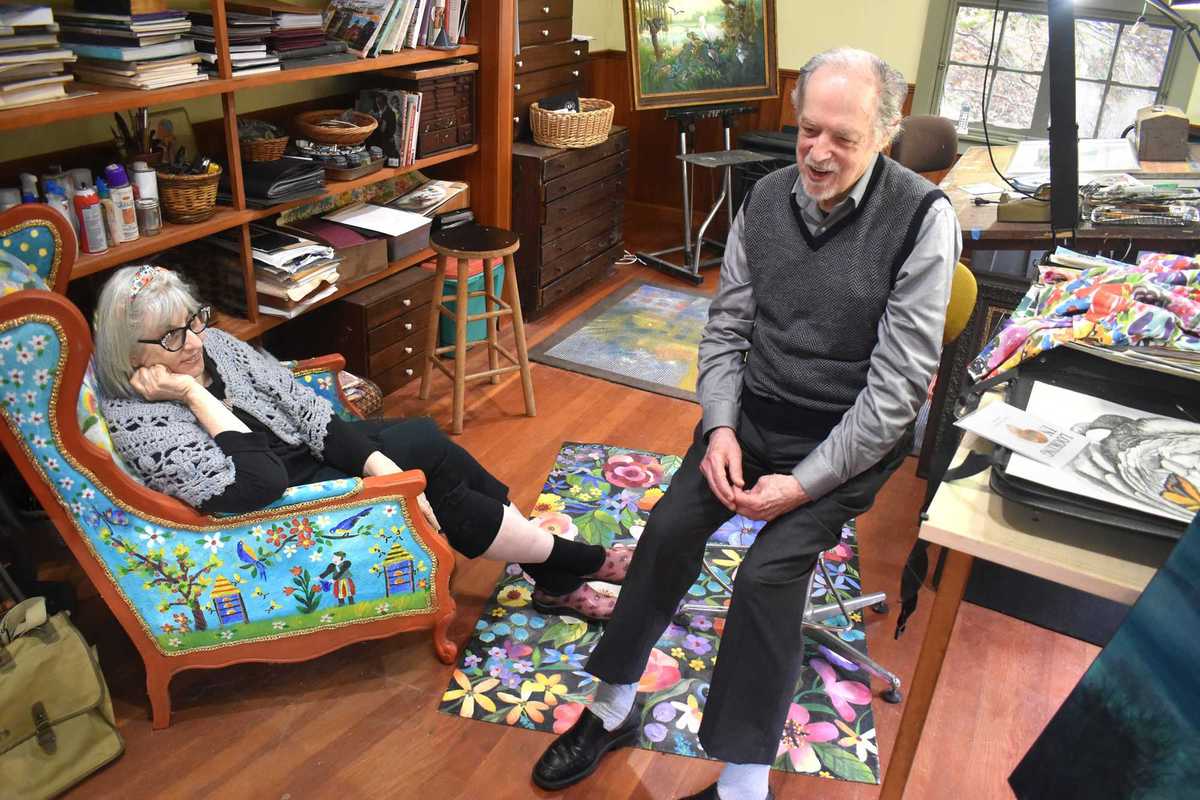
Susan Schneider, owner of Shandell’s in Ashley Falls, in her studio.
It’s a joyful process. —Susan Schneider

A beautiful September morning found Susan Schneider of Shandell’s working in her Ashley Falls home studio, while linen cocktail napkins she had marbled the day before hung on a line outside her back door. Her helpers, dogs Daisy and Stubbs, are never far from her.

“Marbling,” Schneider explained, “the art of floating paint on a liquid and printing it on a medium, has been around for hundreds of years.”

Keep ReadingShow less

Through the lens of war

Through the lens of war

“Omaha Beach Rescue, D-Day +1, Normandy, June 7, 1944.” one of the best-known photographs of D-Day.

Walter Rosenblum

Longtime Norfolk resident Nina Rosenblum will present her award-winning documentary, “They Fight With Cameras,” on Saturday, Sept. 26, at 6:30 p.m. at the Norfolk Library.

The film tells the story of her father, decorated U.S. Army Signal Corps combat cameraman Walter Rosenblum.

Keep ReadingShow less
google preferred source

Want more of our stories on Google? Click here to make us a Preferred Source.

Brian Gersten finds the story in the overlooked

Filmmaker Brian Gersten

D.H. Callahan

At 6 p.m. on Saturday, Sept. 26, award-winning filmmaker Brian Gersten will screen four short documentaries at the David M. Hunt Library in Falls Village, exploring obscure topics such as a lingering territorial dispute between the United States and Canada, a nationwide toilet paper panic sparked by a late-night joke, the infamous “Balloon Boy” saga and the history of bowling in America.

The Chicago-raised, Millerton-based filmmaker has worked as an editor on feature-length documentaries like the cycling film “Enter the Slipstream” and Netflix’s profile on author Tom Wolfe, “Radical Wolfe.” In 2025, “Why We Dream,” a film he edited about bringing D-Day veterans back to the beaches of Normandy, premiered aboard the U.S.S. Intrepid in New York City. When it comes to directing, Gersten’s own interests focus more on the underappreciated and unremembered, as the four short films he directed will demonstrate.

Keep ReadingShow less
Sharon artist takes top prize at Lime Rock art show
Muriel Stockdale, left, and judge Roger McKee during the awards announcement at the juried art show at Trinity Episcopal Church. Stockdale\u2019s \u201cKevin\u201d was the second place winner.
Patrick L. Sullivan

The annual juried art show at Trinity Episcopal Church in Lime Rock was won by Mi-Kyung Hwang of Sharon for “Wild Hazelnut from Eggleston.”

The winners were announced at the show’s opening reception at the church Friday evening, Sept. 18.

Keep ReadingShow less
From Woodstock to the Warner, Graham Nash is still singing for peace

Graham Nash brings a career-spanning retrospective to the Warner Theatre in Torrington on Sept. 30, joined by Todd Caldwell, Adam Minkoff and Zack Djanikian.

Misti Layne

Imagine stepping out onto a stage in front of hundreds of thousands of tired, wet and weary strangers with a lineup of songs they’ve never heard before. If you’re Graham Nash, who will perform with his current band at the Warner Theatre in Torrington on Sept. 30, you don’t have to imagine. You only have to remember.

The legendary Woodstock music festival was only the second concert Nash played with Crosby, Stills, Nash & Young. David Crosby, Stephen Stills and Nash had already formed Crosby, Stills & Nash, releasing their debut album earlier that year. Theirs was a sound both new and nostalgic when it hit the scene in the late 1960s, and, thanks in part to the success all three members had had with previous bands, they instantly found a wide and willing audience.

Keep ReadingShow less
google preferred source

Want more of our stories on Google? Click here to make us a Preferred Source.

google preferred source

Want more of our stories on Google? Click here to make us a Preferred Source.