New ski jump tower nearly ready for launch

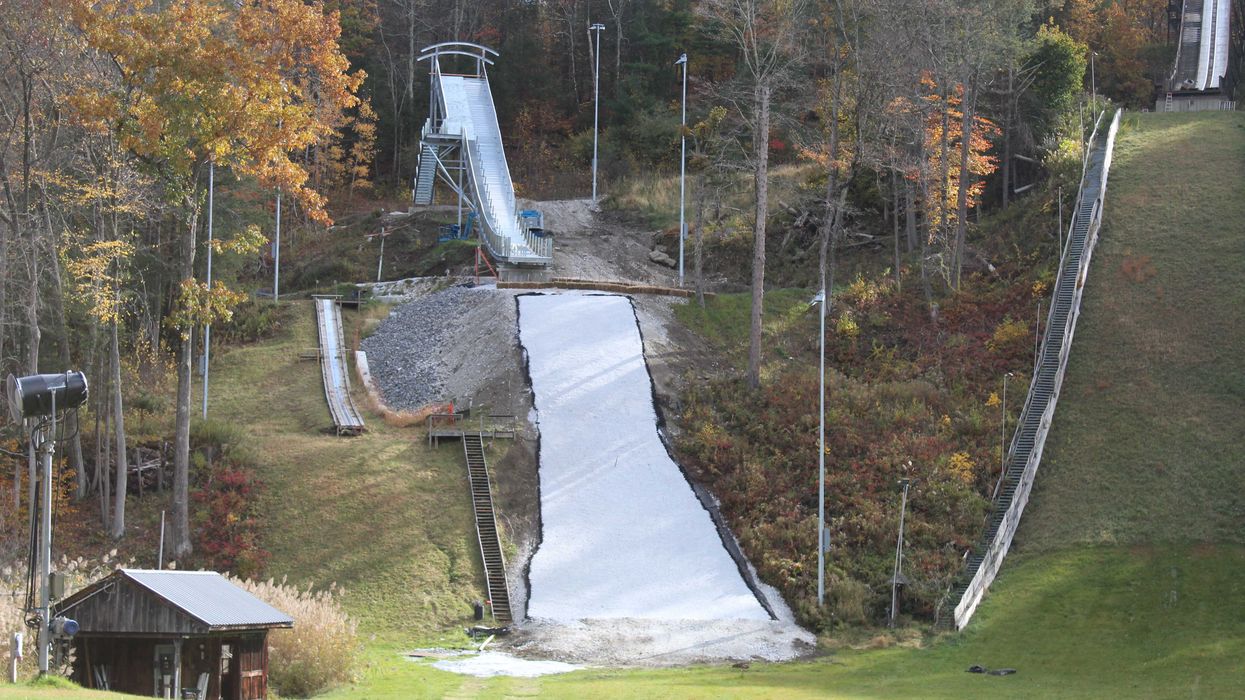
The new 36-meter intermediate jump at Satre Hill is about 90% complete and will be ready for December’s Junior Ski Jump Camp.
Patrick L. Sullivan

The new 36-meter intermediate jump at Satre Hill is about 90% complete and will be ready for December’s Junior Ski Jump Camp.
SALISBURY — The new intermediate jump at Satre Hill is about 90% complete.
Ken Barker, president of the Salisbury Winter Sports Association, said on Friday, Oct. 24, that the 36-meter jump will be ready for the Junior Ski Jump Camp in late December.
In the spring, a plastic surface will be put on the hill to allow for year-round jumping.
The new jumping tower is made of galvanized steel, aluminum, “and a little plywood,” Barker said.
“Should be maintenance-free for many years.”
All the work was done by local contractors, he added.

What if I told you the only way you can get your college degree is by spending the next 20 years paying off the debt to attend that school. Would you still go?
Many people I know need to achieve that dream of walking across a stage and receiving a diploma to put themselves in a better position in life. However, that dream comes with a price tag now. A price tag that is so big at times that these people that I know have to give up on their dreams.
It has gotten to the point where higher education to earn a good paying job seems to be an unreachable luxury. Many kids who have a passion to pursue a certain career after high school cannot because they are too poor to reach a higher level of education. This makes higher education less about ability and more about affordability, reducing opportunity and diversity on campuses.
Even for those who make it to college, rising tuition widens the gap between students from wealthy families and those from low-income backgrounds. Many talented students must work long hours while studying, leaving them less time to focus on academics and extracurricular activities. The rise in cost takes away time from campus events and functions that students can attend during some downtime to get a leisure activity in.
In my personal experience as a student athlete, not only am I a full-time student that must prepare and study for class, but I also must prepare and train for my sport while also taking up a part-time job at the school. Balancing sport, school, and the mindset of making enough money to stay in school comfortably leads to lack in performance and mental health.
The issue of debt doesn’t just affect individual students. The issue of student debt affects entire communities and the country’s economy. When young people are forced to take out massive loans, they end up delaying important milestones like buying a home, starting a family, or even beginning a business. Instead of contributing to economic growth, they spend years trapped in a repayment cycle.
Furthermore, many students who start college but cannot keep up with tuition end up dropping out, leaving them with debt but no degree to show for it. This cycle creates long-term financial stress and limits upward mobility for millions of Americans.
The constant rise in tuition makes college feel less like an opportunity to learn and more like a business transaction. The cost of education discourages students from pursuing degrees in fields that truly interest them. Instead, many choose careers that simply offer higher salaries, rather than following their passions or pursuing work that benefits society. This means a lack of teachers, social workers, and artists. which are professions that shape communities and culture. When education becomes only about survival and not personal growth, society loses creativity and compassion. Schools should focus on helping students succeed, not just on making profits.
Colleges often justify tuition increases by pointing to improved facilities, technology, or campus programs, but those benefits mean little if fewer students can afford to experience them. Education should be a right, not a privilege reserved for the wealthy. If the goal of higher education is to prepare the next generation of thinkers, leaders, and innovators, then it must be made accessible to all who are willing to work hard for it.
Overall, the growing cost of college is transforming education, which is supposed to be a pathway to open doors, into a barrier that limits success for many hardworking students. Colleges and policymakers need to find solutions to make higher education more accessible and affordable.
Expanding need-based scholarships, increasing state funding for public universities, and controlling unnecessary fees could help ease the cost that gives many students an untenable burden. Investing in education benefits everyone by creating a stronger, more skilled population that can achieve a career after their time in college to help boost the economy and quality of life in our country.
If tuition continues to rise unchecked, fewer students will be able to achieve their educational goals, and the nation will lose out on the talent and innovation that come from diverse backgrounds filled with motivated graduates who still have so much potential left to reach.
Collin Jefferson is a sophomore at Mitchell College majoring in Business Management.
7,600 pounds of Turkey
We are blessed to have a dedicated group of nonprofits doing incredible work to improve the lives of people in our community. You know the names — Jane Lloyd Fund, SWSA, Salisbury Volunteer Ambulance, Lakeville Hose, and many others. But there is one charity that may fly under your radar, that does extraordinary work, especially this time of year.
Sunday in the Country Food Drive raised funds, organized logistics, and delivered complete Thanksgiving dinners to 800 area families last week. Including an additional 425 lbs of chickens and two tons of dry goods. They purchased all the food from local businesses, with local employment in mind.
And their work is only halfway done- they will be providing the same number of dinners for families in need this Christmas. Sunday in the Country Food Drive has provided these services for the past 33 years, and its donations help an average of 13 local food pantries meet their needs.
If you can find it in your budget to donate to this worthy cause, you will help brighten the lives of many in this community, perhaps even your neighbors.
Sunday in the Country Food Drive, P.O. Box 789, Millerton, NY 12546
Sundayinthecountry.org
Love Where You Live,
Kendra Chapman
Lakeville
The COVID-19 pandemic was supposed to spell the end of the cruise line industry. These massive ships, crammed with sick passengers, were labeled “petri dishes” by the media, infectious disease experts, and politicians. Six years later, the sector is alive and growing.
AAA projects that a record-breaking 21.7 million Americans are planning to hop aboard an ocean cruise in the coming year. If so, that would mark the fourth year in a row the cruise industry has experienced record passenger volume. This year, more than 20 million passengers flooded the gates to new King Kong-sized vessels, offering fixed-price packages and promising a wide variety of cruise options for every age and pocketbook.
If you break down the demand demographically, Baby Boomers still make up the majority of cruise-goers, followed by Millennials. Most adults travel with a companion. Nearly 50% of U.S. cruise passengers are cruising as a couple.
About 65% of adult passengers are 55 or older. However, 27% are from younger generations (35 to 54 years old), and 7% are aged 18 to 34. The trend also includes multi-generational groupings who choose to take cruise vacations together. One quarter of Baby Boomers who like cruises do so with their adult children, and roughly 29% of Gen Z members cruise with their parents.
A survey identifying trends shaping the modern cruise experience found that Millennials and Gen Z are increasingly enthusiastic about opting for a cruise vacation. Key among the changes in attitude was the affordability of shorter itineraries, which allow younger generations to vacation more frequently. They much prefer a two-to-four-day sailing to the more traditional five-to-seven-day voyage.
The Caribbean remains the most popular destination, attracting 72% of American cruise passengers. As a result, Florida ports are the busiest in the world due to this vacation demand. The new mega-vessels ply the Caribbean, Mediterranean and Northern European waterways. Smaller vessels are more common in Northern Europe for expedition cruises and in the Mediterranean for luxury trips.
More than half of the 4,500 people surveyed had already cruised, and nearly 30% planned to do so again over the next two years. Of those planning another cruise, 36% were born between 1981 and 1996. The average age of a cruise guest is now 46 years old, and 36% of all cruisers are now under 40.
Cruise lines have quickly adjusted to these preferences and begun marketing three-to-five-night cruises. Another popular consumer preference is the chance to visit a private island. Cruise lines are investing big bucks to create this type of destination or upgrade existing ones. Cruise operators know that the main draw for vacationers is convenience and value, especially today.
As such, cruise companies bundle lodging, meals, and entertainment. The price often equates to a lower per-night cost than on a land-based vacation. Celebrity-level chefs and Broadway-level shows have replaced the rubber chickens and crew member chorus offerings of yesteryears.
Modern-day ships are increasingly resembling ocean-going resorts, complete with floating buffets and satisfied customers — couples like the built-in date-night dining and entertainment options. Families appreciate the kid clubs, water parks, and multi-room lodgings. An expanding list of destinations, such as a cruise to Antarctica or the Arctic, excites and attracts younger adventure seekers.
More than 90% of U.S. cruise passengers rate their experience as good or very good, according to AAA, and 91% have taken multiple cruises. With those kinds of repeat rates, cruise lines expect growth to continue well beyond the next few years.
Wall Street likes what it sees and has rewarded these companies with higher stock prices. Rather than rest on their laurels, cruise companies worldwide are expanding their fleets, building destination islands and upgrading their offerings hand over fist.
Bill Schmick is a founding partner of Onota Partners, Inc., in the Berkshires.Bill’s forecasts and opinions are purely his own and do not necessarily represent the views of Onota Partners, Inc. (OPI).None of his commentary is or should be considered investment advice.
Misconduct by its recently disgraced and departed chairwoman, Marissa Gillett, has Connecticut’s Public Utilities Regulatory Authority on the defensive. Past utility rate decisions have been put in legal jeopardy, utility companies are getting angry and aggressive, Gillett’s Democratic allies in the General Assembly have been discredited for their complicity with her power grabbing and lies, longstanding criticism by Republican legislators has been vindicated, and state government’s infamous “public benefits charges” on electricity bills are becoming a political issue again.
Some of those charges were recently removed by legislation with their financed transferred to state government borrowing, but most of the charges remain, comprising about 20% of customer electric bills, an estimated $1 billion annually. So at a Hartford Business Journal conference last month, a senior vice president of Connecticut’s largest electric utility, Eversource, Digaunto Chatterjee, called for removing the charges from electric bills entirely and financing their programs through the state budget.
For some time this has been the position of Republican legislators, who note that the charges function not only as a hidden tax but also as a tax on a necessity of life. But the electric companies, being heavily regulated and long having been scapegoated for Connecticut’s high electricity prices, had not been taking sides on the issue, lest they aggravate their adversaries.
Governor Lamont and most Democratic legislators are still resisting serious reform with the charges. The House chairman of the General Assembly’s Energy and Technology Committee, Rep. Jonathan Steinberg, D-Westport, says it makes little no difference how the programs financed by the charges are paid for -- by footnotes on electricity bills or by regular state government appropriations and formal taxes.
Steinberg is wrong. For if the “public benefits charges” were eliminated, the programs they finance would have to start competing for appropriations along with everything else state government spends money on. They would become part of the budget process, where the items financed by the charges would get far more scrutiny from the governor, legislators, news organizations, and the public than they get now when they are buried in electric bills.
The HBJ reported last week that the “public benefits charges” consist of 63 fees that are summarized on electric bills in two line items, a format that virtually prohibits intelligent review. Of course that’s the way the governor and most Democratic legislators like it. They don’t think they would gain much politically from a billion-dollar reduction in electricity costs if it came with a billion-dollar increase in the state budget and taxes. Then they might face another billion dollars’ worth of controversy as they converted from a system where the charges and the programs they finance are hidden to a system where they would jostle against everything else government money is wanted for. Maybe in such a public process the governor and legislators would have trouble justifying some of the charges. Maybe they would feel compelled to reduce or eliminate some of the programs.
Moving the charges to the state budget would be best but it’s not the only way to increase transparency and accountability. A modest improvement might be for state government to keep the charges and their programs but to recover their costs with a formal sales tax on electricity — itemized in bold lettering at the top of all electricity bills.
That would get people’s attention even if it failed to explain the programs being financed by the charges.
Some of those programs may be necessary for the stability of the electrical system, but some are environmental niceties and nuttiness and some are simply welfare subsidies that are fairly resented by people who pay their own electric bills.
If the main objective of the “public benefits charges” is to pay for necessary things, they can be financed by the state budget and formal taxes.
If the main objective of the charges is just to conceal government expenses and deceive people, nothing is worth that much and programs financed that way should be scrapped.
Chris Powell has written about Connecticut government and politics for many years.