SHARON — A Torrington Superior Court hearing Sept. 26 regarding the development of Paley Farm in Sharon yielded no change to the dispute between the property owners and Sharon Land Trust.
David and Liza Bainbridge, owners of 135 Millerton Road in Sharon, otherwise known as Paley Farm, have begun construction of a multi-million-dollar home. Sharon Land Trust (SLT) has sought to block development of this land, which was protected by a conservation conveyance with the State of Connecticut in 1984.
SLT and concerned citizen Carol Flaton brought the matter before Superior Court in July disputing the Department of Agriculture’s decision to approve construction. SLT requested an injunction be implemented to stop construction while the case is ongoing. Before the hearing, the defendants disputed SLT’s standing in this matter and disputed the court’s jurisdiction over the case.
On Sept. 26, Judge Walter A. Menjivar granted three weeks for additional review to determine standing and jurisdiction. As for the work at Paley Farm, which has expanded from driveway construction to foundation development, Menjivar said the owners would be responsible for remediating the property to its previous condition should the court find jursidiction and establish standing for the plaintiffs.
“The parties do so at their own risk,” said Menjivar. “That’s a financial expense that they are risking by choosing to move forward.”
Attorney Alex Copp, representing SLT and Flaton, requested the injunction take effect immediately. Menjivar denied this request due to the question of jurisdiction.
Both parties, the Court and the Attorney General’s office were given three weeks to review the case. A follow-up hearing was set for Oct. 16 at Torrington Superior Court.


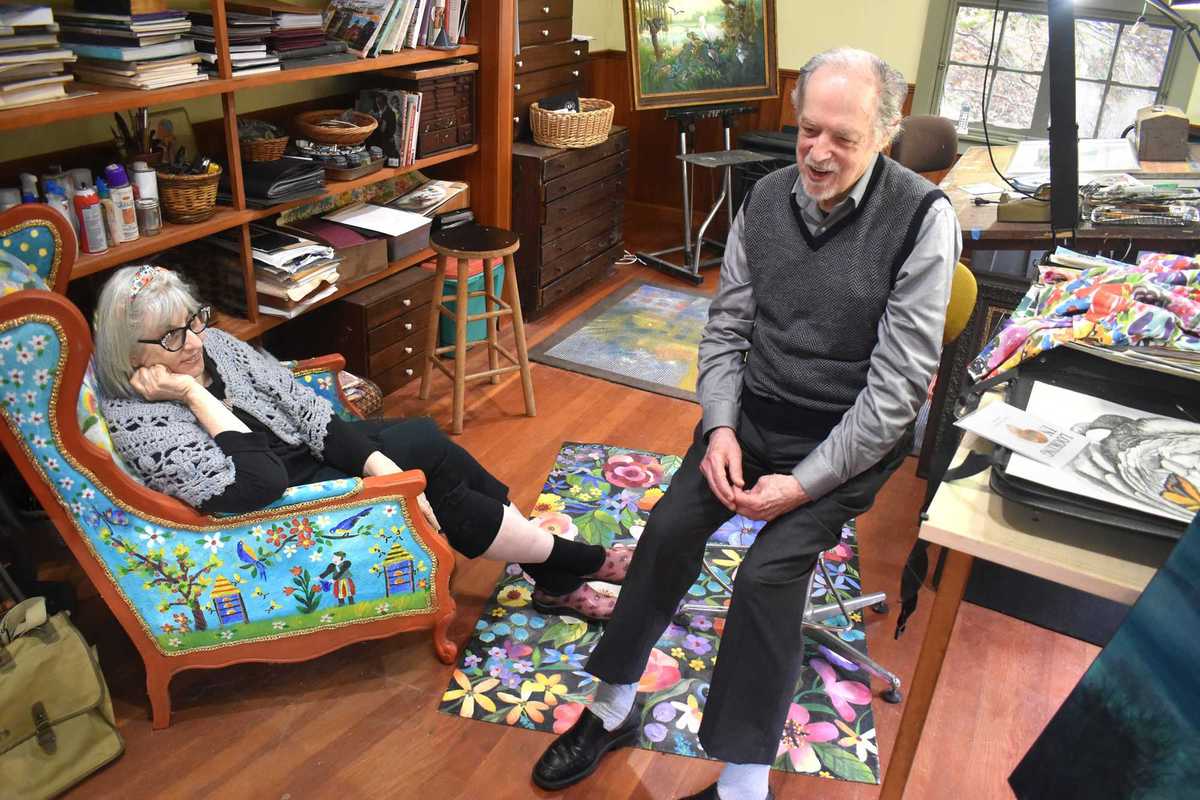
 Justine and Victor Valla in their studio with a painting of Victor’s,”Jonah and the Whale.” Robin Roraback


 A ceramic vase by Kathleen Heidemann.Provided
  Joy Brown’s delightful ceramic sculptures.Provided