Sustainable construction turns forest to frame

Sustainable construction turns forest to frame

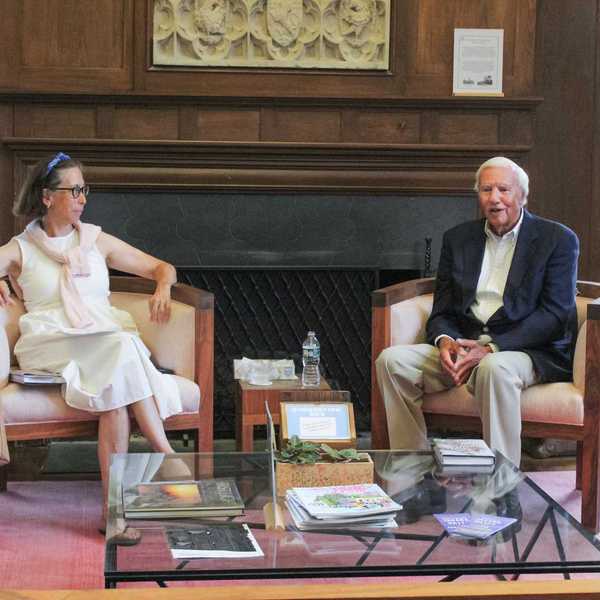
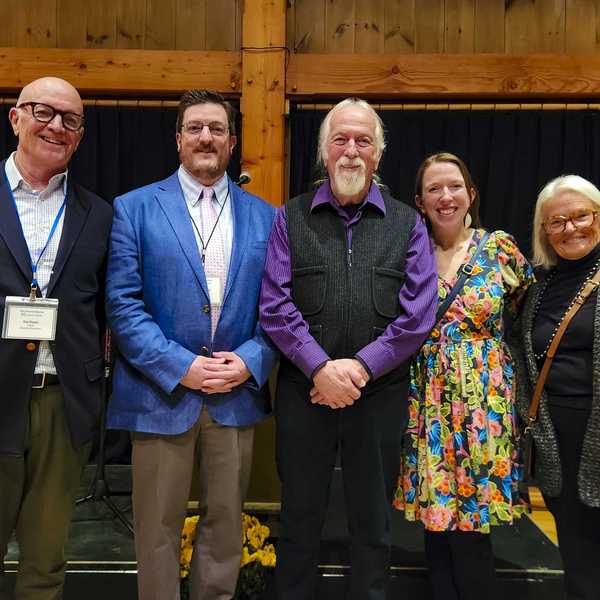
Author Brian Donahue, right, was in conversation with Mike Zarfos Oct. 5 during the Haystack Book Festival in Norfolk.

Patrick L. Sullivan

NORFOLK —Brian Donahue and his wife built a house in rural Gill, Massachusetts using wood from their own land and local artisans, loggers and foresters.

From this experience Donahue wrote a book, “Slow Wood: Greener Building from Local Forests.”

Donahue was interviewed by Great Mountain Forest executive director Mike Zarfos at the Norfolk Library Sunday, Oct. 5, as part of the Haystack Book Festival.

Donahue is professor emeritus of American Environmental Studies at Brandeis University.

Zarfos started by asking why he left the Boston area.

“The plan was always to leave,” he said, adding that it took a lot longer than he anticipated.

“It was a series of five-year plans.”

The Donahues, with some friends, chipped in and bought a substantial property in Gill, of which 50 acres of grassland is devoted to beef cattle and produce.

The friends took over the existing farmhouse and the Donahues started from scratch.

The goal (and end result) was a timber frame house made from the trees on the property.

Freely acknowledging he is not a forester nor a carpenter, Donahue said he relied on local talent to decide which trees to cut and how to cut them.

Everything that could be done locally was done locally. Donahue described a chain of loggers, carpenters, sawmill operators and assorted artisans who had a hand in the building of the house.

This was by design as well.

Donahue said that by following his path, development in New England can proceed in a way that is ecologically responsible and that provides employment.

“If you have the resources,” he added.

Donahue talked about “ecological forestry.”

“It’s the current term of art,” he said. The idea is that as trees are cut, the primary consideration is the ecological value of the activity, not the bottom line financially.

So while the white pine on the property was more valuable, other less prized species such as hemlock were excellent for building purposes.

“So we sold the pine.”

There are drawbacks to this approach to forest management and home building, he said. On the forestry side, the total amount of product is not as large, and the returns don’t come in as fast.

And on the building side, it is more expensive than using lumber trucked in from Canada or the southeastern U.S.

But if someone wants to be a good steward of the forest, then it is a way to get things done, slowly, on a small scale, while protecting the environment and helping the local economy.

Latest News

Winter sports season approaches at HVRHS

Mohawk Mountain was making snow the first week of December. The slopes host practices and meets for the HVRHS ski team.

By Riley Klein

FALLS VILLAGE — After concluding a successful autumn of athletics, Housatonic Valley Regional High School is set to field teams in five sports this winter.

Basketball

Keep ReadingShow less
Bears headline DEEP forum in Sharon; attendees call for coexistence, not hunting

A mother bear and her cubs move through a backyard in northwest Connecticut, where residents told DEEP that bear litters are now appearing more frequently.

By James H. Clark

SHARON — About 40 people filled the Sharon Audubon Center on Wednesday, Dec. 3, to discuss black bears — and most attendees made clear that they welcome the animals’ presence. Even as they traded practical advice on how to keep bears out of garages, porches and trash cans, residents repeatedly emphasized that they want the bears to stay and that the real problem lies with people, not wildlife.

The Connecticut Department of Energy and Environmental Protection (DEEP) convened the meeting as the first in a series of regional Bear Management Listening Sessions, held at a time when Connecticut is increasingly divided over whether the state should authorize a limited bear hunt. Anticipating the potential for heated exchanges, DEEP opened the evening with strict ground rules designed to prevent confrontations: speakers were limited to three minutes, directed to address only the panel of DEEP officials, and warned that interruptions or personal attacks would not be tolerated.

Keep ReadingShow less
Kent unveils two new 'smart bins' to boost composting efforts

Rick Osborne, manager of the Kent Transfer Station, deposits the first bag of food scraps into a new organics “smart bin.” HRRA Executive Director Jennifer Heaton-Jones stands at right, with Transfer Station staff member Rob Hayes at left.

By Ruth Epstein

KENT — Residents now have access to around-the-clock food-scrap composting thanks to two newly installed organics “smart bins,” unveiled during a ribbon-cutting ceremony Monday morning, Dec. 1.

Rick Osborne, manager of the Kent Transfer Station, placed the first bag of food scraps into the smart bin located at 3 Railroad St. A second bin has been installed outside the Transfer Station gate, allowing 24/7 public access even when the facility is closed.

Keep ReadingShow less
Cornwall selectmen prioritize housing, healthcare in new two-year goals

Cornwall First Selectman Gordon Ridgway

File photo

CORNWALL — Housing and healthcare topped the list of 15 goals the Board of Selectmen set for the next two years, reflecting the board’s view that both areas warrant continued attention.

First Selectman Gordon Ridgway and Selectmen Rocco Botto and John Brown outlined their priorities during the board’s regular meeting on Tuesday, Dec. 2. On housing, the board discussed supporting organizations working to create affordable options in town, and Botto said the town should also pursue additional land acquisitions for future housing.

Keep ReadingShow less