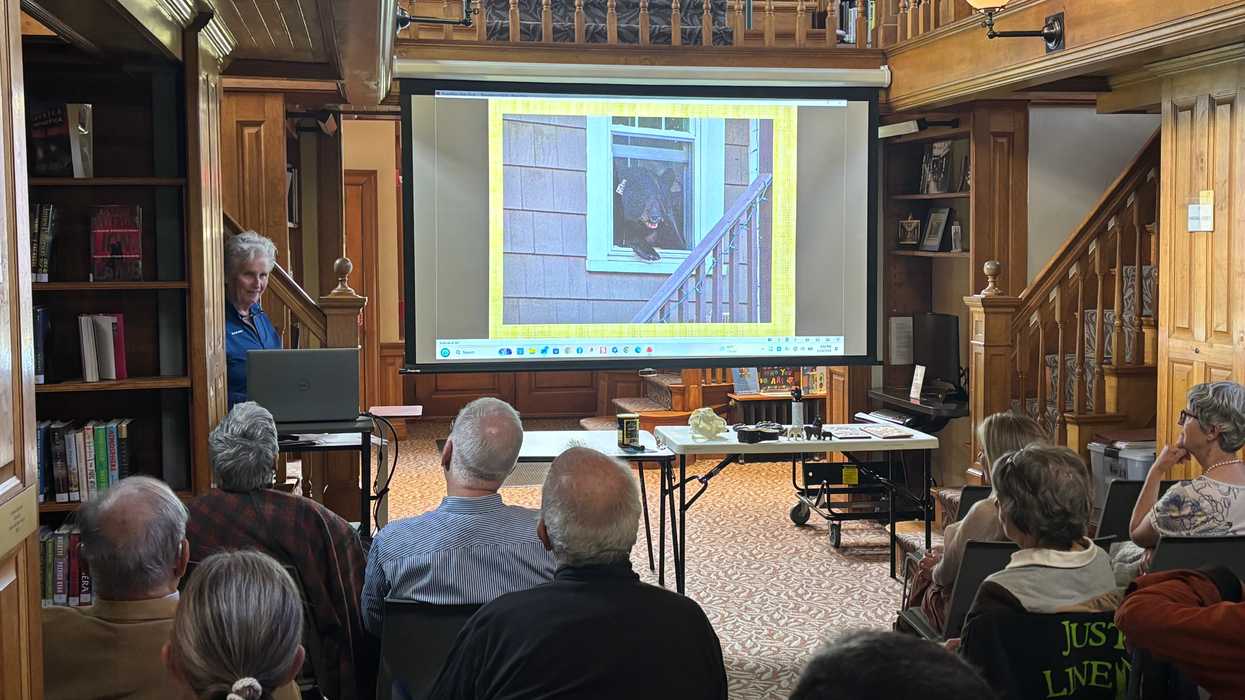
SHARON – Connecticut has one of the smallest black bear populations in the Northeast but the most conflicts between bears and humans, wildlife conservationist Ginny Apple said during a Sunday afternoon library talk. The reason, she said, is our habits.
“Seventy percent of our problems with black bears in Connecticut are bird seed and unsecured garbage,” Apple told attendees at Hotchkiss Library.
“If a black bear gets habituated to [human] food, it can get a little pushy,” she said.
Still, she said black bear encounters are rarely dangerous—“It’s more likely you’ll be struck by lightning than be killed by a black bear.”
During the 90-minute presentation, Apple, a master wildlife conservationist certified by the state Department of Energy and Environmental Protection (DEEP), discussed bear species past and present, from the relatively small sun bear of Southeast Asia to the massive short-faced bear, Arctodus, which she said could stand up to 12 feet tall on its hind legs.
These prehistoric giants went extinct approximately 11,000 years ago. Today, the black bear is the only bear species found in the northeastern United States.
Apple described it as among the most docile of the world’s eight bear species.
Still, she said, its association with larger, more aggressive bears, such as grizzlies, “causes a lot of problems for black bears.”
Apple said that many myths surrounding black bear aggression are actually more characteristic of grizzly bear behavior.
The warning never to get between a mother bear and her cubs applies more to brown bears, Apple said. A mother black bear will often send her cubs up a tree and stand watch below until the perceived threat has passed.
Apple said fear and misinformation contributed to the black bear’s disappearance from much of New England in the 19th century, as landowners killed bears they perceived as dangerous. Other animals that were driven out of the region included wolves, mountain lions and turkeys.
With reduced farming and the regrowth of forests, which were extensively cleared a century ago, several animals, including bears, have returned.
Black bears started to repopulate Connecticut in the 1980s, and now number between 1,000 and 1,200, according to DEEP’s 2026 “The State of the Bears” report.
Other nearby states—excluding Rhode Island which has a very small population—have far more bears, according to the report.
Massachusetts has about 4,500, while New York has up to 8,000, though Connecticut has far more reported conflicts between humans and bears, mostly in the western part of the state. Approximately 3,100 reports were filed in Connecticut in 2023 versus 645 in Massachusetts and 1,200 in New York that year.
Connecticut also has the most home entries by bears of any state in the region, with 265 reports from 2020-2025, with the vast majority occurring in the Northwest Corner. DEEP reports that conflicts and home entries are both trending upward in the state.
A growing bear population and a highly fragmented landscape—meaning forest habitat is disrupted by roads and new subdivisions—contribute to the increase, Apple said. Connecticut is approximately 60% forested, but is one of the most fragmented states in the nation.
“With all the development, our land is getting chopped up like a giant Pac Man is running around,” Apple said.
Under the circumstances, bear encounters are inevitable, she said, but can be mitigated by responsible behavior, meaning limiting bird feeders, storing trash responsibly in bear-safe bins and enclosing hen houses with electric fencing. They’re opportunistic and highly general feeders, she said—“They eat my neighbor’s motor oil,” Apple said—and will be persistent once they locate an easy food source.
Many enter homes through screen doors and open windows. In the case of Betsy Pearson, a Sharon resident who attended the talk, one decided to break through her garage door and rip a door off its hinges. Furthermore, the bear kept coming back.
“He was incorrigible,” she said, “He just kept coming and coming.”
She said she reported the issue to DEEP, which attempted to trap the bear—using a cage with a door triggered by a bait of two dozen donuts—on three separate occasions to no avail.
“I accused my husband of eating the donuts but he probably didn’t,” Pearson quipped.
During one break in, the bear managed to burst open a box of bagged wine stored in the garage.
“He drank the whole thing,” Pearson said.
Apple maintained that modifying human behavior remains the most effective mechanism to mitigating problematic encounters with bears.
“If you have something that smells really good, close your windows,” she said. Also, “never let your dog chase a bear… it’s not fair to the bear or your dog.”








 Meg Sher, executive director of the David M. Hunt Library in Falls Village.L. Tomaino




 Samir LanGusProvided