Kent after-school program reinstated for another year

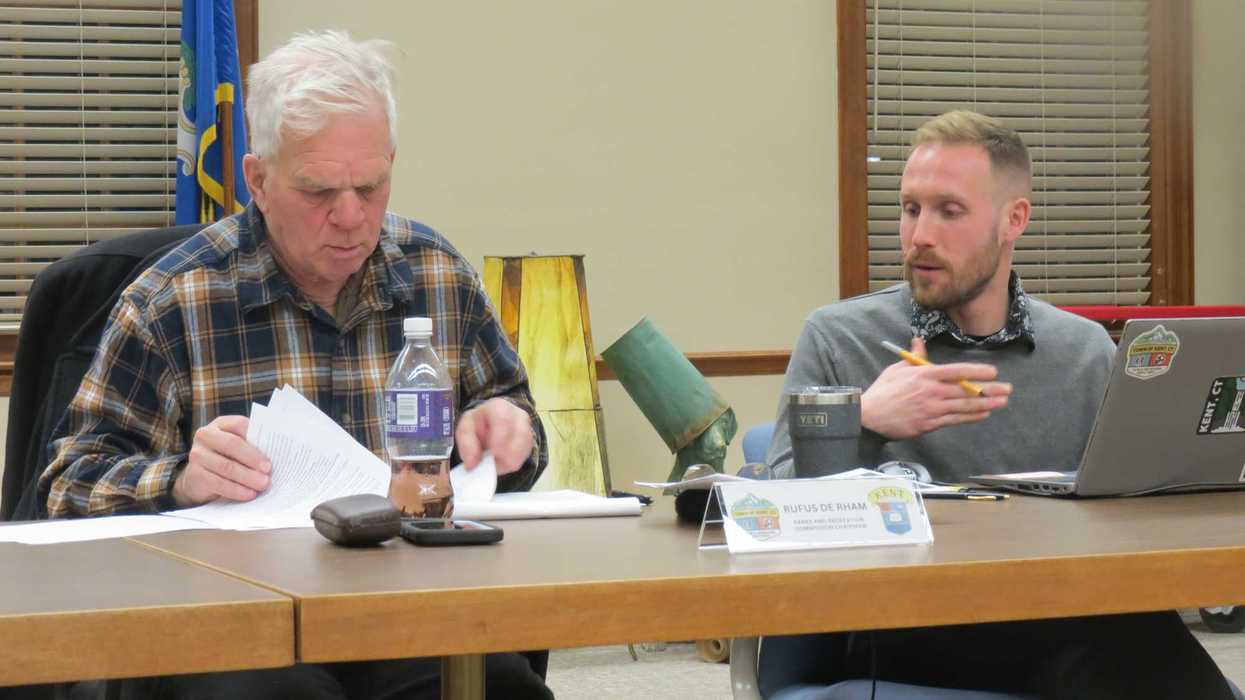
Kent Park and Recreation Commission Chairman Rufus de Rham, left, and Park and Recreation Director Matt Frasher confer during the Park and Recreation Commission’s meeting Tuesday.
Ruth Epstein

Kent Park and Recreation Commission Chairman Rufus de Rham, left, and Park and Recreation Director Matt Frasher confer during the Park and Recreation Commission’s meeting Tuesday.
KENT — The Park and Recreation Commission voted Tuesday, Feb. 3, to restore funding for staff salaries for the after-school program at Kent Center School, ensuring the after-school program will continue for another year.
The commission reinstated $9,722 in salary funding after reversing a decision made last month to eliminate the program as part of its proposed 2026–27 budget. Following nearly two hours of discussion, commissioners voted 4–2, with one abstention, to restore the funds.
The issue became a point of contention when the commission voted last month on a budget proposal that would “do away with the After-School Program,” according to the meeting minutes.
The move prompted several letters to the commission, including one signed by 34 residents, expressing deep concern.
“This announcement was made without prior communication to families who would be directly impacted by such a change,” the joint letter read. “This denies our town and families the opportunity for collaborative problem-solving about how to ensure that a stated priority of many residents—attracting and keeping families in our community—is also reflected as a financial priority of the town’s services.
“Additionally, reports that these reductions may be used to support administrative restructuring, including promotions or new positions, without clear explanation of how such changes would benefit working families, further undermines trust.”
In her own letter, resident Andrea Schoeny said, “It was shortsighted for the commission not to consider the impact” of such a move.
Parent Ginger Blake, whose son attends the program daily and who was at the meeting, said she was unaware that its closure was being considered. She was one of the 34 signers and found it disturbing that there was no response to the letter. “The lack of interest in what we want is stark,” she said.
Resident Cinda Clark, whose daughter also attends the program, said she understands it is not economically sustainable in its current form but noted that new families are expected to use it in the future. “It’s important to consider the broader public value. This is big for all of us. I consider it a program, not babysitting.”
In explaining the reasoning for the decision, Park and Recreation Director Matt Frasher provided extensive data on the history of the program. Enrollment is low, with only six families using the service.
Most of the children, an average of about five per day, are in the lower grades, with the older ones aging out to participate in other programs. He said there are also staffing shortages at times when emergency coverage is needed. The rate of $13 a day needs to be increased. A total of $25,000 is needed to run the program.
At the meeting’s outset, commission Chairman Rufus de Rham said, “We all agree the program is vital, but in other towns Park and Recreation is not always the operating force and it may not be the operating force here in the future.”
Commission member Kevin Frost said the town is subsidizing what he termed “a not insignificant loss.” He doesn’t think the Park and Recreation Commission should be the driving force and that parents should band together to seek a solution. Member Heidi Wilson said the program is just not working. “It needs to be completely reimagined. It cannot survive in its current format. We can work with other entities to come up with a solution.”
Before the commission voted to restore the funding, some members and residents questioned whether a new program model could realistically be put in place in time for the next budget cycle.
Clark said, “If you cut the budget, it seems like you don’t care. Seven months is a short time to implement a new model. If it’s not in the budget, we’re left without anything next year.”
Commission member David Schreiber argued that restoring the funds would provide needed breathing room. “Putting the money back in will buy us the time to create a subcommittee to come up with a viable solution,” he said. “If we don’t fund it, we’re putting the program to rest.”
Commission member Claire Love volunteered to head the subcommittee, which was endorsed by the commission.
Representatives from Kent Center School and the Kent Community Nursery School are expected to be asked to participate.

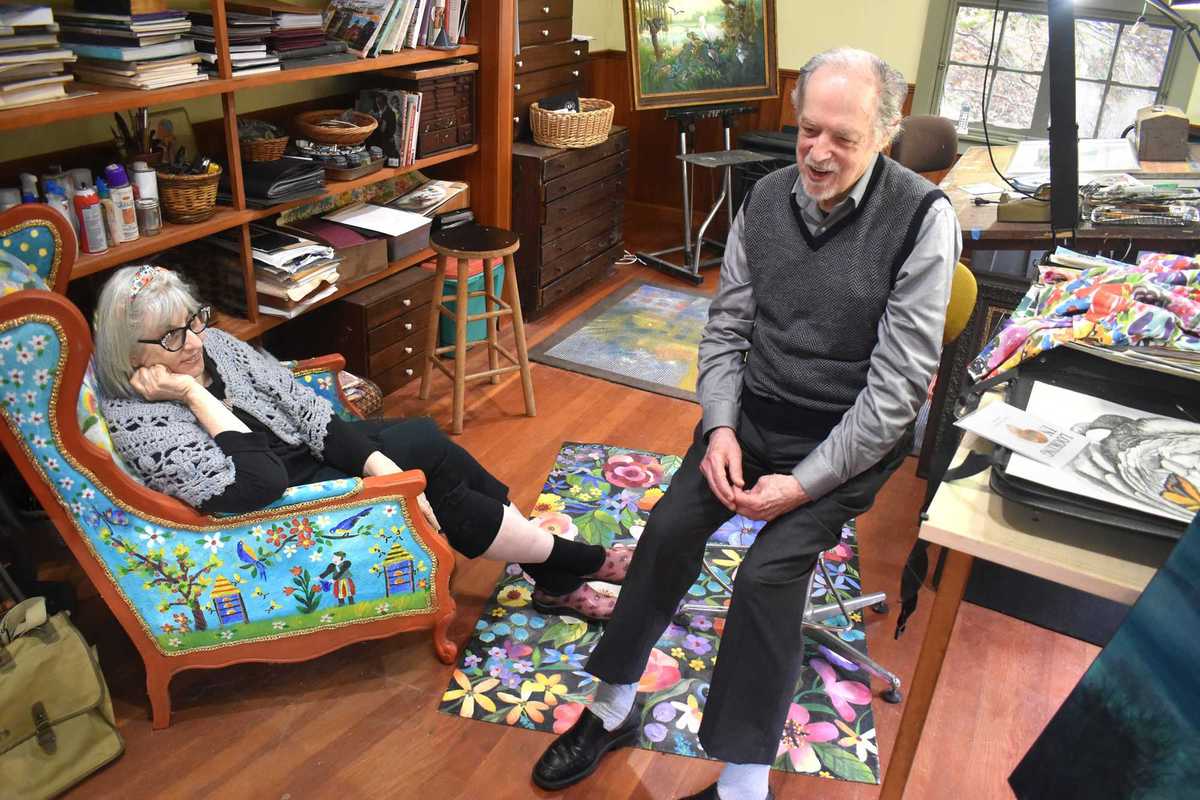
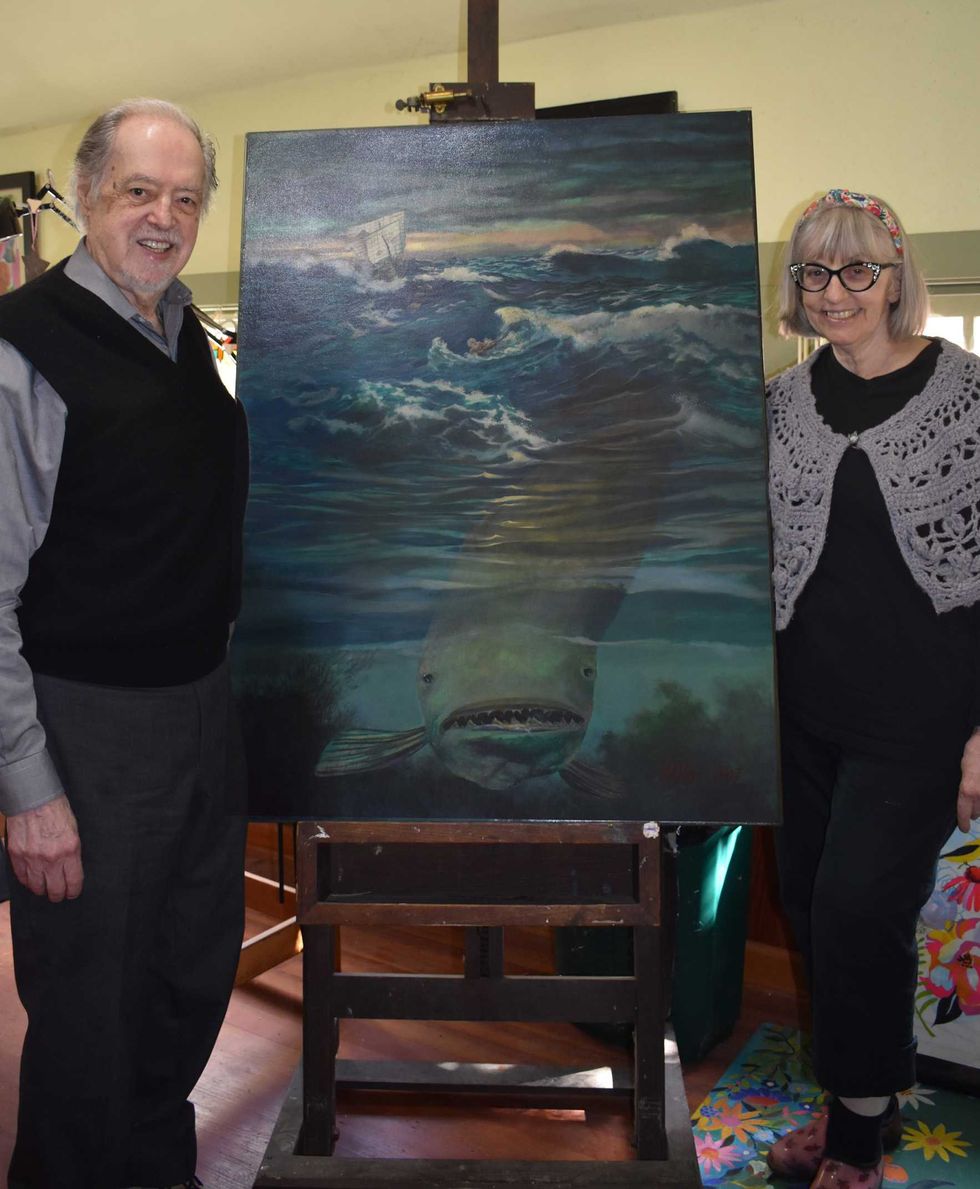
Laurie Fendrich and Peter Plagens at home in front of one of Plagens’s paintings.
He taught me jazz, I taught him Mozart.
Laurie Fendrich
For more than four decades, artists Laurie Fendrich and Peter Plagens have built a life together sustained by a shared devotion to painting, writing, teaching, looking, and endless talking about art, about culture, about the world. Their story began in a critique room.
“I came to the Art Institute of Chicago as a visiting instructor doing critiques when Laurie was an MFA candidate,” Plagens recalled.
“He was doing critiques with everyone,” Fendrich said of Plagens. “We met at one of those sessions and, well, what can I say. We fell in love instantly.”
Fendrich speaks candidly about the pressures that shaped her early life choices. “We both married the first time at 21, which a good number of women of my generation did without much thought.” Her first husband was a good guy, she says, but “we weren’t suited for each other at all, even though he suited my parents perfectly.” Her decision to get a divorce was seismic. “My mother didn’t speak to me for a year.” Time softened the rupture. “One day she told me, ‘I see now why you left.’”
Fendrich had a rigorous liberal arts education at Mount Holyoke. “I studied painting and drawing, but I also got interested in political philosophy. Plato, Aristotle, Machiavelli — Rousseau was my big guy — Tocqueville, everybody. And I still read them.” Plagens’s path was less formal. “I went to USC at 17,” he said, “and declared English as my major. It was a frat school, and I was in one for the first two years. Then I started doing the cartoons for the Daily Trojan, took a couple art classes, and thought, ‘Wait a minute, I like this.’”
Culturally, they diverged just as sharply. “I came from a fairly puritanical family that didn’t even go to the movies,” Fendrich said. Plagens, by contrast, grew up immersed in pop culture. “My father was an omnivorous reader,” he said, “and a jazz fan, and he shared these passions with me.” In 1966, Plagens walked into Artforum’s LA office and said, “I want to write reviews.” He was paid five dollars per piece. “Gasoline was 23 cents a gallon, so it went a long way.”
Over time, the couple slowly fused their educations. “He taught me jazz, I taught him Mozart,” Fendrich said with a laugh. “I’ve had a movie education from him; he read Jane Austen because of me.”

During their early years in LA, Plagens taught at USC, and Fendrich at Art Center College of Design. In 1985, they decided “our kind of abstraction would do better in New York,” as Fendrich put it. “So, we up and moved to Tribeca with $10,000 and a toddler.”
Both artists grounded their artistic careers in teaching and writing. “Teaching, which I loved, gave me the financial stability to be an artist,” Fendrich said, reflecting on her 27 years as a professor at Hofstra. “It meant that being an artist didn’t require I make money from every show. I didn’t start writing until 1999, but though I write for publication frequently, I make hardly any money at it.”
Artistically, they guard each other’s independence. “We have unspoken rules,” Plagens said. “You don’t comment on someone’s work while they’re in the middle of creating it.” Critique comes by invitation only. “He’s not mean, just direct,” said Fendrich. Over time, their aesthetics have subtly converged. “My work has gotten cleaner from looking at his,” she said. “He’s gotten more colorful because of me.”
The two have had several two-person exhibitions. At a recent duo show at the Texas Gallery in Houston “Laurie’s paintings flew off the wall,” Plagens recalled. “Me, well, not so much.”
Plagens’s parallel career in journalism shaped their lives in tangible ways. He worked as art critic at Newsweek from 1989 until 2003 and currently contributes reviews of museum exhibitions to The Wall Street Journal. “Being at Newsweek was one of the luckiest breaks I ever had,” he said. “They paid me to see things I would gladly pay to see.”
Their creative processes mirror their personalities. “I start with a specific idea,” Fendrich said, “and then modify things as I paint.” Plagens laughed. “I start with complete mush, just blurting it out and spending the rest of the time fixing it.”
In 2019, they made what Fendrich calls “a decision of contraction.” They left the TriBeCa loft they had lived in for three decades, sold their Catskills home with its large studio, and moved full-time to a former auto repair shop in Lakeville, now a house where each has a studio, and the ground floor retains the open feel of a loft.
What sustains them in life, art and love, decades in, are endless conversations — and arguments — about art, history, exhibitions, books and movies. That exchange, ongoing and rigorous, may just be the masterpiece of their shared life.
Hyalite Builders is leading the structural rehabilitation of The Stissing Center in Pine Plains.
For homeowners overwhelmed by juggling designers, architects and contractors, a new Salisbury-based collaboration is offering a one-team approach from concept to construction. Casa Marcelo Interior Design Studio, based in Salisbury, has joined forces with Charles Matz Architect, led by Charles Matz, AIA RIBA, and Hyalite Builders, led by Matt Soleau. The alliance introduces an integrated design-build model that aims to streamline the sometimes-fragmented process of home renovation and new construction.
“The whole thing is based on integrated services,” said Marcelo, founder of Casa Marcelo. “Normally when clients come to us, they are coming to us for design. But there’s also some architecture and construction that needs to happen eventually. So, I thought, why don’t we just partner with people that we know we can work well with together?”
Traditionally, homeowners hire designers, architects and contractors separately, a process that can lead to miscommunication, budget overruns and design revisions once construction begins. The new partnership seeks to address those challenges by creating a unified team that collaborates from the earliest planning stages through project completion.
“We can explore possibilities,” Marcelo said. “Let’s say the client is not sure which direction they want to go. They can nip that in the bud early on — instead of having three separate meetings with three separate people, you’re having one collaborative meeting.”
The partnership also reflects an expanded view of design, moving beyond surface aesthetics to include structural, environmental and performance considerations. Marcelo said her earlier work in New York City shaped that perspective.
“I had a 10-year career in New York City designing townhouses and penthouses, thinking about everything holistically,” she said. “When I got here and started my own business, I felt like I was being pigeonholed into only the decorative part of design. With the weight of an architect on our team now, it has really helped us close those deals with full home renovations, ground up builds and additions.”
The team emphasizes what it describes as high-performance design, incorporating modern building science, energy efficiency and improved air quality alongside aesthetic goals.
“If you’re still living inside 40-year-old technology and building techniques, we haven’t really handed off the best product we could,” said Soleau. “The goal is to not only to reach that level of aesthetic design but to improve the envelope, improve the living environment within a home and bring homes up to elevated standards of high-performance building.”
This integrated approach has proven particularly useful for renovation projects, where modern materials and systems can be thoughtfully incorporated into older structures. The firms also prioritize durability and long-term functionality, often incorporating antiques, vintage elements and high-quality materials designed to support clients’ lifestyles.
“I’m very big on investing in pieces that are going to be quality and last you the test of time,” Marcelo said. “Not just designing for a five- to 10-year run, but really designing for the long haul.”
The collaboration is already underway on several projects, including a major renovation in Sharon that involves rebuilding a 1990s modular home to maximize views while upgrading structural and performance systems. The firms are also exploring advanced visualization technology that would allow clients to experience projects through virtual reality before construction begins.
“For me, as somebody who wants to take the project all the way from beginning to end and make the process as effortless as possible for my client, it’s easier to do that with collaboration and a team than to do it alone,” Soleau said. “Most clients, especially second-home owners, want a team that can lead the project from concept through completion; aligning design, budget, and construction.”
On Feb. 19, the three firms will officially launch the initiative at an invitation-only event at The Stissing Center in Pine Plains, where Hyalite Builders is leading the structural rehabilitation of the historic building. A limited number of “hard hat tour” reservations will be available by request, providing rare, behind-the-scenes access while work is actively underway. Those interested in attending may contact event organizer Lauren Fritscher of Berkshire Muse at hello@berkshiremuse.com.
Autumn Knight will perform as part of PS21’s “The Dark.”
This February, PS21: Center for Contemporary Performance in Chatham, New York, will transform the depths of midwinter into a radiant week of cutting-edge art, music, dance, theater and performance with its inaugural winter festival, The Dark. Running Feb. 16–22, the ambitious festival features more than 60 international artists and over 80 performances, making it one of the most expansive cultural events in the region.
Curated to explore winter as a season of extremes — community and solitude, fire and ice, darkness and light — The Dark will take place not only at PS21’s sprawling campus in Chatham, but in theaters, restaurants, libraries, saunas and outdoor spaces across Columbia County. Attendees can warm up between performances with complimentary sauna sessions, glide across a seasonal ice-skating rink or gather around nightly bonfires, making the festival as much a social winter experience as an artistic one.
The Dark’s lineup includes several world and U.S. premieres. Highlights include Thomas Feng performing “Night Prayers,” a program of compositions by late Ethiopian composer and Orthodox nun Emahoy Tsegué-Maryam Guèbrou; Phil Kline’s outdoor participatory score “Force of Nature (February);” an audiovisual collaboration between composer David Lang and Academy Award-nominated filmmaker Bill Morrison; an interdisciplinary performance by Lee Ranaldo of Sonic Youth and multimedia artist Leah Singer; and “We Survived the Night: A Coyote Story in Four Parts” by Julian Brave NoiseCat.
For more information about The Dark or to purchase tickets, visit ps21chatham.org/the-dark
Exterior of the Linde Center for Music and Learning.
The Tanglewood Learning Institute (TLI), based at Tanglewood, the legendary summer home of the Boston Symphony Orchestra, is celebrating an expanded season of adventurous music and arts education programming, featuring star performers across genres, BSO musicians, and local collaborators.
Launched in the summer of 2019 in conjunction with the opening of the Linde Center for Music and Learning on the Tanglewood campus, TLI now fulfills its founding mission to welcome audiences year-round. The season includes a new jazz series, solo and chamber recitals, a film series, family programs, open rehearsals and master classes led by world-renowned musicians.
“We have been thrilled and humbled to see the Tanglewood Learning Institute embraced as a year-round destination for a breadth of exceptional programming, including classical, jazz and family-friendly events,” said BSO President and CEO Chad Smith. “Our 2025–26 fall, winter and spring season reflects our deepening commitment to engaging the vibrant, year-round Berkshires community and to fully exploring the potential of TLI as a space where BSO programs make thought-provoking connections between music, art and society.”
TLI is once again presenting its Chamber Concerts series on Sunday afternoons, with small ensembles of BSO musicians performing familiar favorites and classic mainstays, as well as new music by contemporary composers. There are upcoming chamber concerts scheduled for Feb. 22, March 8 and March 15.

New this season is the TLI Jazz series, which continues March 20 with the Sullivan Fortner Trio, led by Grammy Award-winning artist and educator Sullivan Fortner, whose eponymous ensemble won the 2024 DownBeat Critics Poll for Rising Jazz Group. “Soul-sax sensation” Nick Hemp brings his free-blowing blend of “barroom excitement and modern jazz finesse” for a rousing night of soul jazz April 10. Rounding out the jazz series, and back by popular demand, is Grammy Award-winning trumpeter and singer Jumaane Smith, who brings his repertoire of jazz and American Songbook standards to the Linde Center on May 9.
Another season highlight comes April 12 with an animated live concert screening of the 3D stop-motion adventure film “Magic Piano.” Produced by the Academy Award-winning BreakThru Films production company in Poland, the film will be accompanied by a screening of “The Chopin Shorts,” a collection of animated films set to Chopin’s etudes, performed by pianist Derek Wang.
All performances take place in Studio E, the Linde Center’s 4,000-square-foot multiuse room that serves as TLI’s main performance and event space. It features retractable seating, acoustic and technical systems, flexible configurations, and is accessible and comfortable for all patrons.
The entire Linde Center for Music and Learning is worth a visit in itself. The complex, which also includes the informal Cindy’s Cafe (seasonal) for a quick bite, is conceived not as a single building but as a cluster of pavilion-like spaces connected by an outdoor covered walkway and arranged around a century-old red oak tree. The center promotes a welcoming and serene sense of place and continuity with the rolling Tanglewood lawn and surrounding woodlands.
Smith said, “This ongoing work is also a passion project for our musicians, who form deep ties to the area and are eager to remain active in the Berkshires beyond the summer months. We look forward to welcoming new and returning audiences to experience all that TLI offers — all year long.”
The Tanglewood Learning Institute is located at 3 W. Hawthorne Road, Lenox, Mass. For more information and to purchase tickets,
visit bso.org/tli.