Our visit to Hancock Shaker Village

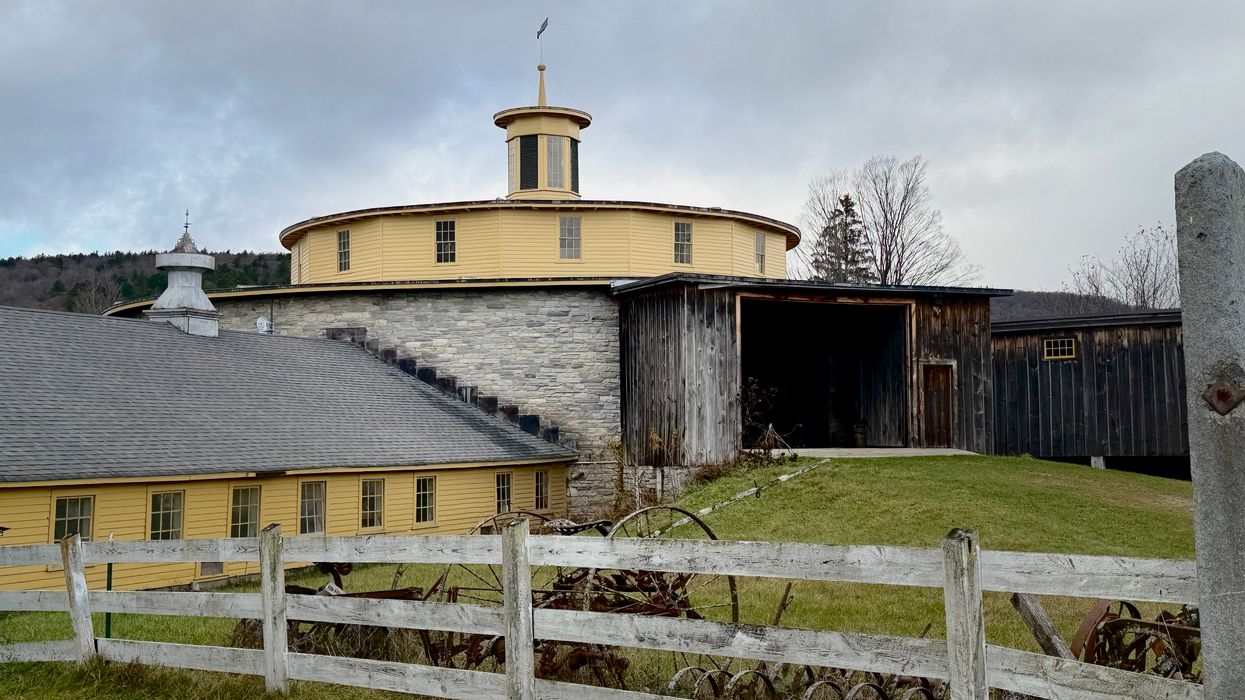
The Stone Round Barn at Hancock Shaker Village.
Jennifer Almquist

The Stone Round Barn at Hancock Shaker Village.
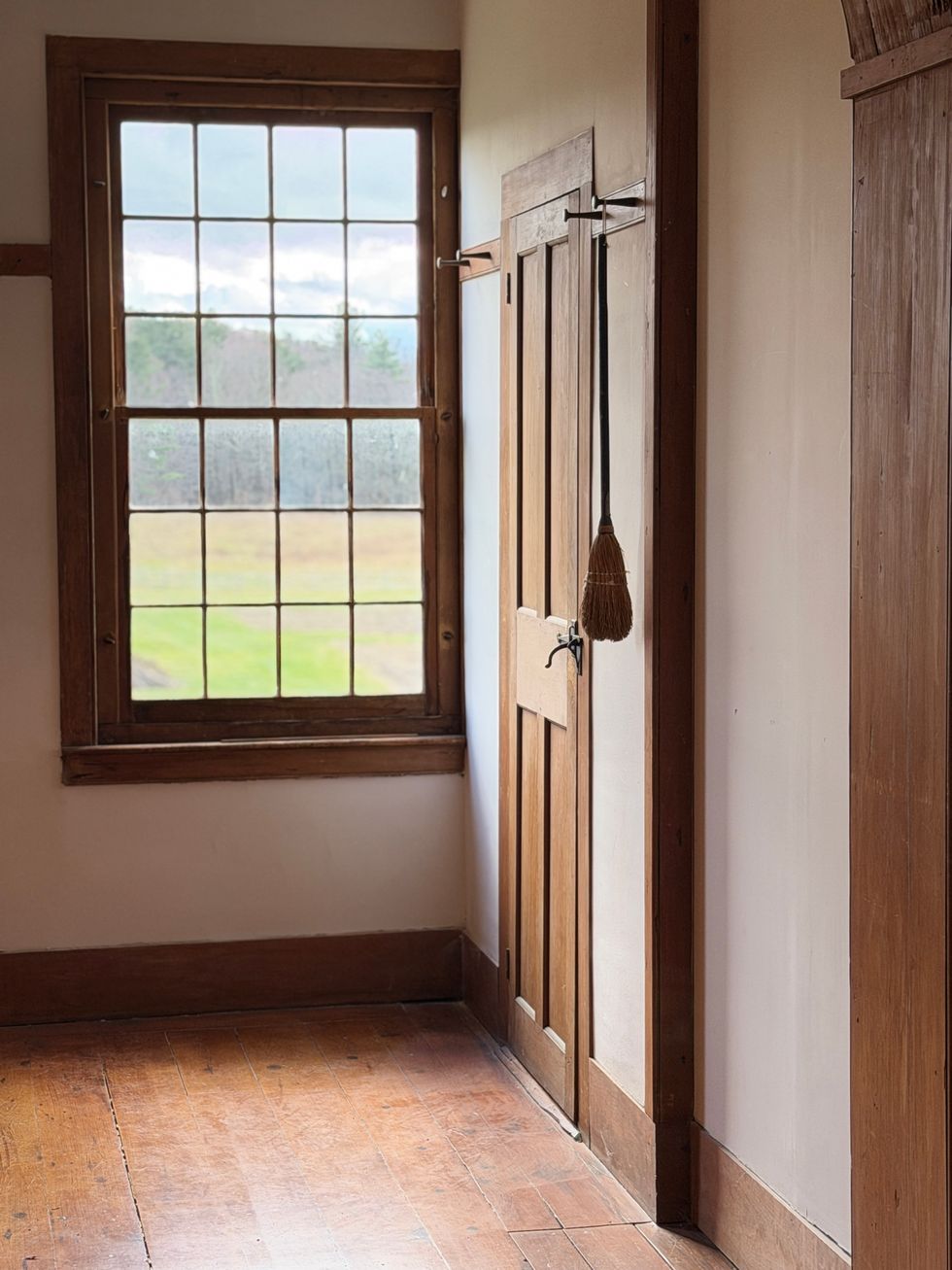
My husband Tom, our friend Jim Jasper and I spent the day at Hancock Shaker Village in Pittsfield, Massachusetts. A cold, blustery wind shook the limbs of an ancient apple tree still clinging to golden fruit. Spitting sleet drove us inside for warmth, and the lusty smells of manure from the goats, sheep, pigs and chickens in the Stone Round Barn filled our senses. We traveled back in time down sparse hallways lined with endless peg racks. The winter light was slightly crooked through the panes of old glass. The quiet life of the Shakers is preserved simply.

Originally founded in England, the Shakers brought their communal religious society to the New World 250 years ago. They sought the perfection of heaven on earth through their values of equality and pacifism. They followed strict protocols of behavior and belief. They were celibate and never married, yet they loved singing and ecstatic dancing, or “shaking,” and often adopted orphans. To achieve their millennialist goal of transcendental rapture, we learned, even their bedclothes had to conform: One must sleep in a bed painted deep green with blue and white coverings.
Shakers believed in gender and racial equality and anointed their visionary founding leader, Mother Ann Lee, an illiterate yet wise woman, as the Second Coming. They embraced sustainability and created practical designs of great utility and beauty, such as the mail-order seed packet, the wood stove, the circular saw, the metal pen, the flat broom and wooden clothespins.
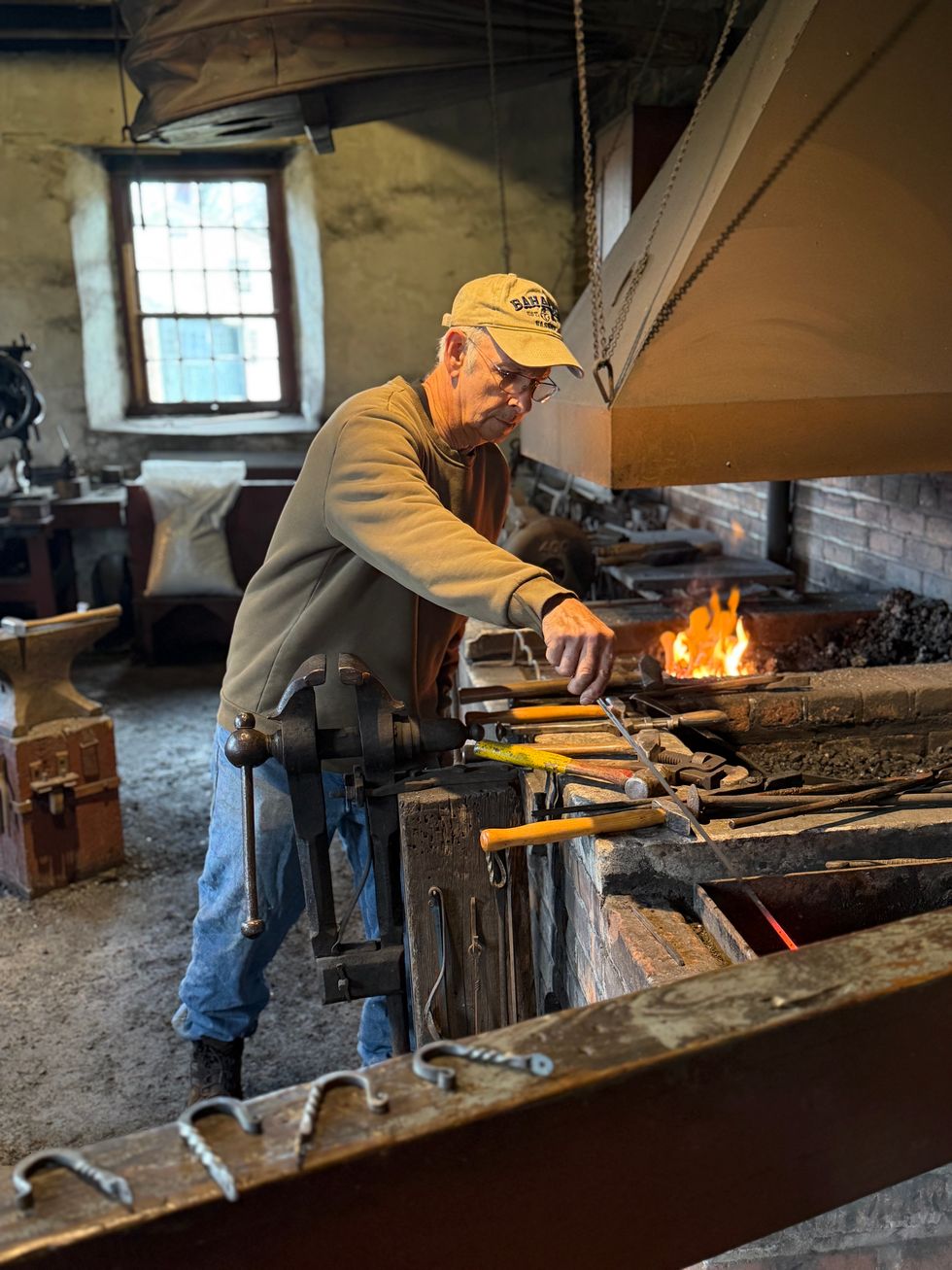
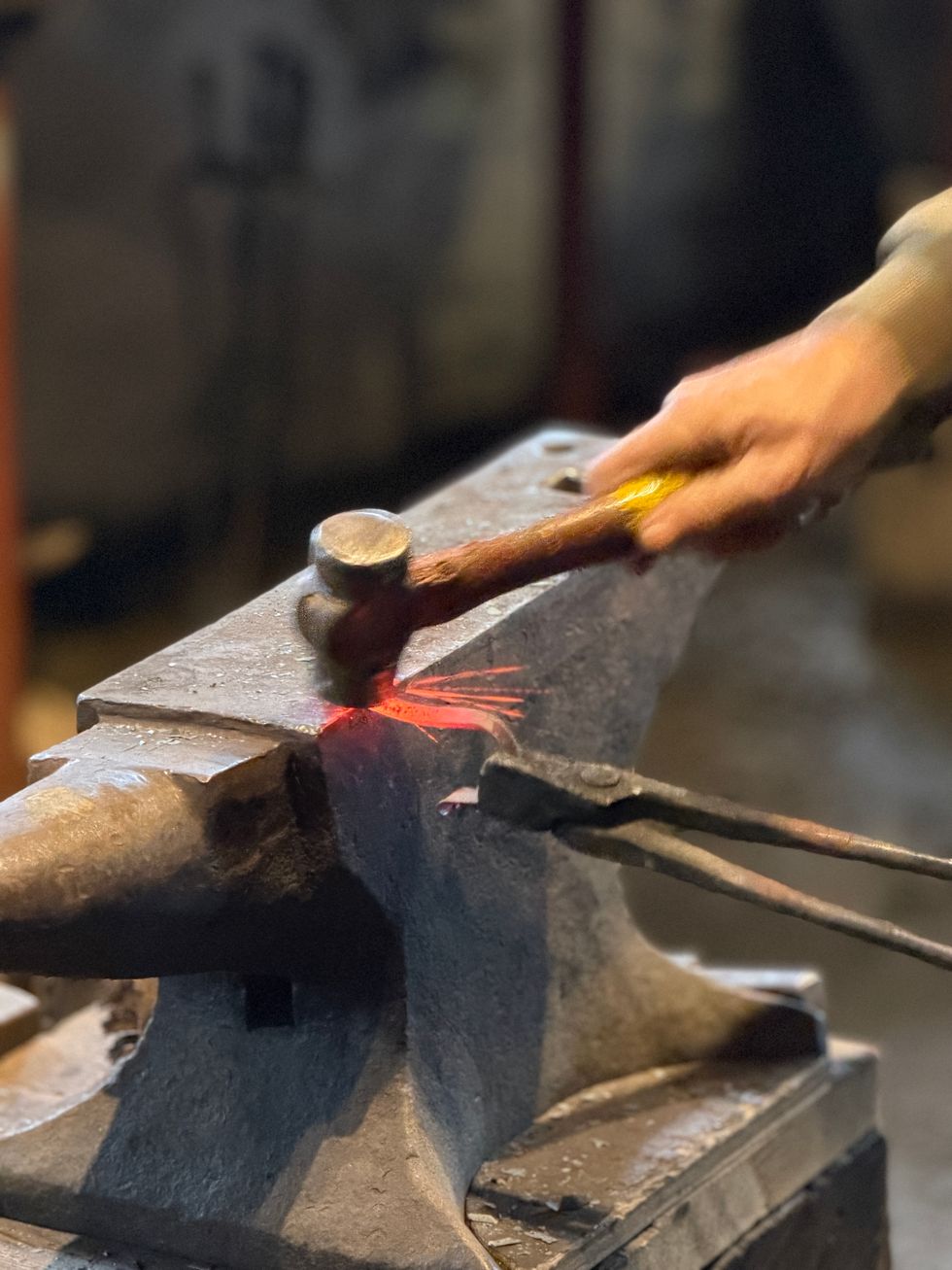
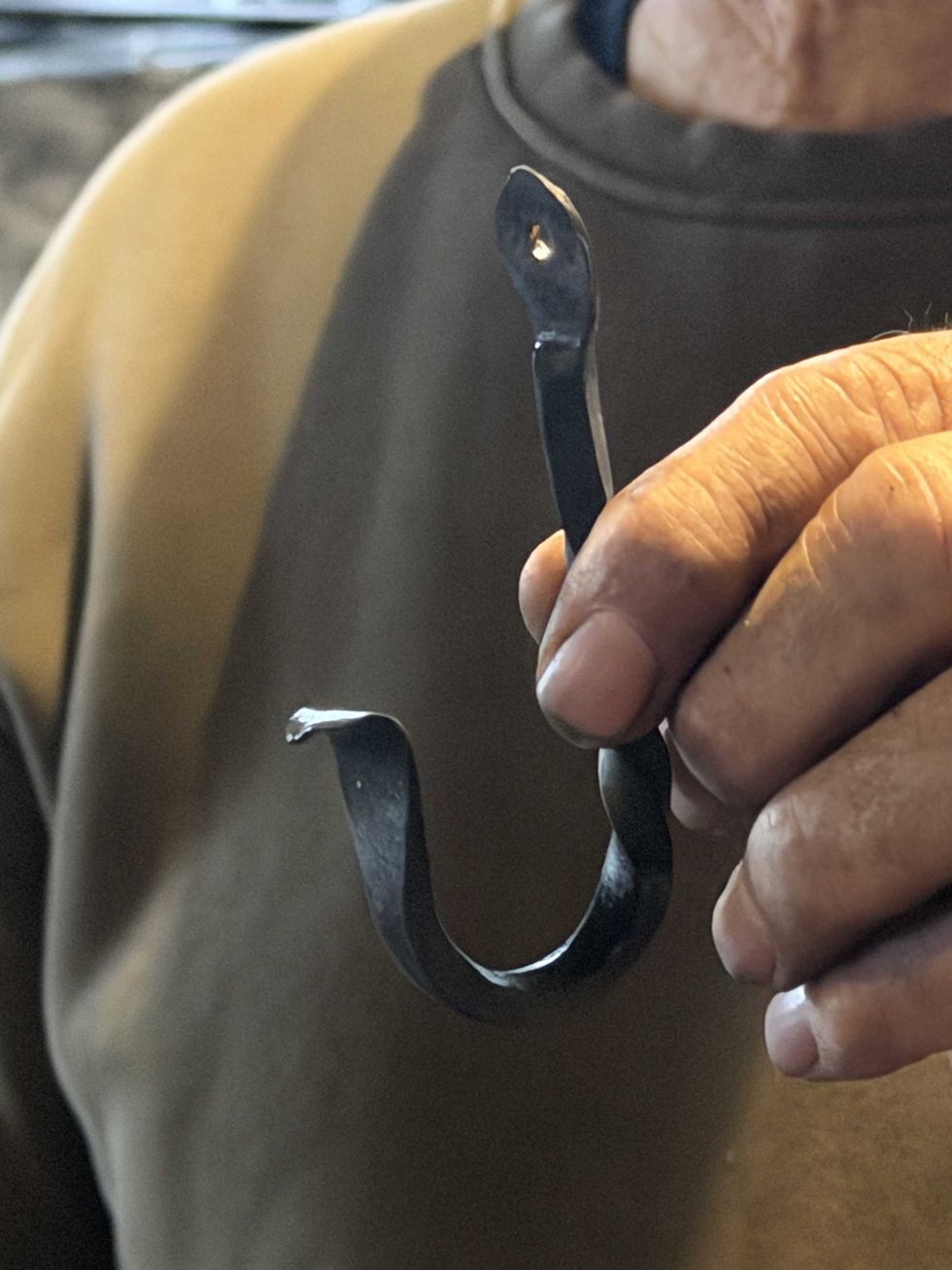
Burning coal smelled acrid as the blacksmith fired up his stove to heat the metal rod he was transforming into a hook. Hammer on anvil is an ancient sound. My husband has blacksmithing skills and once made the strap hinges and thumb latches for a friend’s home.
Shaker chairs and rockers are still made today in the woodworker’s shop. They are well made and functional, with woven cloth or rush seats. In the communal living space, or Brick Dwelling, chairs hang from the Shaker pegs that run the length of the hallways, which once housed more than 100 Shakers.

In 1826, the 95-foot Round Stone Barn was built of limestone quarried from the land of the 3,000-acre Hancock Shaker Village. Its unique design allowed a continuous workflow. Fifty cows could stand in a circle facing one another and be fed more easily. Manure could be shoveled into a pit below and removed by wagon and there was more light and better ventilation.
Shakers called us the “people of the world” and referred to their farm as the City of Peace. We take lessons away with us, yearning somehow for their simplicity and close relationship to nature. One Shaker said, “There’s as much reverence in pulling an onion as there is in singing hallelujah.”
A sense of calm came over me as I looked across the fields to the hills in the distance. A woman like me once stood between these long rows of herbs — summer savory, sage, sweet marjoram and thyme — leaned on her shovel brushing her hair back from her eyes, watching gray snow clouds roll down the Berkshires.
More information at hancockshakervillage.org
Alec Linden
Joseph Markow, who has nearly two and a half decades of experience teaching middle school science in the Northwest Corner, identifies several masses of salamander eggs suspended below the surface of the vernal pond.
SHARON – What do you call a pond with no fish that disappears for half the year? Scientists call it a vernal pool, and it is no riddle, but a vital component of the Northwest Corner’s woodland ecosystems.
Much like a riddle, however, these murky, transient ponds harbor secrets below the surface, and with a little prodding, can reveal surprising truths. On Saturday, April 11, the Sharon Land Trust hosted an evening hike in the aim of doing just that and demystifying these misunderstood resources.
As the sun was setting high on the ridge of Red Mountain, local science teacher Joseph Markow – who guided the excursion alongside landscape professional and sustainability expert Robin Zitter and Sharon Land Trust staff – pointed to a depression full of inky black water.
Without vernal pools, he said, “wood frogs would disappear very quickly.” The wood frog, a small, primarily land-dwelling amphibian, is an example of an “obligate” species, Markow explained – an animal that has adapted to rely on ephemeral wetlands to breed since they are devoid of fish, which eat the eggs and young of amphibians.
As Markow spoke, he gestured towards a lumpy, jelly-like mass half submerged in the murk that resembled a clump of soaked chia seeds: a cluster of wood frog eggs. An undiscerning developer may not notice the signs of life in what otherwise looks like a puddle in the woods, he said. And if the survey is done when the summer heat has dried up the pond, the habitat may be missed entirely.
Zitter sits on Sharon’s Inland Wetlands and Watercourses Commission, which co-hosted Saturday evening’s hike, and said that this is a reason the town needs to codify protections for these delicate resources that so many species, especially amphibians, rely on. She said the IWWC is taking steps to insert those protections into the town’s Plan of Conservation and Development, a ten-year guidance document that is due for an update this year.

She pointed out many species that rely on vernal pools actually spend most of their lives in the terrestrial territory surrounding it – known by ecologists as “upland” habitat. It’s not only the ponds themselves that need protection, she explained, but the broader landscape that supports these types of wetlands.
Luckily, the vernal ponds on Red Mountain are in no immediate danger, at least from development. Its ridgeline and expansive, wooded slopes are part of a network of protected forest and agricultural lands. The Sharon Land Trust’s 278-acre Hamlin Preserve, within which Saturday’s hike was held, connects to the Mary Moore Preserve, another Land Trust property, via a trail that traverses easement-conserved land on the Wike Farm.
The hilltop forest was relatively quiet Saturday evening, which Markow attributed to a brisk wind and recent cold. Like humans, frogs prefer to wait for more comfortable conditions before breaking out in springtime song.
On a warmer evening, Markow said the area around the pond would likely be abuzz with a shrill chorus from the spring peepers – tiny tree frogs whose emergence is a classic symbol of the end of a New England winter.
Markow said that close, extensive exposure to the pitchy trill of spring peepers can actually damage hearing. “They’re louder than a rock concert at times,” he said, reaching 90 decibels at close range.
Markow was ready for a subdued night. Before taking the group into the woods, he gave a presentation with a cast of critters he’d plucked from a vernal pool near his house earlier in the day. A microscope setup provided viewers with an up-close view of the tiny and aptly named fingernail clam, which spends its entire lifespan in vernal pools, burying itself in moist mud to survive when the water dries up.
He also demonstrated another uniquely adapted species. “You’ll see a stick just get up and start walking around,” he said while passing around a small sample vial with a wriggling brown mass inside, “and that’s a caddisfly.” The resourceful larvae of these insects use found materials in the vernal pools to create a protective armor around themselves.
The crowd favorite was a small red-backed salamander that he showed off straight from the palm of his hand. “It’s cool enough today that they are pretty calm,” he said, just before the amphibian started to wriggle with purpose. “It’s waking up in your hand!” came a shout from the crowd.
Patrick L. Sullivan
TORRINGTON – Community Health & Wellness Center (CHWC) announced Monday, April 13 that dental services will be reinstated effective Monday, April 20 at the Torrington Health Center.
In February 2025, CHWC made the decision to suspend dental services indefinitely due to significant financial shortfalls, largely due to underfunding of its high-cost dental services by the state of Connecticut’s Medicaid program.
After negotiations, an agreement was reached in July 2025 to provide Connecticut’s 17 Federally Qualified Health Centers with $80 million in adjustments over the next three years to align to 2023 costs.
Heading the Dental Department at CHWC will be Dr. Ting Luo. Dr. Luo has an extensive career spanning from time served in the US Army as a dental officer, to hospitals and health centers, and most recently as the civilian dentist at the US Coast Guard Base in Boston for ten years.
CHWC will offer routine exams, cleanings, X-rays, fillings, simple extractions, fluoride treatments, scaling and root planning and sealants. More extensive procedures like bridges, root canals and denture care will be evaluated for referral to community partners.
Dental services will be available at the Torrington Health Center Monday through Thursday from 8:30a.m. until 7 p.m. to start. A date to resume dental services in Winsted is yet to be determined.
John Coston
Devin Grosso, left, Lisa Auclair, center, and April Carter founded a nonprofit Northwest Farm to Fork, a new farmers market that will run every third Wednesday starting May 20 at Norbrook Farm Brewery on the Norfolk-Colebrook line.
COLEBROOK – The Northwest Corner is getting a new farmers market next month. Three women who lamented the closing of the Norfolk Farmers Market last year have teamed up to start a new market at Norbrook Farm Brewery on the Norfolk-Colebrook border at 204 Stillman Hill Road.
Beginning Wednesday, May 20 from 5 to 8 p.m. the Northwest Farm to Fork will open under the pavilion at Norbrook, offering food and farm goods such as poultry and beef, produce, flowers, plants prepared foods, including sourdough bread – and live music. The market will run every third Wednesday through October.
“When Norfolk folded last year, we wondered if there was a way that we could bring back a farmers market,” said Devin Grosso, who moved to Norfolk a year ago from Los Angeles. She and April Carter, a fifth generation farmer from Torrington, and Lisa Auclair of Norfolk, who managed the Norfolk market, formed a nonprofit and started scouting for vendors.
To date, Grosso said 20 vendors have been signed. They include Ford Farm in East Canaan, Roy’s Bakery and Farm in Winsted and Jenny’s Greens in New Hartford.
“Anyone who attends can take advantage of what Norbrook has to offer,” Grosso said. “And we picked a day when people are often there for dinner.”She imagines people coming to eat and shopping for weekend groceries.
Norbrook Brewery opened in 2019 and quickly became a popularvenue for young and old with its farm-brewed beers, food offerings and outdoor activities, including hiking and biking trails, bike rentals and disc golf, plus farm animals. A recent expansion has added seating and a tasting room, and a pavilion is nearly complete just beyond the parking lot.
Farmers markets are a staple in the Northwest Corner. Markets in Cornwall and Kent have long-established traditions of drawingregulars for weekend shopping on Fridays in Kent and Saturdays in Cornwall. Millerton also offers a market on Saturdays and there are markets farther afield in Torrington and Collinsville and in Massachusetts in Great Barrington, West Stockbridge and Pittsfield.

Want more of our stories on Google? Click here to make us a Preferred Source.
Patrick L. Sullivan
FALLS VILLAGE — Following a quiet public hearing without questions, the Region One Board of Education voted on Thursday, April 9 to send a $19.5 million 2026-2027 budget proposal to a referendum vote in all six towns. The budget marks a 5.67% increase from last year, and towns will have an opportunity to vote on Tuesday, May 5.
The hearing took place at Housatonic Valley Regional High School (HVRHS) and online.
Flora Lazar, the regional board member from Salisbury and a member of the budget committee, said the budget process had been “meticulous.”
Lazar said the committee started with a considerably higher figure and worked to bring it down.
“What we arrived at is what we must do,” she said.
Sam Herrick, the Region One Business Manager, delivered the presentation, noting that it was developed through a detailed and collaborative process involving board members, administration and department leaders.
The Region One budget has three components: HVRHS, Pupil Services –which includes special education – and the Regional Schools Services Center (RSSC), also known as the Central Office.
The HVRHS budget proposal is for $9,408,838, an increase of $273,260 or 2.99%.
The Pupil Services budget proposal is for $8,111,086, an increase of $588,530 or 7.82%.
The RSSC budget proposal is for $2,013,716, an increase of $186,642 or 10.22%.
The total is $19,533,640, an increase of $1,048,431 or 5.67%.
Herrick said a little over 98% of the overall increase comes from health insurance costs, salaries, and Pupil Services.
On the latter, Herrick said $449,230 of the $588,530 increase at Pupil Services is for tuition and transportation for out-of-district placements.
Following the presentation, moderator Sara Woloszyn asked for comments or questions.
Receiving none, the hearing was closed.
Town assessments
Assessments by town if the Region One budget proposal passes on Tuesday, May 5.
Canaan/Falls Village: $1,752,589 an increase of $208,904 or 14.89%.
Cornwall: $2,168,169, an increase of $163,895 or 8.87%.
Kent: $2,783,359, an increase of $171,360 or 7.48%
North Canaan: $6,140,112, an increase of $519,526 or 9.11%.
Salisbury: $4,798,928, an increase of $17,835 or .43%.
Sharon: $1,890,486, a decrease of $33,356 or - 2.07%.
Lakeville Journal
Remembering and praying for our towns
Preparations for this summer’s Bisesquicentennial, 250th, anniversary remind me of our Bicentennial celebrations in the summer of 1976.I was a child living on the Green in Sharon with my family.
The whole town had a picnic on the Green — we sewed bonnets and ribboned badges, had special quarter dollars in our hands, and speeches in words long gone told a message of hope, dedication and pride. Also the Clothesline Sale on the Green set a lifelong standard for craft and artistry.
Memorial Day we wove ribbons in our bike wheels and carried banners while marching around the Green together. From then on I discovered a longing to return to Sharon.
It wasn’t just the beauty and the color of that summer, it was who we were. There was a generosity to the way we treated each other that goes back to the timeless “one anothers” of the Bible.
A sense of hospitality in the welcoming front porches, with each dwelling’s unique gifts blossoming alongside an orderly, conscientious community rooted in the laws of a gracious and loving God. Do right even when no one is looking. Don’t hold grudges. Forgive. Remember we share one maker. Love one another.
The villages I love are full of churches which hold a sweetness and peace that is a big part of what I treasured. Through prayer we have access to God’s help, guidance, correction and hope. Through prayer, and praying together, we can bring these beautiful truths to full flower in our own lives, in our community, and across the nation. And we can share prayer with a new generation. Let’s pray together! The National Day of Prayer will be celebrated for the 75th time this May 7th at 6 p.m. at the Salisbury Town Hall.
Sarah Davis Hughes
Lakeville

Want more of our stories on Google? Click here to make us a Preferred Source.

Want more of our stories on Google? Click here to make us a Preferred Source.