I decided right there and then that this would be my life.
—Paul Chaleff
Paul Chaleff never thought he’d be an artist and never quite considered himself an insider. Even with a career that has brought his ceramics into some of the world’s most prestigious museums and the homes of collectors around the world, the Ancram-based art world pioneer still describes himself as something of an outsider. Perhaps this independence of spirit is precisely what makes his journey so extraordinary.
Chaleff grew up in the Bronx, the youngest of three sons in a working-class family. His father, a Jewish baker, immigrated from Poland (in what is now Belarus) at 13; his mother, the daughter of Austrian immigrants, worked as a secretary. They lived next to a cooperative housing development built in 1919 at Bronx Park East and Allerton Avenue, a community Chaleff fondly remembers as a “workers’ paradise” and where many of his father’s relatives lived.
There were no artists in the family and no connections to the art world. Yet, as a child, Chaleff loved making things. When his parents bought a house and renovated it themselves, his job was to collect nails with a magnet. He also loved spending time in his great-uncle’s workshop, shellacking and helping with small projects. He was an adventurous child and roamed the neighborhood collecting anything that caught his eye. His father often joked that there wasn’t a piece of neighborhood trash Chaleff didn’t drag home.
Still, he never imagined these experiences might lead to a life in the arts.
At the Bronx High School of Science, he excelled in geometry. “No one could come close to me,” he recalled. “I felt comfortable with three-dimensional space; it made sense to me.”
He enrolled at City College of New York (CCNY), intending to study science and perhaps become a dentist. Art was something he enjoyed, but he had not considered it as a career. Then one of his professors asked a question that changed everything: “Why are you studying biology? Don’t you know you were born to be an artist?”
When Chaleff admitted he’d never even visited an artist’s studio, the professor arranged a visit to a friend’s studio in the West Village.
“I decided right there and then that this would be my life.”
At CCNY, Chaleff studied under accomplished ceramic artist and educator Walter Yovaish, who became a longtime friend and mentor. He was in the first group to graduate with an MFA from the college’s new program, earning a fellowship and teaching in the ceramics department. His early work included ambitious clay murals and sculptural fountains, some inspired by the social and political issues of the day.
But it was Japanese ceramics and calligraphy that would ultimately shape his artistic direction. A fifth-century Japanese wood-fired bottle by one of Rosanjin’s workers, displayed at the Japan House Gallery in New York and associated with the ancient anagama firing tradition, made a lasting impression.
Through a fortunate friendship with legendary Japanese calligrapher Kampo Harada, Chaleff moved to Japan, spending two years studying ceramics, working alongside accomplished Japanese artists and mastering the demanding tradition of wood-fired pottery.
Returning to the United States, he joined a group of artists establishing Stissing Hollow Craftworks, a craft community in Pine Plains. He built a studio and one of the country’s first anagama wood-fired kilns, bringing the ancient Japanese ceramic tradition to America.
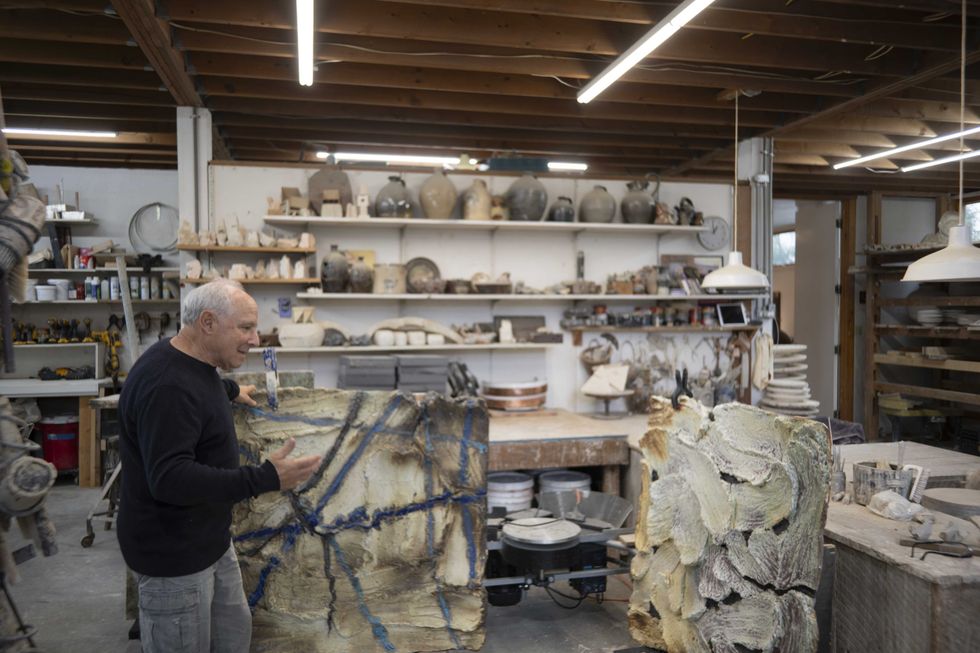 Paul Chaleff in his studio with some recent ceramic sculptures.Annette Stover
His ambition was not simply to recreate Japanese pottery but to develop a language of his own while making beautiful, meaningful ceramics that were within reach of all.
Recognition followed. At the 1978 Rhinebeck Crafts Fair, his work caught the attention of Rand Castile, founding director of the Japan House Gallery. Astonished by what this American artist had accomplished, Castile introduced Chaleff’s work to Arthur Drexler, the celebrated director of the Museum of Modern Art’s Department of Architecture and Design.
Today, Chaleff’s work is held in the permanent collections of the Metropolitan Museum of Art, the Museum of Modern Art, the Museum of Fine Arts in Boston, the Los Angeles County Museum of Art and the Smithsonian’s Renwick Gallery, among many others.
Yet international recognition has not changed his daily routine. Chaleff continues to work every day in his renovated sculpture studio in Ancram, where he lives with his wife, Haesook Kim, a retired professor of sociology.
There is plenty to look forward to. Chaleff’s work can be seen in the “Perfect Imperfection in Ceramics” recurring exhibition at the Metropolitan Museum. MoMA plans to include one of his vases in their exhibition, “Bold Is Better: ‘80s and ‘90s Design,” opening Jan. 17. Closer to home, beginning Dec. 5, Mad Rose Gallery in Millerton will showcase a selection of his powerful and socially significant cylindrical forms, new wood sculptures and a group of jar forms.
There is something timeless about Chaleff’s ceramics. They seem almost discovered rather than made, as though the earth has been waiting for his artistic vision to release long-dormant shapes and structures in clay.
There was no road map for his journey from a working-class Bronx neighborhood to Japan and the world’s great museums. It came through curiosity, friendships, a willingness to take chances, his sense of humor and, as Chaleff readily admits, a good deal of luck.
We are fortunate that this internationally celebrated artist continues to make his home and his art here in our community. And even more fortunate that he is still making something new every day.
 Provided

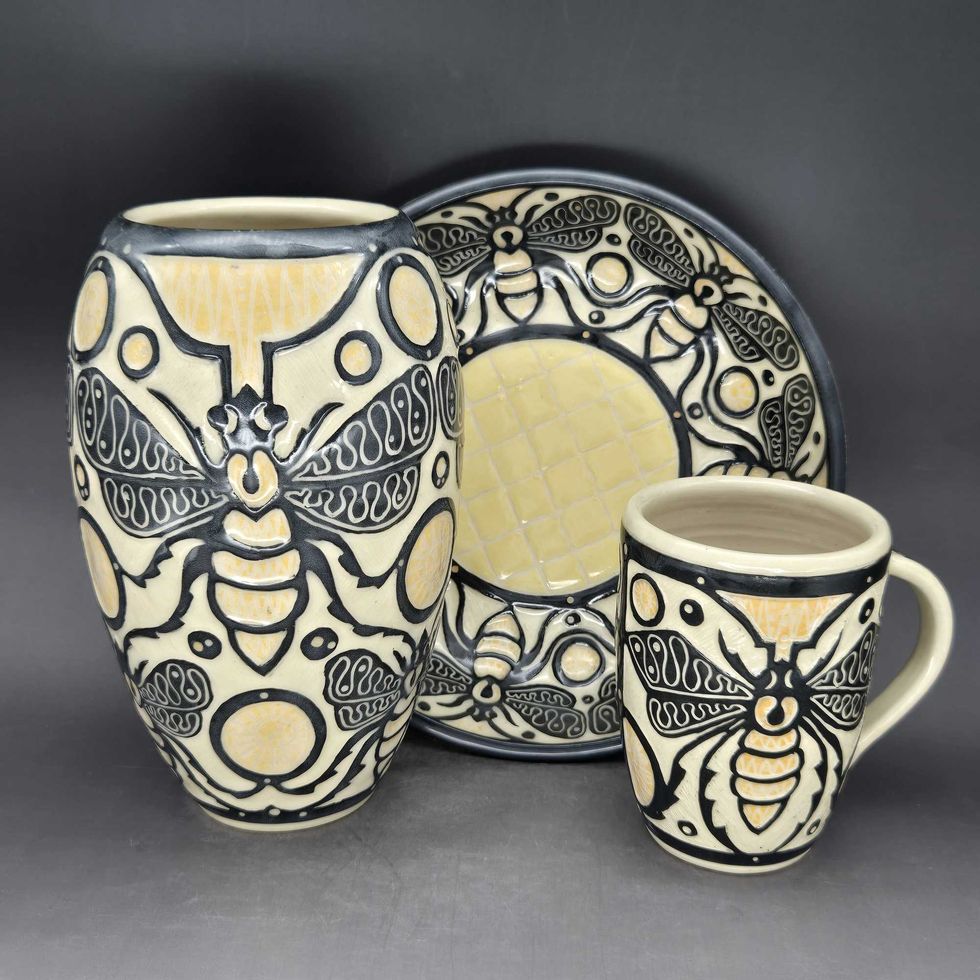 Stoneware by Dale Wolfield. Provided