Thank you!
Your support is sustaining the future of local news in our communities.

Robert Cronin, 90, reflects on career as an artist and a brush with Picasso

Robert Cronin, 90, reflects on career as an artist and a brush with Picasso

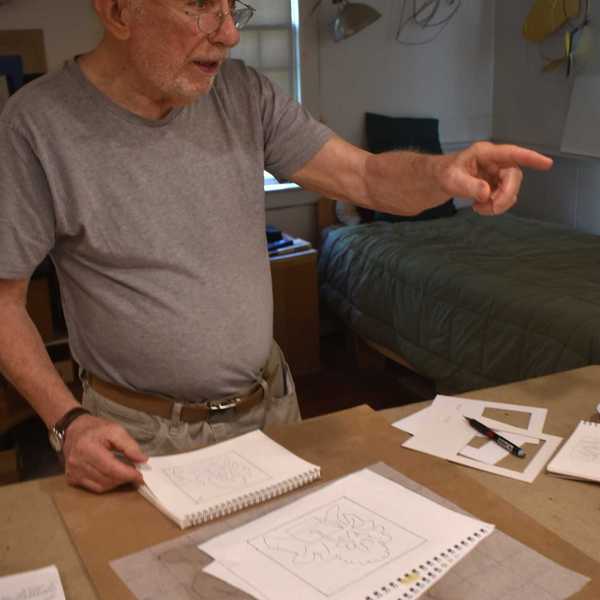
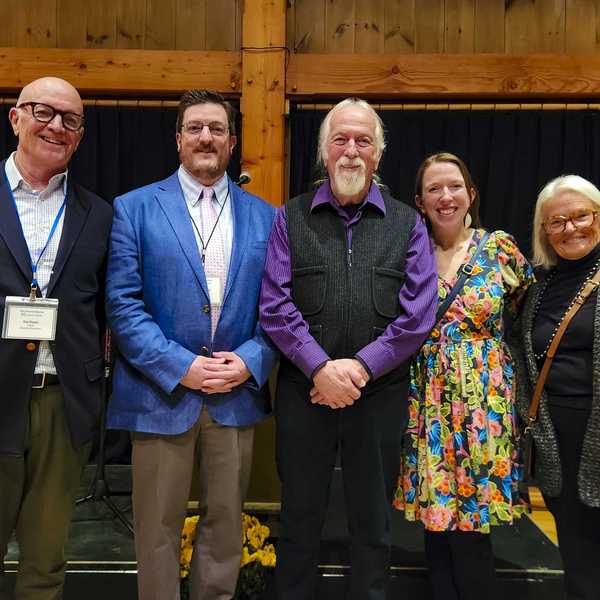
Artist Robert Cronin, left, and Hunt Library volunteer Garth Kobal prior to Cronin’s retrospective talk Thursday, Aug. 13.

Patrick l. Sullivan

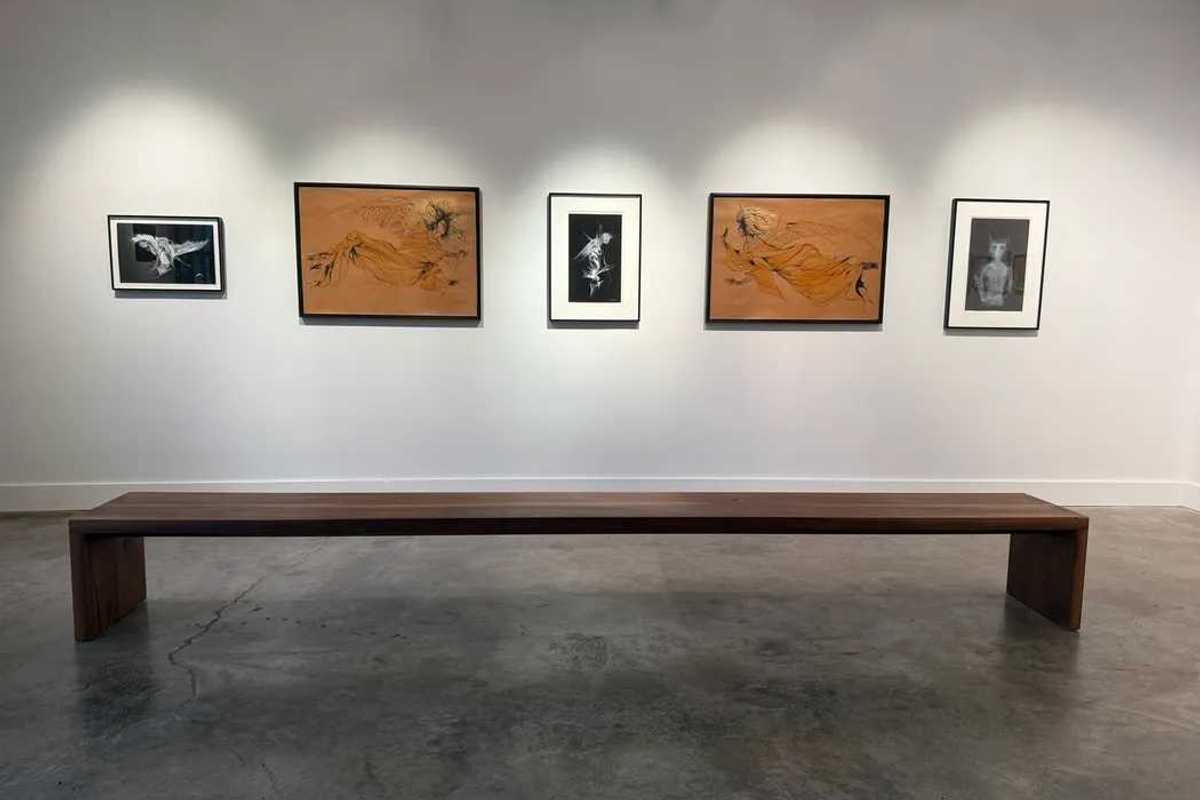
FALLS VILLAGE — Painter Robert Cronin provided an overview of his career – including a close encounter with Pablo Picasso – at the David M. Hunt Library Thursday, Aug. 13, shortly after the opening of his current exhibit of paintings on the library’s ArtWall, on view through Sept. 11.

While Cronin, 90, is known today for his prolific body of work including abstract paintings, he began his foray into art with an attempt at industrial design — an attempt to make a 14-inch model of an automobile, to be more specific.

Cronin said that in the 1950s, General Motors sponsored a competition that brought select young designers to the Midwest to meet GM executives.

“If you won first prize in your state, you were flown to Detroit,” Cronin said of the contest, in which he saw some success, although he wasn’t invited to Michigan.

He participated throughout all four years of high school in the early 1950s and earned honorable mention a couple of times. As a prize, he remembers winning an X-Acto knife set, which impressed the young man.

Cronin said his interest gradually shifted from industrial design to fine art, and at the Rhode Island School of Design he “made an impression” on the faculty and fellow students with an exercise he completed for “2D class.”

“The professor hung it over a window for the whole semester,” Cronin recounted.

During the talk, he showed two slides: one a portrait of his girlfriend at the time and one self-portrait, along with photos of his abstract art pieces.

“I enjoyed the instinctive connection of abstraction and the discipline of representation,” he said.

Ultimately, Cronin’s career went in the abstract direction.

In 1969, now an established artist and art teacher, Cronin and his wife, Connie, traveled to Nice, France, and the surrounding area for a five-week stay.

One day they decided to drive to the nearby town of Vallauris to see Pablo Picasso’s pottery at the Galerie Madoura.

As they left the gallery, a Lincoln Continental pulled up, looking ostentatious and out of place.

Pablo Picasso, a very small man, emerged from the Lincoln, a very large car.

“He was wearing a bathrobe, basically,” Cronin said. “We just flipped.”

Connie managed to take a furtive snapshot, but they didn’t want to impose.

So they went for lunch instead.

On the way back to their car, the Lincoln appeared again, heading toward them.

“I said, you wave, I’ll get the picture.”

Picasso, recognizing them from the earlier encounter, leaned out the window and said ‘bonjour’ with a big smile. “He had such a happy face,” Cronin said.

Cronin had a Kodak Instamatic camera and, although he got a photo of Picasso going by in the passenger seat of the Lincoln, it wasn’t “THE” photo.

“This would have been a famous, iconic photo,” said Cronin. “But I missed it.”

Latest News

Benjamin Franklin’s glass armonica comes to the Berkshire Opera Festival

Dennis James plays the glass armonica in Colonial costume.

Dennis James

In the early 1760s, Benjamin Franklin was one of the most popular people in the world. The writer, printer, inventor and electricity pioneer was known throughout the British Colonies in America, as well as in Europe, as a respected intellectual and diplomat. While we know him as one of the Founding Fathers of the United States, he spent almost a third of his life in Europe. Eight of those years were spent in France, working to secure support from the French military during the Revolutionary War. But before that, he spent 18 years in England as a diplomatic representative from the colonies.

It was during that time when Franklin first witnessed a musician play a series of glass bowls by wetting his fingers and drawing them across the bowls’ rims. The sound was haunting and otherworldly — like nothing he, nor anyone else, had ever heard before. But as Franklin was transfixed by the sound, he saw what many great innovators see when witnessing something new: inefficiencies. The musician was moving all over the place, working far too hard to make these angelic sounds. So Franklin went about fixing the problem.

Keep ReadingShow less
More than movies: Jeremy Boviard found his calling at The Moviehouse

Jeremy Boviard, General Manager at the Moviehouse in Millerton.

Annette Stover
There’s something special about sharing a story in a room full of other people.
— Jeremy Boviard

More than movies: Jeremy Boviard found his calling at The Moviehouse

Spend a few minutes talking with Jeremy Boviard about movies and you’re likely to forget what time it is.

Keep ReadingShow less
The mycelial web of nature, creativity, science and magic at Berkshire Mushroom Festival

Presenters at the 2025 Berkshire Mushroom Festival.

Daniel Shankin

“Mycelium is Earth’s natural Internet,” says mycologist Paul Stamets. He also calls fungi “the grand recyclers of the planet” and says, “Fungi are the interface organisms between life and death.”

If that sounds like a pretty good argument for paying more attention to what’s happening under your feet, the Berkshire Mushroom Festival is hosting a weekend made for you.

Keep ReadingShow less
google preferred source

Want more of our stories on Google? Click here to make us a Preferred Source.

From grave to stage: “Zombie Prom” lights up the Sharon Playhouse

(From L to R) Jakob Kerr-Lucero (Jake), Charlotte Wise (Candy), Richie Crane (Joey), Brianna Vivace (Coco), and Vivian Burnham (Stage Manager) in rehearsal for Sharon Playhouse’s “Zombie Prom.”

Michael Kevin Baldwin

Jonny is dead. He’s also still dating Toffee. And he has every intention of making it to the prom.

That’s the basic problem at the heart of “Zombie Prom,” the gloriously campy musical comedy coming to the Sharon Playhouse Aug. 21-23.

Keep ReadingShow less
The flood that changed Winsted forever
Jack Lutris presented “Inundated” Connecticut’s Great Flood of 1955 at the American Mural Project in Winsted.
Jack Sheedy

The flood of 1955 was more than a natural disaster for Winsted, Connecticut. It was a defining event that changed the town forever, according to historian Hamish Lutris, who discussed the flood and its aftermath during a presentation Aug. 7 at the American Mural Project.

“For Winsted, this is really the operative event in their post-World War II history,” Lutris said. “Winsted, for better or worse, has never really been the same since that flood. Half of Main Street got kind of wiped out.”

Keep ReadingShow less
google preferred source

Want more of our stories on Google? Click here to make us a Preferred Source.

google preferred source

Want more of our stories on Google? Click here to make us a Preferred Source.