North Canaan’s real estate sales

This 3 bedroom/2 bathVictorian at 196 Church Street sold for $230,000.
Christine Bates

This 3 bedroom/2 bathVictorian at 196 Church Street sold for $230,000.
NORTH CANAAN —There were 10 transfers in North Canaan in the first three months of the year that fell below the Litchfield County March median home price of $350,000.
Of the 13 total properties sold, three homes closed for less than $200,000, another five between $200,000 and $300,000 and two over $300,000. The highest priced home was 15 Marilyn Drive at $475,000. Additionally, two commercial properties found buyers.
In mid-April only three single family homes are listed for sale on Smart MLS — all below $500,000 with numerous commercial rentals available on Rail Road Street and Main Street.
Transactions
140 West Main St. — 3 bedroom/2 bath home on 0.5 acres sold by Justin and Amber Carlson to Andrea M. and Nathaniel L. Mrowka for $300,000.
21 Park Ave. — 3 bedroom/1.5 bath Cape Cod home sold by Tobi Wolfe to Robert Hewins Jr. and Denise M. Cohn for $175,000.
6 Housatonic Ave. — 3 bedroom/1 bath home sold by Cate Asher and Alaisha Hellman to Apostolos D. Fliakos for $334,000.
241 East Canaan Road — 3 bedroom/1 bath home sold by Christine M. Kell to Cooper Brown and Melissa Pinardi for $340,000.
52 Trescott Hill Road — 3 bedroom/2 bath house sold by Adam M. Augustine to Kyle Joseph and Patricia Joan O’Connor for $315,000.
16 Barlow St. — 3 bedroom/1 bath home sold by US Bank Trust NA to Fabricio E. Gualan for $258,000.
196 Church St. — 3 bedroom/2 bath home sold by Gregory Tomaino to Brian L. Shippa for $230,000.
4 Highland Lane — 4 bedroom/2.5 bath home with in-ground pool sold by Nicholas and Tabitha E. Brewer to Eric Vieira for $240,000.
15 Furnace Hill — 3 bedroom/1.5 bath home sold by Canaan Mountain LLC to Mary N. Perotti and Evan Q. Haxo for $50,000.
10 Railroad St. — Commercial building with apartment upstairs sold by 32 Railroad LLC to Prospect Mountain Partners for $295,000.
15 Marilyn Drive — 4 bedroom/2.5 bath home on 1.37 acre lot sold by Gina Young to Pauline Yeats for $475,000.
271 East Canaan Road — 3 bedroom/1.5 bath home sold by John Truskaukas to Matthew and Christopher J. Humes for $155,000.
332 Norfolk Road — 7 bath commercial structure housing the Pooch Palace on 3 acres sold for $633,000.
*Town of North Canaan real estate transfers recorded as sold between Jan. 1, 2025, and March 31, 2025, provided with the help of the North Canaan Assistant Clerk. Transfers without consideration are not included. Current market data courtesy of Smart MLS and Info Sparks. Compiled by Christine Bates, Real Estate Salesperson with William Pitt Sotheby’s International Realty, Licensed in Connecticut and New York.
The “Monuments to Motherhood” sculpture by artist Molly Gochman outside of Wassaic Project.
For nearly two decades, the Wassaic Project has served as a vibrant beacon in Dutchess County, creating a space for emerging artists to hone their craft and explore social change. And while a seven story, 8,000-square-foot former grain elevator may not seem like a likely home for an arts space, the nonprofit is receiving countywide recognition for its unforgettable events.
Last month, the Wassaic Project was named the winner of the 2025 Events Tourism Award of Distinction at Destination Dutchess’ annual Tourism Awards of Distinction breakfast. Held Nov. 13 at Locust Grove Estate in Poughkeepsie, the honor places the arts organization alongside some of the region’s most celebrated tourism partners and highlights its impact on the upstate New York cultural landscape.
“Our Tourism Awards of Distinction allow us to pause and celebrate the people and businesses that make Dutchess County shine,” said Melanie Rottkamp, president and CEO of Destination Dutchess, in a press release. “Our team is extremely proud to help travelers discover Dutchess, inspiring them to visit and spend their travel dollars in our communities.”
The Wassaic Project earned the award over other finalists, including Beatrix Farrand Garden Association and Innisfree Garden.
Wassaic Project Co-Executive Directors Eve Biddle, Bowie Zunino and Jeff Barnett-Winsby said, “We are just thrilled about this honor. We have worked with the Dutchess County Tourism office for more than a decade on promoting the beauty of the region. They are wonderful and supportive partners. We live in such a special place!”
The award arrives as the Wassaic Project prepares to welcome visitors to Maxon Mills for one of its most beloved seasonal traditions: The Winter Wonderland Market, running Dec. 6 to 7 and Dec. 13 to 14 from noon to 5 p.m. each day. The festive market invites the community to shop from Wassaic artist alumni and local makers, with offers ranging from playful art kits and stocking stuffers to limited-edition prints curated by Zunino.
The 2026 Winter Exhibition, “This Must Be The Place” also opens Dec. 6, and features work by 11 artists.
The Wassaic Project is located at Maxon Mills, 37 Furnace Bank Road, Wassaic. For more info, visit: wassaicproject.org
Front row, left to right, Sarah Cuoco, Kellan Lockton, Sam Norbet, Kate Drury, Savannah Stevenson. Middle row, left to right, Callan Scott, Philippa Cavalier, Wild Handel, Ivan Howe, Lyra Wilder, Gilvey Barnett-Zunino. Back row, left to right, Wolf Donner, Drew Ledbetter, Sienna Rose Lyons, Mollie Leonard, Richie Crane, Alex Wilbur, C.C. Stevenson, Andrus Nichols, Caroline Lapinski.
The Sharon Playhouse YouthStage is presenting an original adaptation of “Peter Pan” by directors Andrus Nichols and Drew Ledbette, set to open Dec. 17. The show will take place in the Bok Theater at the Sharon Playhouse and close Dec. 21.
This is the world premiere of this adaptation of “Peter Pan,” which entered the public domain in 2024. Nichols and Ledbette are returning for their third year with Sharon Playhouse Youth after directing “The Lion, the Witch and the Wardrobe” in 2023 and “A Christmas Carol” in 2024. This is their first original adaptation with the Playhouse.
“The YouthStage is a great place to bring new work,” said Education and Community Director Michael Baldwin. He said the production is part of an effort to bring original material to local youth who hope to pursue theater in the future. Baldwin also said the production is an opportunity for collaborative theater between the Playhouse team and the youth performers. Rehearsals began in October, allowing time to shape the show as a collaborative whole.
The main cast consists of Ivan Howe as Peter Pan, Wild Handel as Wendy, Callan Scott as John, Philippa Cavalier as Michael, and Alex Wilbur as Hook. The ensemble includes Lyra Wilder as Slightly, Gilvey Barnett-Zunino as Tootles, Kate Drury as Nibs, Wolf Donner as Curly, Sam Norbet as First Twin, Kellan Lockton as Second Twin, Sienna Rose Lyons as Starlights, Mullins, and Lily Starr, Richie Crane as Nana and Smee, Mollie Leonard as Cecco, Bill Jukes, Cookson, and Catastrophe June, and C.C. Stevenson as Starky and Noodler. These 15 cast members also serve as crew and were chosen through a competitive audition process.
“Peter Pan” will be the final show at the Playhouse this year. “On Wednesday, Jan. 14, we will unveil the MainStage and YouthStage titles for the Sharon Playhouse 2026 season. Be sure to check our digital channels for the exciting reveals,” Baldwin said. Registration for Summer YouthStage productions will be open from Jan. 27 to Feb. 5, 2026, and classes will be available at the Playhouse in January for people of all ages.
“The Sharon Playhouse is a real gem in our community, and I hope community members will attend as many shows as they can, take as many classes as they can, and support the Playhouse so it can thrive for years to come,” Baldwin said.
For more information about “Peter Pan” and next year at the Sharon Playhouse, visit sharonplayhouse.org.
Gallery director and artist Natalie Tyler
Mad Rose Gallery in Millerton recently invited visitors to experience both of its current exhibits, “Ebb & Flow” and “The Female Gaze” with many of the artists in attendance.
The tour began with “Ebb & Flow,” an installation of glass works by Steven Weinberg, Lisa Sacco, Eric Hilton and Natalie Tyler. In the late-afternoon sun, the room became a kaleidoscope of bending, fracturing, flickering light. Color slid across the walls; reflections dissolved into shadow. It was a subtly instructive prelude to “The Female Gaze” next door as the glass didn’t just glow — it shifted the angle of attention, teaching the eye to notice differently.
The term “the female gaze” is attributed to feminist film theorist Laura Mulvey, who, in her 1975 essay “Visual Pleasure and Narrative Cinema,” named what Hollywood had long taken for granted: the camera — and by extension, the viewer — was aligned with a masculine subjectivity. Women existed on-screen largely as objects, not agents.
In the decades since, the “female gaze” has evolved into something more expansive. It signals authorship, yes, but also empathy, subjectivity, and the refusal to flatten lived experience into familiar tropes. It is not simply the opposite of the male gaze; it is another way of seeing altogether.
Mad Rose’s eight featured photographers explore this premise across mediums, histories and sensibilities using diverse approaches to challenge conventional narratives. The response has been so positive that the exhibit has been extended through Dec. 28.

The tour began with Ava Pellor, whose large black-and-white portraits of bodies in nature rely on trust. She explained that she photographs with a tripod or a Rolleiflex so she “never breaks the connection with the subject.” The goal isn’t voyeurism, she said, but agency.
“What really shocks me is when people say, ‘I’ve never been photographed by a woman before,’ and then they thank me for letting them be who they are,” she explained. “That’s why I photograph the nude, to almost desexualize the female body, or the human body in general.”
The work explores the symbiotic, inseparable relationship between bodies and the natural world. “To live symbolically is to remember we are not apart from nature, but a continuation of it,” said Pellor.
Across from Pellor hang glossy and colorful images by internationally renowned fashion and costume designer, Han Feng. Co-founder of Mad Rose Neal Rosenthal spoke of her work saying, “I find her work exceptionally expressive and beautiful.”

Next was Jan Meissner, a writer who discovered the camera could tell stories she couldn’t write. Her early-2000s street photographs were taken in Soho. “I’ve never staged a photograph in my life,” she said. Revisiting the images now was strange, she admitted, depictions of a city that no longer exists.“I don’t think I could make these photographs anymore. The terrain has changed and I have changed. It was a moment in time, and I thank Mad Rose for sending me back there.”
An abstract photographer and longtime human rights lawyer, Pamela Takiff brings a different kind of witnessing. Her work begins with overlooked textures — broken glass, peeling paint —then pares away context so the viewer’s imagination takes over.
A Guggenheim Fellow and recent Cleveland Arts Prize Lifetime Achievement Award recipient, Barbara Bosworth’s black-and-white images were made with her 8x10 camera. “I began looking for light in the darkness,” she wrote of the work, which circles family, land, and the thin veil between presence and memory.
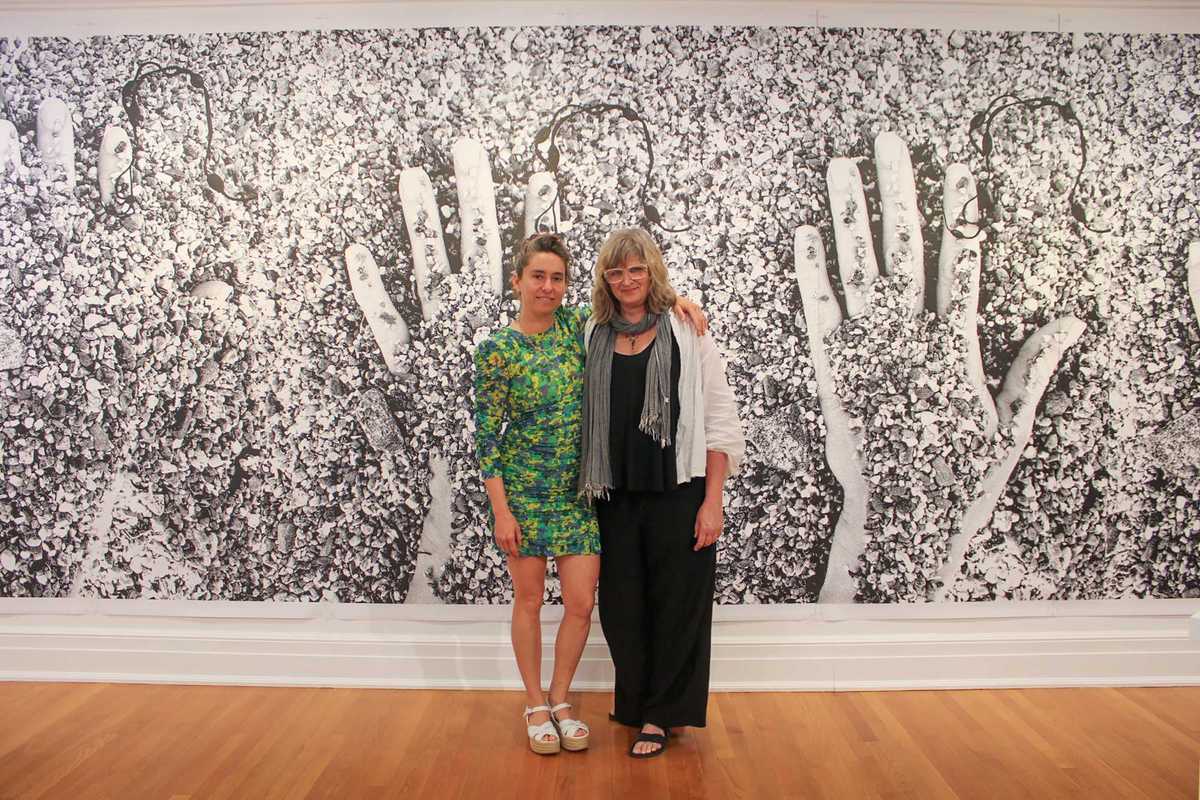
Artist Beatrice PediconiNatalia Zukerman
Beatrice Pediconi’s work spans drawing, photography, painting and video, all organized around her investigations of water as medium. She describes the pieces on view, created between 2009 and 2016, as explorations of “the fragility of all life, highlighting its ephemeral condition.”
Barbara Woike, who spent 33 years as a news photo editor with the Associated Press, offered both history and perspective as she guided visitors through her nearly 50-year-old portraits. “All of these photographs were shot almost 50 years ago,” she said. All pre-digital, all grounded in the subject itself. “Back in the day, photography was more about realism. Even if an abstract picture was shot, it was still shot from something very real — a leaf, a pepper, a naked body twisted so that you’d pause and ask, ‘What is this?’ before realizing it was a body.”

Woike’s career, she explained, grew from that foundation. When digital photography arrived, she witnessed its shift firsthand but stayed true to the ethos of capturing the moment. “Even though photography went digital, there was no alteration of images. I could have been fired for moving a Coca-Cola can out of a picture.”
Her work, she emphasized, has always been about the subject, not the photographer. “The work was about subject matter, not about me. Back then, people still argued whether photography was art at all. Someone might look at these pictures,” she said, gesturing to Beatrice Pediconi’s abstractions across the gallery, “and ask, ‘Is it photography?’ It’s about light, and what light can put into an image.”
Many of Woike’s subjects are no longer alive. “Some I never followed, others I knew until the day they died. That’s the power of portraiture — it lets people stay alive.”
One image holds particular weight: a portrait of Katherine “Sissy” Wells, the first trans person Woike met. When Woike posted the photograph on Facebook to mark what would have been Wells’ 108th birthday, hundreds of people responded with memories. In capturing Wells, Woike did more than preserve a face — she reframed perception, reminding viewers that the story beneath the image, like light through glass, is what makes it real.
The tour ended with Rosenthal speaking about his partner and gallery co-founder, Kerry Madigan’s work. Madigan, who has been making photographs since the 1970s, is experiencing aphasia due to cognitive impairment. Her images, preserved memories, form what Rosenthal described as “a bit of a travelogue of our experiences together traveling all over the world.”
Guests were then invited upstairs for the Mad Rose Winter Salon, featuring the work of local artists at various stages of their careers. Once again, viewers were reminded that perspective is never fixed. It shifts depending on where you stand, what you know, and who is doing the seeing.
Jennie Baird, left, and Christophe Armero are the chocolate makers behind Mudgetown Chocolate. Free tastings will be available at Tri-Corner Feed in Millerton Saturday, Dec. 13, at noon and 3 p.m.
MILLERTON — There’s wine tasting, beer tasting and even coffee tasting, but Millerton is adding something sweeter to the mix. A craft chocolate tasting event will mark the debut of Mudgetown Chocolate on Saturday, Dec. 13, at Tri-Corner Feed. Two free tastings will be held at noon and 3 p.m.
Mudgetown Chocolate is made in Millerton by Sharon-based chocolatiers using cacao beans sourced from all over the world. Saturday’s event will mark the official launch of the small-batch line at Tri-Corner Feed, one of the only places it will be available.
“Our goal is to delight the community with something special,” said Christophe Armero, chocolatier and founder of Mudgetown Chocolate. He describes his product as a “delicious, locally made chocolate that can’t be purchased anywhere else.”
The business began as a retirement passion project for Armero, who spent 38 years in the sugar industry. After moving full-time to Sharon in 2020 from Riverside, Connecticut, he and his wife, Jennie Baird, began experimenting with chocolate in their barn in 2022.“I realized quickly that it’s very easy to make mediocre chocolate,” Armero joked.
After becoming more interested in the process, he grew determined to master the craft. In 2024, he landed an internship at Dandelion Chocolate in San Francisco, where he learned the tricks of the trade.
“It was a bit intimidating because I was this older guy and all the other chocolatiers were young and very professional,” he laughed. “But they taught me a lot.”
Today, Armero can speak fluently about each step of the chocolate-making process, from sourcing the bean and fermentation to roasting, cracking and “melanging,” most of which is done right here on South Center Street in Millerton.
Tri-Corner Feed’s incubator kitchen
Tri-Corner Feed has a bustling storefront where community members can find locally sourced produce, nutrient-dense groceries and even a chai latte — all with sliding scale prices. And there is just as much action happening behind-the-scenes in their fully licensed commercial kitchen.
It’s here that entrepreneurs and early-stage businesses like Mudgetown Chocolate can roll up their sleeves and create products in an affordable space without the burden of high startup costs.
Armero uses a small, 1-kilogram roaster in Tri-Corner’s kitchen, followed by a cracking and winnowing setup that uses a shop vac to suck out the shells and leave the nibs behind. Then, nibs spend 48 hours or more in a granite stone melanger, where they break down and release natural cacao butter. During this part of the process, the bitterness softens and new flavors develop.
Locally made, globally sourced
Armero and Baird purchase cacao beans directly from small farms and fermentaries in countries like El Salvador, Colombia and Uganda. The couple even traveled to Ecuador to visit one of their producers, prioritizing direct relationships whenever possible, which sets them apart from other commercial producers.
Armero said he hopes to bring more local partners into his chocolate business for future creations. “We’ve made some fantastic chocolate infused with whiskey,” he said, adding that he also has a vision of creating a chocolate bar with crunchy bread crumbs. His goal is to partner with local distilleries and bakeries to make this a reality.
Commercial chocolate vs. craft chocolate
Armero said the key differences between commercial chocolate and craft chocolate are “scale and objective.” Big-brand names rely on facilities designed to transform commodity beans into large quantities of uniform chocolate designed to meet the brand’s distinct taste.
Unlike these chocolate giants, Mudgetown Chocolate and other craft makers work in small batches, coaxing the best flavors out of beans. You might get a slightly different flavor with each batch. With only two ingredients in their dark chocolate – cacao and sugar – the results are highly dependent on the bean itself. Armero said, “We’re always trying to get the best out of the beans.”
The Dec. 13 tastings will be at Tri-Corner Feed at 56 South Center St., Millerton.