Putting the garden to bed is not just a metaphor; some blanket trees and shrubs with mulch and burlap. Think of leaves as nature’s blanket, giving precious caterpillars and other insects food, shelter and warmth during the winter. Gentle treatment of leaves now will give insects the best chance of surviving and feeding baby birds in the spring. A gentle blow or rake to move leaves from footpaths into woodland margins or under trees will work. But do not shred or mulch leaves or pile them up too densely, as this will kill the life overwintering there.
For me, fall, especially late fall, is an opportune time for action rather than winding down. Poison ivy has disappeared and, as the days get colder, tick numbers decline (still, no complacency on ticks!). Most of all, now is when the major invasive offenders are easiest to see and eradicate.
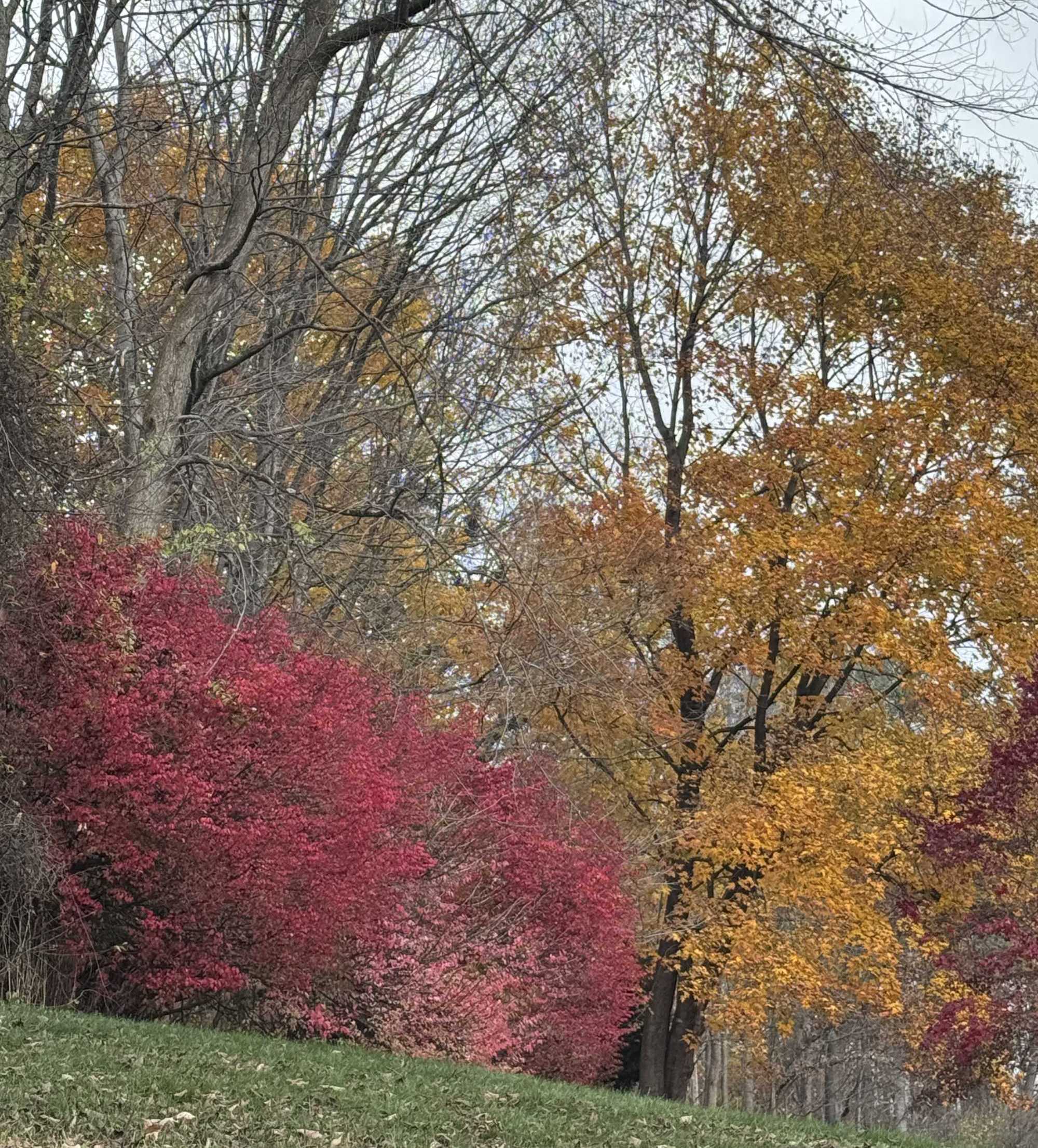
Norway maple, Acer platanoides, stands out with its five-lobed, yellow leaves and red stems that are still attached; native maples lost their leaves weeks ago. This invasive tree has a straight, vertical trunk that, combined with its large leaves, can resemble a child’s drawing. Instead of the sugary sap from which we make maple syrup, Norway maple oozes a milky liquid that does not provide nutrition to our native wildlife.
You can see the dominance of Norway maple along many of our roads, where it deftly outcompetes native trees and plants with a trifecta of superpowers characteristic of many invasives: its leaves cast dense shade, blocking sunlight from reaching the forest floor and preventing the growth of other plants; its leaves emerge earlier in spring and fall later in autumn than those of most native plants, giving it a longer growing season; and, finally, it disperses far more seeds than native species.
These trees grow as tall as 90 feet and, as with all large trees, benefit the Earth by storing carbon and producing oxygen. But this alone does not give these maples a pass; our native oaks do the same while supporting hundreds of species of caterpillars, insects, birds and small mammals. And I challenge anyone to defend the visual appeal of the Norway maple over, say, a mature scarlet oak, especially in the fall.
As with any large tree, mature Norway maples are best cut down by a professional, but a tree under 10 feet tall is easier to tackle yourself. If it is shorter than a couple of feet, try pulling it out by its base; the roots are shallow. Young trees have soft wood trunks that can be easily cut with pruning shears or loppers or, if larger, with a hand saw. You can then apply an appropriate herbicide to the cut surface of the trunk, following label directions. If you do not have an herbicide handy or are opposed to using one, repeated cutting over several seasons can work, but this can be tedious, especially as there likely to be many trees where there is even one.
Burning bush, Euonymous alatus, is like a blinking red light along just about every road this time of year. It is a noxious invasive that alters soil chemistry with its leaf litter, turning soil alkaline so that natives cannot germinate and grow. There are some who cannot let go of this notorious invasive, which is restricted or prohibited for sale in several Eastern states. The fact that it no longer can be bought in some nurseries is a moot point, as it long ago jumped the garden fence and is now running rampant, damaging our native habitats.
Some laud its leaf color in fall; to my eye, it’s blue-red shade is a sore thumb among the orangey russets and scarlets of the native oaks and the brilliant red of our sumac varieties or the Nyssa sylvatica, the tree known as tupelo or black gum. By the time you are reading this, burning bush leaves will have mellowed to a pale purplish pink. Native Mapleleaf viburnum has a similar pale leaf color in fall, along with a sweet lacy white flower in spring, and is a sensible replacement in wooded environments.
I have been steadily working on about an acre of a dense burning bush infestation behind our house. As with Norway maple, the small ones are easily seen and pulled this time of year. The larger ones can be cut with loppers or a hand saw and then treat with herbicide — always closely following label directions. A nice last effort before the winter cold sets in.
Dee Salomon ungardens in Litchfield county.